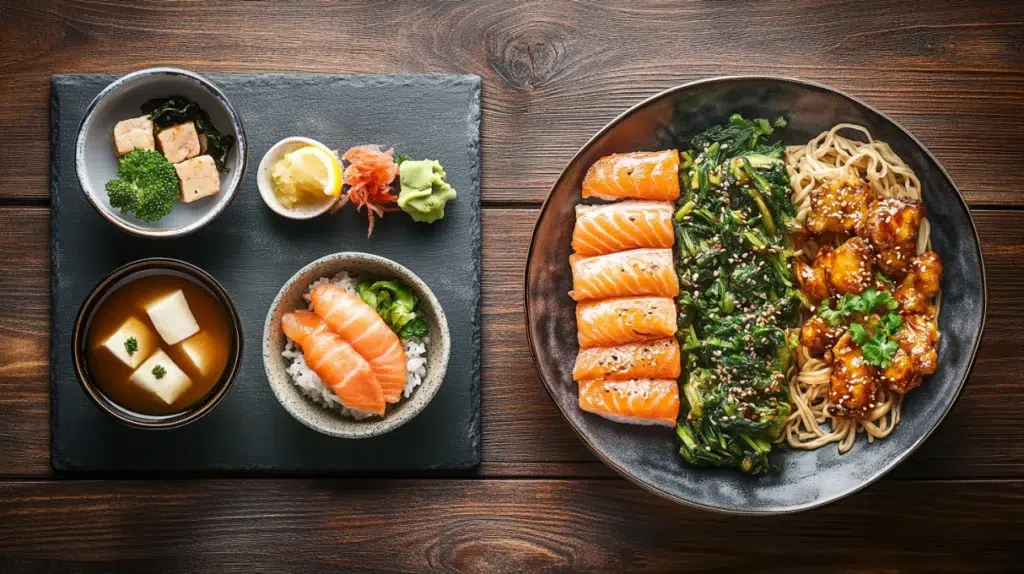
Japanese vs Chinese food is one of the most searched food comparisons on the internet, and one of the most poorly answered, because most articles either treat the two cuisines as essentially similar (they are not) or reduce the comparison to a list of obvious surface differences that misses the deeper philosophical divide.
The honest answer is this: Japanese and Chinese cooking share thousands of years of cultural exchange, many foundational ingredients, and several specific dishes that traveled directly from China to Japan. And yet sitting down to a Japanese meal and a Chinese meal produces two completely different experiences in flavor intensity, in texture, in visual presentation, in meal structure, and in the underlying philosophy of what cooking is supposed to achieve.
Understanding why begins with understanding each cuisine on its own terms. This is part of the Japanese recipes collection, and the comparison requires equal respect and attention for both sides.
The Chinese Side: Scale, Diversity and Bold Flavor
Chinese cuisine is enormously varied because of the country’s vast geographic diversity, historically categorized into four great traditions: Lu cuisine in the north, Yue in the south, Chuan in the west and Huaiyang in the east. This geographic scale is the first and most important fact about Chinese food. China’s cooking traditions span a continent, the wheat-based noodle and dumpling culture of the cold, dry north shares almost nothing with the rice and seafood culture of the warm, humid south, or the fiery, ma la numbing-spice tradition of Sichuan in the west.
What unifies Chinese cooking across this diversity is an approach to flavor that is generally bolder, more assertive and more varied in its use of aromatics than Japanese cooking. Chinese cooking uses garlic extensively and pungently. It uses chili in varieties and quantities that Japanese cooking rarely approaches. It uses a wider range of cooking fats, lard, duck fat, various vegetable oils, at higher temperatures. It values the wok technique (wok hei, the charred, slightly smoky flavor produced by cooking protein and vegetables over extremely high heat in a seasoned wok) as a specific flavor goal that has no Japanese equivalent.
Chinese cooking is also fundamentally abundant in its presentation, generous portions, multiple dishes arriving simultaneously, the table covered. The Chinese meal is communal and expressive, centered on sharing and variety across the whole table.
Key Chinese flavor principles:
- Wok hei: high-heat charring that produces a specific smoky sweetness in stir-fried dishes
- The holy trinity of aromatics: garlic, ginger, spring onion, used in nearly every savory dish
- Soy sauce as a primary seasoning (Chinese soy sauce is darker, saltier, more assertive than Japanese shoyu)
- Five spice: star anise, cloves, cinnamon, Sichuan pepper, fennel seeds, the characteristic warm spice blend of Chinese braised and roasted dishes
- Regional heat: Sichuan ma la (numbing spice from Sichuan peppercorns plus chili), Hunan dry heat, Cantonese restraint
The Japanese Side: Restraint, Precision and the Pursuit of Umami
Japanese cuisine is noted for its subtle and delicate flavors, sushi, sashimi, ramen and sukiyaki among the dishes that have gained worldwide recognition. The word that matters in that description is subtle. Japanese cooking does not aim for bold or assertive. It aims for precise, balanced and deeply considered, extracting the maximum intrinsic flavor from each ingredient through technique rather than supplementing it with assertive seasonings.
The foundational concept is dashi, the clear, pale stock of kombu seaweed and dried bonito that underpins miso soup, noodle broths, simmered dishes and sauces throughout Japanese cooking. Dashi has essentially no color and a very gentle flavor that reads, on first encounter, as almost neutral. On closer attention it is profoundly, synergistically umami, the combination of glutamate from kombu and inosinate from bonito produces an umami impact far greater than either alone. Everything in Japanese cooking is built on this invisible foundation.
Japanese cooking also places extraordinary emphasis on visual presentation, individual portions served in carefully chosen vessels, each component arranged deliberately. The meal structure is ichiju sansai, one soup, three sides, rather than the communal abundance of Chinese dining. Each dish is small, precise and considered as an individual object rather than as part of a shared abundance.
Key Japanese flavor principles:
- Dashi as the invisible flavor foundation of almost everything
- The four core seasonings: soy sauce (lighter shoyu rather than Chinese dark soy), mirin, sake and miso, applied with restraint
- Umami as a specific flavor goal identified and codified in Japanese cooking long before Western food science named it
- Seasonal awareness (shun): specific ingredients used only at their peak season
- Visual precision: presentation as an integral part of the dish, not an afterthought
The Six Honest Differences
1. Oil and Fat
Chinese cooking uses oil at high heat as a primary cooking medium, wok stir-frying in abundant oil at very high temperature is one of the defining techniques. The wok hei flavor comes specifically from this high-heat oil cooking. Chinese dishes often have a glossy, slightly oily quality from the cooking fat.
Japanese cooking uses oil sparingly. Grilling (yakimono), steaming (mushimono), simmering (nimono) and raw preparation (sashimi, sushi) are the dominant techniques. When Japanese cooking fries, karaage, tonkatsu, tempura, the result is lighter and less oily than equivalent Chinese fried dishes because of different batters, different temperatures, and different frying philosophies.
2. Garlic
Chinese cooking uses garlic extensively, pungently and constantly, crushed, sliced, minced, fried until golden, used as a primary aromatic in most savory dishes.
Japanese cooking uses garlic sparingly and subtly. Many traditional Japanese dishes contain no garlic at all. Where garlic appears in Japanese cooking, in ramen tare, in karaage marinade, in gyoza filling, it is a background note rather than a leading flavor. The difference in garlic usage alone is one of the quickest ways to identify which cuisine you are tasting.
3. Heat and Spice
Chinese cooking has regional spice traditions of genuine intensity, Sichuan cuisine in particular uses Sichuan peppercorns (which create a specific numbing sensation called ma) and dried chili in combinations that produce a heat experience unlike any other cuisine in the world.
Japanese cooking is not a spice cuisine. The heat in Japanese food is primarily wasabi (served with sushi and sashimi) and togarashi (Japanese chili flakes used as a table condiment). Neither is used in the cooking itself. The flavor profile of Japanese food is savory and subtly sweet, not hot.
4. Fermentation
Both cuisines use fermented ingredients extensively, but differently. Chinese cooking ferments black beans, doubanjiang (fermented bean and chili paste), fermented tofu and Shaoxing rice wine as primary flavoring agents. The fermented flavors in Chinese cooking are present as assertive, recognizable elements.
Japanese fermentation is deeper and more pervasive. Miso, soy sauce, sake, mirin, rice vinegar, tsukemono (pickled vegetables), natto (fermented soybeans), and the dried fermentation of katsuobushi, the fermented and dried bonito that is half the foundation of dashi, are all fermented products central to daily Japanese cooking. The fermentation in Japanese cooking tends to be subtler and more integrated than in Chinese cooking, present as a background depth rather than a prominent flavor.
5. Noodles
Both cuisines have deep noodle traditions, but the noodles themselves are different. Chinese noodles are most commonly made from wheat flour or rice flour, boiled and served in broth or stir-fried. The textures range from thin and silky (Shanghai noodles) to thick and chewy (knife-cut noodles, biangbiang noodles).
Japanese noodles divide into three main types: ramen (thin wheat noodles, Chinese in origin), udon (thick, soft wheat noodles), and soba (thin buckwheat noodles). The broth traditions differ significantly, Japanese noodle broths are built on dashi and tare and are typically clearer and more delicate than Chinese noodle broths, which are often richer, more oil-forward and more intensely seasoned.
6. Meal Structure and Presentation
A Chinese restaurant meal arrives communally, multiple dishes placed at the center of the table simultaneously, everyone sharing from the same plates. Portion sizes are generous. The visual presentation of individual dishes varies by region but is generally less formally precise than Japanese presentation.
A Japanese meal, even an everyday home meal, follows a deliberate structure. Individual bowls and plates. Each component in its own vessel. The visual arrangement of each dish considered as carefully as its flavor. The ichiju sansai structure (rice, miso soup, three sides) creates a balanced, complete meal from small components rather than from abundant shared dishes.
The Shared Heritage: What Japan Borrowed From China
The connection between Japanese and Chinese food is real and historically significant, and worth understanding because it explains several apparent contradictions.
Ramen, came from China. The word is a Japanese pronunciation of the Chinese la mian (pulled noodles). Chinese traders brought noodle soup to Yokohama in the 1880s and Japan adapted it into something entirely its own over the following century. Modern ramen tastes nothing like Chinese noodle soup, but its DNA is Chinese.
Tofu, originated in China and was introduced to Japan via Buddhist monks. The Japanese tofu tradition, silken tofu, agedashi tofu, hiyayakko cold tofu, is now so distinctively Japanese that most people do not think of it as a Chinese import.
Gyoza, the Japanese pan-fried dumplings served at every ramen shop and izakaya, are directly derived from Chinese jiaozi. The Japanese version uses thinner wrappers, less filling and more garlic than the Chinese original, and is almost always pan-fried rather than boiled, but the shape and concept are unmistakably Chinese.
Soy sauce and miso both trace their origins to Chinese fermented soybean pastes introduced to Japan by Buddhist monks and later developed into distinctively Japanese forms.
The pattern is consistent: Japan received these elements from China, absorbed them deeply, refined them with characteristic Japanese precision and restraint, and produced something that is now culturally and culinarily Japanese. The origin is Chinese. The result is Japanese. Both facts are true simultaneously.
Which Is Better?
This question has no meaningful answer, the correct answer is that they are optimizing for completely different things.
Chinese cooking at its best produces extraordinary complexity, abundance and the specific pleasures of wok hei, spice heat and communal generosity that Japanese cooking does not attempt.
Japanese cooking at its best produces extraordinary precision, delicacy and the specific pleasures of umami depth, seasonal awareness and visual beauty that Chinese cooking does not prioritize in the same way.
The interesting question is not which is better but which you want at any given moment. Craving bold, abundant, fiery, varied, Chinese. Craving precise, delicate, seasonal, considered, Japanese. Both are among the greatest food cultures in the world.
FAQ About Japanese Vs Chinese Food
Is ramen Japanese or Chinese?
Both, in different senses. Ramen originated from Chinese noodle soups brought to Japan in the 1880s. Modern ramen, with its tare system, Japanese dashi-based broths, chashu pork, marinated eggs and regional Japanese style variations, is a Japanese culinary form that has almost nothing in common with Chinese noodle soups today. It is Chinese in origin and Japanese in identity.
Is soy sauce Chinese or Japanese?
Soy sauce originated in China as a fermented soybean paste before developing into liquid form. Japanese shoyu is a specific variant developed in Japan with roasted wheat added to the soybeans, producing a lighter, more rounded flavor than Chinese dark soy sauce. Both are genuine soy sauces with different production methods and different flavor profiles.
Why does Chinese food taste oilier than Japanese food?
Chinese cooking, particularly stir-frying and deep-frying, uses oil at high temperatures as a primary cooking medium and wok hei (the charred flavor from high-heat oil cooking) is a specific flavor goal. Japanese cooking favors lower-fat techniques, grilling, steaming, simmering, raw preparation. The difference is intentional and reflects different culinary philosophies rather than a quality difference.
Are dim sum and sushi similar?
Both are small-portion food served in a social setting, but they are completely different in technique, flavor and cultural context. Dim sum is a Cantonese Chinese tradition of steamed and fried dumplings, buns and small dishes served in bamboo steamers. Sushi is a Japanese tradition of vinegared rice with various toppings. The only similarity is the small-format social eating context.
Planning your week? Add both a Japanese and a Chinese-inspired dinner to your weekly meal planner and taste the difference side by side.
More From the Japanese Recipes Collection: