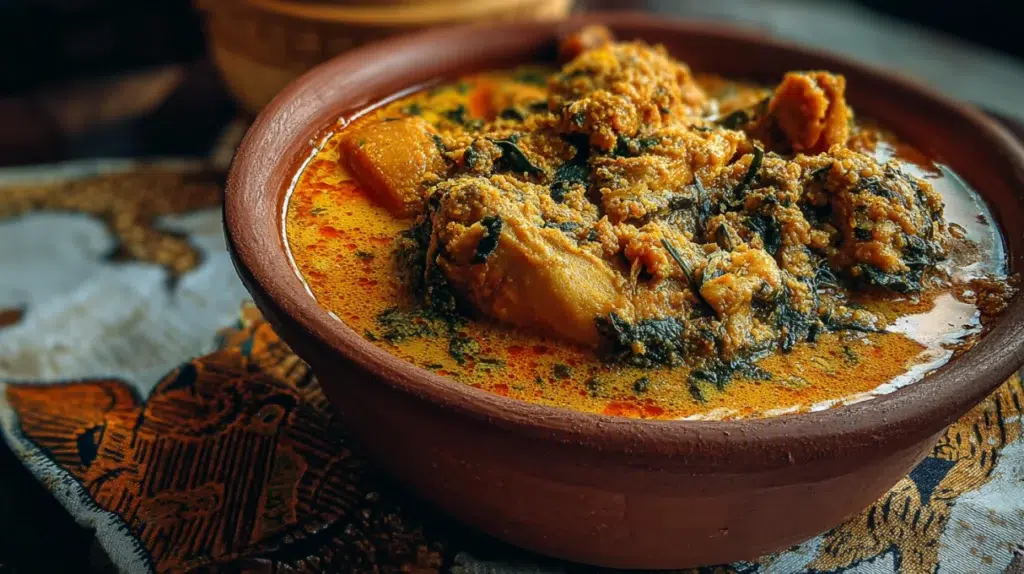
Egusi soup recipe searches are among the most common Nigerian food searches in the world, because egusi soup is not one of many Nigerian dishes. It is the dish. The one served at every celebration, the one asked for by Nigerians returning home after long absences, the one that most accurately represents what southern Nigerian cooking is at its most essential and most satisfying.
Understanding egusi soup properly starts with understanding what egusi is. Egusi (pronounced eh-goo-see) are the seeds of certain varieties of West African melon, dried and ground into a coarse cream-colored powder. They are not the flesh of the melon, only the seeds, which are high in protein and fat, and which when cooked in palm oil form the rich, thick, golden body of the soup. There is nothing else quite like them in Western cooking. Their closest analog is perhaps a dense nut flour, but the flavor, earthy, slightly bitter, deeply savory when cooked in palm oil, is entirely their own.
This is part of the Nigerian recipes collection. The Nigerian jollof rice is what Nigerians are famous for abroad. Egusi soup is what Nigerians feed each other at home.
Egusi Soup’s Place in Nigerian Food Culture
In southern Nigeria soups thickened with ground egusi seeds and enriched with palm oil are central to daily life, served alongside gari, pounded yam or plantains as the starchy swallow. This sentence describes not just a dish but a daily rhythm. Egusi soup, or a variation of it, appears on Nigerian tables multiple times a week across the Yoruba southwest, the Igbo southeast and the Niger Delta.
Each ethnic group makes it slightly differently. Yoruba egusi tends to be thinner, with more tomatoes and sometimes tomato paste added to the base. Igbo egusi is typically thicker, with bitter leaf (ofe onugbu style) as the green and assorted meats and stockfish as the protein. Delta egusi uses periwinkle shells and dried fish alongside fresh fish. The spine of the dish, ground egusi seeds fried or cooked in palm oil with crayfish, peppers and greens is the same throughout. The variations are the personality of each tradition.
The Two Methods: Frying vs Water
Every serious debate about Nigerian cooking eventually arrives at egusi soup, and every debate about egusi soup eventually arrives at the same question: do you fry the egusi first, or cook it directly in water?
The frying method (liso): The ground egusi is mixed with a small amount of water to form a thick paste, then dropped by spoonfuls into hot palm oil and fried until golden-brown, crumbly clumps form. These toasted egusi clumps are then cooked in the soup liquid. The frying develops a toasted, nutty depth in the egusi that the water method cannot produce. The soup has more complexity, more layers of flavor, and a more interesting texture where the clumps have slightly different textures between their fried exterior and softer interior.
The water method: The ground egusi is added directly to the soup liquid and cooked until it absorbs the liquid and thickens the soup. Faster and simpler. The egusi produces a smoother, more uniform texture with a milder flavor.
The verdict is not close. The frying method is correct for the best egusi soup. The water method is acceptable for weeknights when time is short. This recipe uses the frying method with a note on adapting to the water method.
The Complete Egusi Soup Recipe
Ingredients (serves 6)
For the protein (assorted meat):
- 500g (1.1 lbs) assorted meat, Nigerian egusi soup traditionally uses a combination. Choose 2-3: beef chunks, goat meat, cow tripe (shaki), cow skin (ponmo), smoked turkey or chicken, stockfish (dried salted cod, soaked overnight and cleaned)
- 1 medium onion, roughly chopped
- 1 stock cube (Maggi or Knorr)
- 1 teaspoon curry powder
- Salt to taste
For the blended pepper base:
- 3 medium plum tomatoes
- 2 scotch bonnet peppers (reduce to 1 for less heat, do not omit entirely)
- 1 red bell pepper, deseeded
- 1 medium onion, roughly chopped
For the soup:
- 250g (9 oz / about 2 cups) ground egusi, buy pre-ground at African grocery stores
- 150ml (⅔ cup) red palm oil, Zomi or Banga brand
- 2 tablespoons ground crayfish
- 200g (7 oz) fresh spinach, washed and roughly chopped, or frozen spinach, thawed and squeezed dry. Traditional Nigerian greens: bitter leaf (washed thoroughly to remove bitterness), uziza leaves, or pumpkin leaves (ugwu). Spinach is the most widely available substitute.
- 1 stock cube
- Salt to taste
- 200ml (¾ cup) water or light stock
Method:
Step 1: Season and cook the assorted meat (30-40 minutes)
Place all your chosen proteins (except stockfish, add this later) in a heavy pot. Add the chopped onion, stock cube, curry powder and a generous pinch of salt. Add just enough water to barely cover the meat, about 200ml.
Bring to a boil, reduce to a simmer and cook covered 25-35 minutes until the meat is tender. Tougher cuts like tripe and cow skin will take longer than tender beef, cook them first or give them a head start. Taste the broth, it should be well-seasoned and savory. This is your meat stock and it goes directly into the soup. Do not discard it. Set the cooked meat and stock aside separately.
If using stockfish: soak overnight in cold water, changing the water once. Rinse well, break into large pieces and add to the pot for the last 15 minutes of the meat cooking. It needs less time than tougher cuts.
Step 2: Make the blended pepper base
Blend the tomatoes, scotch bonnets, red bell pepper and onion until completely smooth. Set aside. This is the pepper blend, the same foundation used in Nigerian jollof rice, egusi, stews and dozens of other dishes.
Step 3: Fry the egusi (the critical step, 15 minutes)
Measure the ground egusi into a bowl. Add just enough water, a tablespoon at a time, to bring it to a thick paste, the consistency of soft peanut butter. It should hold its shape when pressed but not be crumbly or dry. Too much water makes it loose and difficult to shape.
Heat the palm oil in a wide, heavy pot over medium heat until it is fully liquid and beginning to shimmer, about 2 minutes. Nigerian palm oil solidifies in cold conditions and needs to be fully melted and hot before use.
Drop the egusi paste into the hot palm oil by rough spoonfuls, tablespoon-sized amounts. Do not stir. Let them sit in the hot oil for 3-4 minutes until the underside turns golden-brown. Carefully turn each piece once. Fry the second side 2-3 minutes. The egusi should now be in golden-brown, slightly crumbly clumps that smell toasted and nutty. This smell is correct. This is exactly what you want.
Step 4: Build the soup (20-25 minutes)
Add the blended pepper mixture directly to the pot with the fried egusi. The mixture will sizzle and steam dramatically. Stir gently, incorporating the fried egusi into the pepper base. Cook over medium heat, stirring occasionally, for 10-12 minutes until the pepper base reduces and the raw tomato sourness cooks out. The mixture will darken and the oil will begin to separate slightly at the edges, this is correct.
Add the ground crayfish and stir through. Add the cooked assorted meat directly into the soup. Pour in the reserved meat stock, add all of it. Stir well. Crumble in the stock cube. Add more salt to taste.
The soup should now be quite thick. Add the 200ml of water or additional stock to loosen it to a consistency where it flows slowly when stirred, not watery, not paste-like, somewhere between a thick stew and a gravy.
Cover and simmer over low-medium heat for 10 minutes, stirring once halfway through. The egusi will soften further and absorb the flavors of the broth.
Step 5: Add the greens and finish (5 minutes)
Add the spinach (or traditional greens) and stir through. Cook 3-4 minutes, just until the greens are wilted and tender but still bright. Do not overcook the greens. They should retain some texture and color.
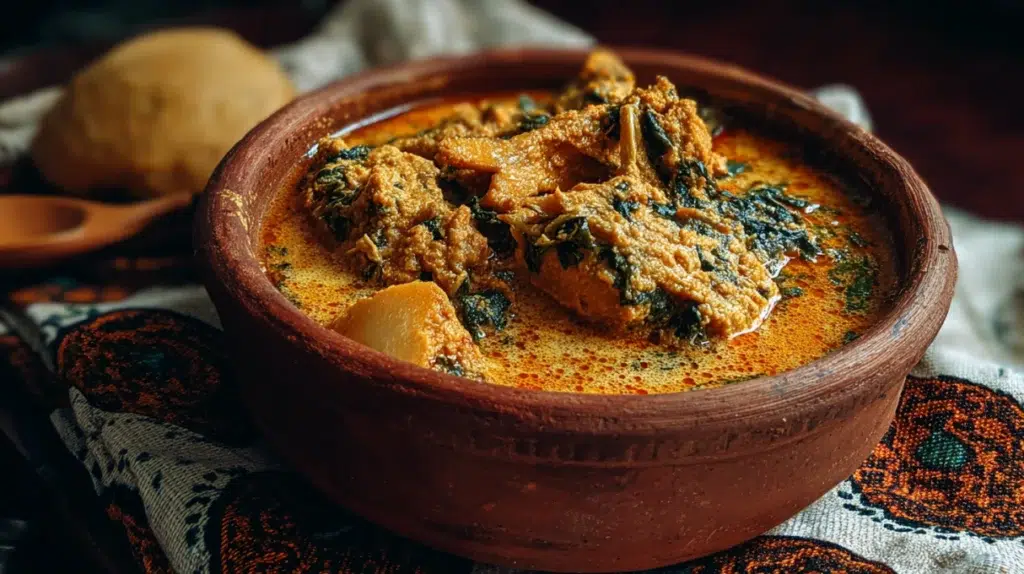
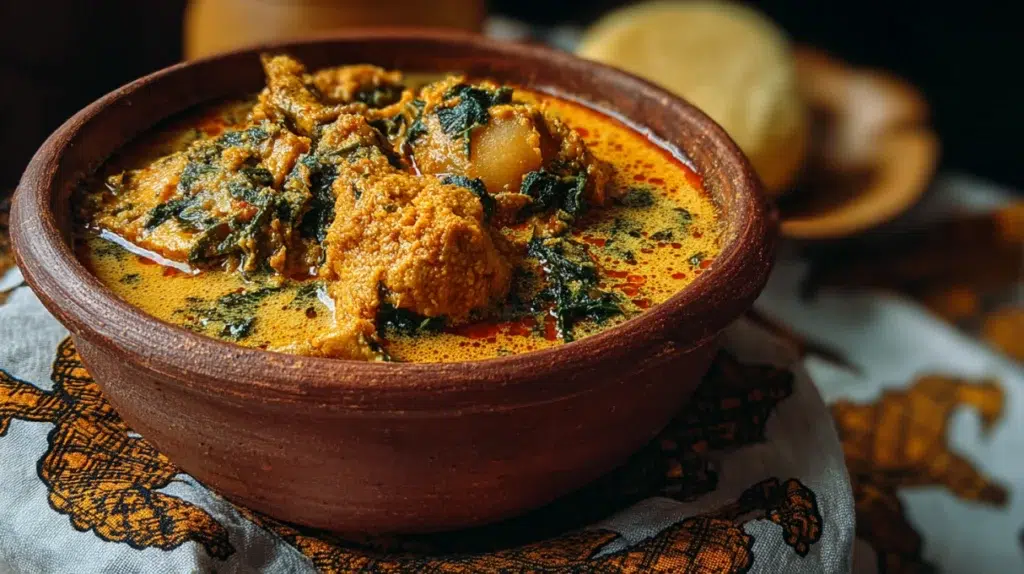
Taste and adjust, more salt, more crayfish, more scotch bonnet if you want more heat. The finished soup should be deeply savory, rich with palm oil, with the egusi providing a nutty thickness and the crayfish adding a background oceanic depth. It should coat the back of a spoon and not run off immediately.
Rest 5 minutes off the heat before serving. Egusi soup deepens in flavor as it sits.
What to Serve With Egusi Soup
Fufu, starchy foods like cassava, yams or plantains boiled and pounded into smooth balls, is dipped into soups and stews and is the traditional accompaniment for egusi throughout West Africa. In a Nigerian context this means one of the following swallows:
Pounded yam: the most prestigious pairing. Nigerian white yam boiled until completely tender, then pounded in a mortar for 15-20 minutes until smooth, stretchy and completely lump-free. Requires a large wooden mortar and genuine physical effort. The reward is a swallow with a specific elastic texture that no shortcut version fully replicates. Instant pounded yam powder (sold at African grocery stores, Poundo Yam brand) produces an acceptable everyday substitute in 5 minutes.
Eba (gari): the most common everyday swallow. Boiling water poured over gari (fermented dried cassava granules) and stirred vigorously until firm and smooth. Ready in 3 minutes. More textured than pounded yam, slightly sour from the fermentation, excellent with egusi.
Fufu (cassava fufu): cassava soaked and fermented, then boiled and pounded. A softer, stickier swallow than pounded yam with a distinctive slightly sour flavor from fermentation. Beloved in the south.
Semovita: semolina-based swallow, milder and smoother than eba, widely available across Nigeria as an everyday option.
For non-Nigerian palates: Egusi soup is excellent over white rice, not traditional but genuinely delicious and considerably more accessible for first-timers.
The Frying Method vs Water Method: Explained in Detail
For cooks who want to understand the difference fully before choosing:
Frying method result: Egusi clumps that have a toasted exterior and a slightly softer interior. More complex flavor with nutty depth. The oil and egusi integrate differently, the frying process sets the exterior of each clump so they remain as distinct pieces in the finished soup rather than dissolving into a uniform paste. More interesting texture and flavor. Recommended.
Water method result: Egusi that dissolves more completely into the soup, producing a smoother, thicker consistency throughout. Milder, more neutral egusi flavor. Faster to cook. More forgiving for beginners. Acceptable.
How to use the water method with this recipe: Skip Step 3 entirely. Instead, after frying the pepper base in Step 4, add the dry ground egusi directly to the soup, pour in the stock, and stir well. Cook covered over low heat for 20 minutes, stirring every 5 minutes to prevent sticking, until the egusi has cooked through and thickened the soup. Then proceed with Step 5.
Where to Buy Egusi and Other Nigerian Ingredients
Ground egusi: African grocery stores carry it pre-ground in bags or tubs. Buy pre-ground for convenience, whole egusi seeds require cleaning and grinding which adds significant time. Look for it labeled “ground egusi seeds” or “egusi powder.”
Red palm oil: African grocery stores, H Mart, some Whole Foods. Buy red palm oil specifically (Zomi brand is excellent), not refined, bleached palm oil which has no flavor.
Ground crayfish: African grocery stores in small jars. This single ingredient does more for the flavor of Nigerian soup than almost anything else. Do not skip it.
Stockfish: dried and salted cod, sold at African grocery stores in hard, flat pieces. Requires overnight soaking. If unavailable, smoked mackerel or smoked herring are acceptable substitutes.
Bitter leaf: fresh or frozen at African grocery stores. Must be washed very thoroughly before use, the bitterness is intentional in ofe onugbu style but must be balanced by washing. Frozen bitter leaf has already been prepared and is more convenient.
Frequently Asked Questions
u003cstrongu003eCan I use regular cooking oil instead of palm oil?u003c/strongu003e
Technically yes, the soup will work. It will not taste like egusi soup. Palm oil is not a flavoring agent that can be replaced with a neutral oil, it is the flavor of southern Nigerian cooking. The earthy, rich, distinctly fruity character of red palm oil is what makes egusi soup taste like itself. If you cannot source it, vegetable oil plus a small amount of tomato paste increases the depth slightly, but the authentic result requires palm oil.
u003cstrongu003eMy egusi soup is bitter, what went wrong?u003c/strongu003e
Either the crayfish was poor quality or old, or traditional bitter greens (bitter leaf) were used without washing them thoroughly enough. Bitter leaf must be washed, squeezed and rinsed multiple times until the wash water runs mostly clear. Alternatively the scotch bonnet seeds were left in, producing a sharp bitterness rather than fruity heat. Remove seeds for a cleaner, hotter-without-bitter result.
u003cstrongu003eCan egusi soup be frozen?u003c/strongu003e
Yes, egusi soup freezes extremely well. Cool completely and freeze in portions. Reheat gently over low heat with a splash of water, stirring to prevent sticking. The flavor often improves after freezing and reheating. Make a large batch and freeze half.
u003cstrongu003eHow long does egusi soup keep in the refrigerator?u003c/strongu003e
3-4 days refrigerated. Reheat thoroughly each time. Nigerian soups are generally even better the day after cooking, once the flavors have had time to develop.
u003cstrongu003eWhat is the difference between egusi soup and groundnut soup?u003c/strongu003e
Both are major Nigerian soups but completely different. Egusi soup uses ground melon seeds as its thickening and body agent. Groundnut soup (ofe ose oji in Igbo, miyan gyada in Hausa) uses ground roasted peanuts as its base. Both use palm oil and assorted meats. Both are excellent. Groundnut soup is more common in the north; egusi is more associated with the south and Igbo cooking specifically.
Planning your week? Add egusi soup night to your weekly meal planner, it reheats beautifully all week and makes enough to serve a family from one pot.
More From the Nigerian Recipes Collection:
- Nigerian Recipes: The Complete Guide
- Nigerian Jollof Rice: The Party Method and Smoky Bottom
- Nigerian Suya: The Yaji Spice Blend and the Technique
- Nigerian Snack Recipes: Puff Puff, Akara and Chin Chin
Egusi Soup
- Total Time: 75 minutes
- Yield: 6 servings 1x
- Diet: Non-Vegetarian
Description
Egusi soup is a traditional Nigerian dish made with ground melon seeds, palm oil, and assorted meats, known for its rich flavors and thick consistency.
Ingredients
- 500g assorted meat (beef, goat, tripe, cow skin, turkey, or chicken)
- 1 medium onion, roughly chopped
- 1 stock cube (Maggi or Knorr)
- 1 teaspoon curry powder
- Salt to taste
- 3 medium plum tomatoes
- 2 scotch bonnet peppers
- 1 red bell pepper, deseeded
- 1 medium onion, roughly chopped
- 250g ground egusi
- 150ml red palm oil
- 2 tablespoons ground crayfish
- 200g fresh spinach, washed and roughly chopped
- 1 stock cube
- Salt to taste
- 200ml water or light stock
Instructions
- Season and cook the assorted meat for 30-40 minutes in a heavy pot with chopped onion, stock cube, curry powder, and salt, adding enough water to cover.
- Blend the tomatoes, scotch bonnets, red bell pepper, and onion until smooth.
- Fry the egusi in hot palm oil until golden-brown clumps form, about 15 minutes.
- Add the blended pepper mixture to the fried egusi, cooking and stirring for 10-12 minutes until reduced.
- Incorporate the cooked assorted meat and reserved meat stock into the soup, adjusting consistency with water if necessary, and simmer for 10 minutes.
- Add spinach and cook for 3-4 minutes until wilted. Rest off the heat for 5 minutes before serving.
Notes
Try serving with traditional swallows such as pounded yam or eba for an authentic Nigerian experience.
- Prep Time: 15 minutes
- Cook Time: 60 minutes
- Category: Main Course
- Method: Cooking
- Cuisine: Nigerian
Nutrition
- Serving Size: 1 serving
- Calories: 500
- Sugar: 6g
- Sodium: 800mg
- Fat: 30g
- Saturated Fat: 10g
- Unsaturated Fat: 15g
- Trans Fat: 0g
- Carbohydrates: 40g
- Fiber: 5g
- Protein: 25g
- Cholesterol: 70mg