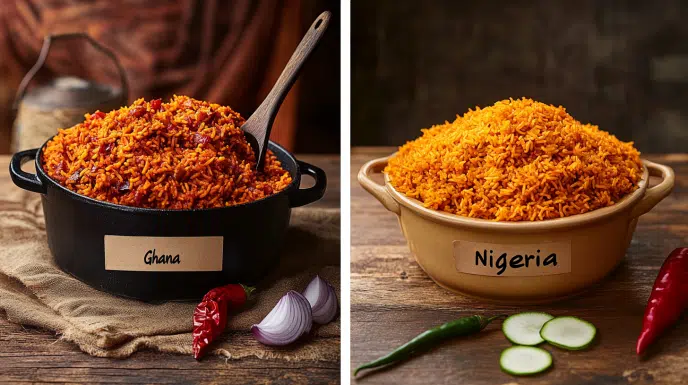
Nigerian vs Ghanaian jollof is not a trivial debate. It is not a lighthearted social media joke that only exists on Twitter. It is a genuine, decades-long argument between two countries that share a dish, a border and almost nothing else in terms of how they approach cooking that dish, and it is an argument that tells you something important about both food cultures and about West African identity.
This article does not declare a winner. That is not the point and it is not possible. What it does: explains exactly what is different between the two versions, why those differences produce different results in the bowl, and gives you both complete recipes so you can make both and form your own opinion.
Jollof rice has become a point of cultural pride for many West Africans, Nigerians use parboiled rice while Ghanaians often use long-grain jasmine rice, and party jollof cooked over live flames retains a distinctive smoky flavor. These two sentences contain the technical heart of the entire debate. This article unpacks them in full.
This is part of the Nigerian recipes collection. The complete Nigerian jollof rice recipe with the full party jollof technique is covered separately, this article focuses on the comparison.
The Cultural Context: Why This Matters So Much
Both countries take jollof seriously in a way that goes beyond food. Jollof rice at a Nigerian celebration is an expression of cultural identity, how it is made, who makes it, whether the smoky bottom is achieved, how deeply red the color runs. When Nigerians evaluate a cook’s jollof, they are evaluating their competence, their care and their respect for tradition simultaneously.
The same is true in Ghana. Ghana possesses a rich indigenous cuisine including fufu, kenke, groundnut soup and waakye, food that reflects the country’s agricultural wealth and varied cultural connections. Jollof is central to Ghanaian celebration food culture just as it is in Nigeria, served at outdoorings (naming ceremonies), weddings, funerals and every gathering where food is served to guests.
When Nigerians and Ghanaians argue about jollof online, which happens constantly and with genuine passion, they are arguing about cultural identity using food as the vehicle. Understanding this is essential to understanding why the debate matters and why neither side will ever fully concede.
The Six Real Differences
1. The Rice
Nigeria: Parboiled long-grain rice. Parboiling partially cooks the rice in the husk before milling, producing a firmer grain that holds its shape during long cooking, absorbs flavor deeply, and separates cleanly in the finished dish. Uncle Ben’s converted rice is the most widely available parboiled rice in the US. This firmer texture is what gives Nigerian jollof its characteristic bite.
Ghana: Long-grain jasmine rice. Softer, more fragrant than parboiled, with a lighter texture and a subtle floral quality from the jasmine variety. Ghanaian jollof made with jasmine rice has a different mouth feel, slightly more tender, slightly more delicate, with less of the chew that parboiled rice provides.
The result: Nigerian jollof has a denser, more separate grain. Ghanaian jollof is lighter and more fragrant. Neither is wrong, they are optimizing for different textural results.
2. The Pepper Base
Nigeria: A blended base of plum tomatoes, scotch bonnet peppers, red bell peppers and onion, fried in vegetable oil until deeply concentrated and darkened. The frying stage, 20-25 minutes until the raw tomato sourness cooks out completely, is non-negotiable in Nigerian cooking and is what gives Nigerian jollof its deep red color and complex flavor.
Ghana: Also a blended tomato and pepper base, but typically with more tomato paste added and sometimes a slightly different ratio of peppers. Some Ghanaian cooks add a small amount of tomato puree for a redder color and sweeter base note. The frying step exists in Ghanaian cooking too, but the flavor profile tends to be slightly sweeter and less aggressively savory than the Nigerian version.
3. The Oil
Nigeria: Vegetable oil, sunflower or canola. Clean, neutral, lets the tomato and pepper flavors dominate.
Ghana: Also vegetable oil in most contemporary versions. Some older Ghanaian recipes use a small amount of palm oil alongside vegetable oil, which adds a subtle earthiness that Nigerian jollof does not have.
4. The Spicing
Nigeria: Curry powder, dried thyme, bay leaves, stock cube (Maggi or Knorr). The curry powder used in Nigerian cooking is mild and slightly sweet, not Indian-style curry. It adds color and a warm background note.
Ghana: Similar spice profile but with some variations by region and cook. Many Ghanaian recipes add a small amount of ground cinnamon or cloves alongside the curry powder, a subtly warmer, slightly more complex spice note. The difference is modest but perceptible.
5. The Smoky Bottom: Party Jollof
Nigeria: The party jollof technique, cooking over high heat at the end to develop a smoky, slightly charred bottom crust, is a defining characteristic of the best Nigerian jollof. It is deliberately sought, celebrated and considered a sign of skill. Nigerians will tell you this smoky bottom is what Ghanaian jollof consistently lacks.
Ghana: Ghanaian jollof does not traditionally emphasize the smoky bottom in the same way. The goal is a perfectly cooked rice throughout, each grain separate, fragrant, fully flavored, rather than a charred base layer. Ghanaians will tell you this consistency throughout is superior to the uneven char that Nigerian jollof prizes.
This is the single most argued point between the two camps. Nigerians say: if there is no smoky bottom, it is not real jollof. Ghanaians say: if you are deliberately burning the rice, you have lost control of your pot.
6. The Texture Philosophy
Nigerian jollof aims for: deeply colored, intensely flavored, with individual grains that are separate but richly coated, and a smoky bottom crust.
Ghanaian jollof aims for: evenly cooked throughout, fragrant, slightly lighter in color, with jasmine rice’s delicate quality preserved.
Both are correct within their own framework. The debate exists because each country is judging the other’s version against its own framework, and finding it lacking.
The Two Recipes Side by Side
Nigerian Jollof Rice (Summary)
Rice: Parboiled long-grain Pepper base: Tomatoes, scotch bonnet, red bell pepper, onion, blended and fried 20-25 minutes Oil: Vegetable oil Spices: Curry powder, thyme, bay leaves, stock cube Technique: Sealed foil-and-lid cook, followed by high-heat 8-10 minute finish for the smoky bottom Target result: Deeply red, richly flavored, separate grains with charred bottom crust
→ Full detailed recipe: Nigerian jollof rice
Ghanaian Jollof Rice: Complete Recipe
Ingredients (serves 6)
For the blended pepper base:
- 3 medium plum tomatoes
- 2 scotch bonnet peppers (or 1 for less heat)
- 1 red bell pepper, deseeded
- 1 medium onion, roughly chopped
For the jollof:
- 500g (2½ cups) long-grain jasmine rice, rinsed once
- 100ml (7 tablespoons) vegetable oil
- 1 medium onion, finely diced
- 3 tablespoons tomato paste
- 2 tablespoons tomato puree (passata), this extra tomato adds sweetness and color
- 500ml (2 cups) chicken stock, warm
- 1 teaspoon curry powder, mild
- ½ teaspoon ground cinnamon, subtle warmth, distinctly Ghanaian
- 1 teaspoon dried thyme
- 2 bay leaves
- 1 stock cube
- Salt to taste
Method:
Blend the tomatoes, scotch bonnets, red bell pepper and chopped onion until smooth.
Heat vegetable oil in a heavy pot over medium heat. Add the diced onion and fry 5 minutes until softened. Add the tomato paste and tomato puree and stir into the oil, fry 3 minutes until the paste darkens slightly.
Add the blended pepper mixture. Cook over medium heat, stirring every few minutes, for 15-18 minutes. The base should reduce and thicken, slightly less aggressive frying than Nigerian style, aiming for a sweeter, more rounded base. Add curry powder, cinnamon, thyme, bay leaves and crumbled stock cube. Stir and cook 2 more minutes.
Add the warm chicken stock and stir well. Taste, season with salt. Bring to a simmer.
Add the rinsed jasmine rice and stir to coat every grain in the pepper base. The liquid should just cover the rice.
Cover with a tight-fitting lid, a single lid, without foil, is the Ghanaian method. No deliberate sealed-steam technique. Cook over low-medium heat for 20-25 minutes, checking once at 15 minutes and adding a small splash of water if the pot looks dry.
Once the rice is cooked through, tender throughout with no hard center, turn the heat off. Leave covered for 5 minutes to rest.
Fluff gently with a fork before serving. The goal is evenly cooked, separate, fragrant grains throughout the entire pot.
Serve alongside: Fried plantains, Ghanaian fried chicken (marinated in ginger, garlic and spices before deep frying), and a crisp green salad with red onion.
What Each Version Does Better
Nigerian jollof does better: The smoky bottom crust, there is nothing like it when it is achieved correctly. The depth of flavor from the long-fried pepper base. The individual grain separation from parboiled rice after long cooking. The deep red color that comes from fully developed tomato and pepper.
Ghanaian jollof does better: The fragrance from jasmine rice, the rice’s own delicate quality comes through in a way parboiled rice never allows. The consistency throughout, every spoonful is the same quality. The slightly sweeter, more rounded flavor from the extra tomato and the cinnamon.
The Verdict, Or Rather, Why There Is None
The jollof wars are unresolvable not because both versions are equal in every way, they are not, but because they are not trying to be the same dish. They share a name and a base concept. Beyond that they diverge in rice, technique, spice and philosophy in ways that make direct comparison like comparing two different musical genres. Claiming one is objectively superior requires ignoring what the other version is actually trying to achieve.
What can be said: Nigerian jollof, when the party jollof technique works perfectly, produces a smoky depth and textural complexity that Ghanaian jollof does not have and does not claim to have. Ghanaian jollof, when the jasmine rice is correctly cooked and the spice balance is right, produces a fragrant lightness and consistency that Nigerian jollof does not have and does not claim to have.
Make both. Eat them side by side. Form your own opinion. And then defend it loudly, because that is what the jollof wars require.
FAQ About Nigerian vs Ghanaian jollof
Which jollof rice is the original?
Neither Nigerian nor Ghanaian jollof is the original, both are regional adaptations of a dish that originated in the Senegambian region of West Africa, descended from the Wolof thiéboudienne, spreading across West Africa over centuries. Both Nigeria and Ghana adapted the dish independently using their own local ingredients and cooking traditions.
Is Senegalese jollof (thiéboudienne) better than both?
Thiéboudienne is actually a different dish, it is made with fish, not chicken or beef, and uses broken jasmine rice specifically. Comparing it directly to Nigerian or Ghanaian jollof is comparing different dishes that share a common ancestor.
Can I combine both methods, parboiled rice with the Ghanaian spice profile?
Yes, and it works well. The parboiled rice will produce more separation and the cinnamon will add a subtle warm note that is pleasant and not at all out of place. This hybrid approach produces a very good jollof that Nigerian and Ghanaian guests both usually enjoy.
Why does Ghanaian jollof sometimes taste more smoky than Nigerian?
Some Ghanaian cooks use a small amount of liquid smoke or smoked paprika in their jollof specifically to compete with the Nigerian party jollof character. This is a modern adaptation and is not traditional Ghanaian jollof.
Planning your week? Add a jollof cook-off to your weekly meal planner, make both versions on the same day and let your household decide.
More From the Nigerian Recipes Collection:
- Nigerian Recipes: The Complete Guide
- Nigerian Jollof Rice: The Party Method and Smoky Bottom
- Egusi Soup Recipe: The Two Methods Explained
- Nigerian Suya: The Yaji Spice Blend and the Technique
- Nigerian Snack Recipes: Puff Puff, Akara and Chin Chin