⏱ Prep: 8 min 🔥Cook: 10 min 👤Serves: 2 🌏Origin: Thailand
Thai basil minced pork, pad kra pao moo is the most eaten dish in Thailand. Not the most famous abroad, not the one tourists order first, but the one every Thai person eats constantly, the one that appears at plastic tables outside petrol stations at seven in the morning and at street stalls at midnight and everywhere in between. If you ask a Thai person what their favourite food is, the answer is very often this.
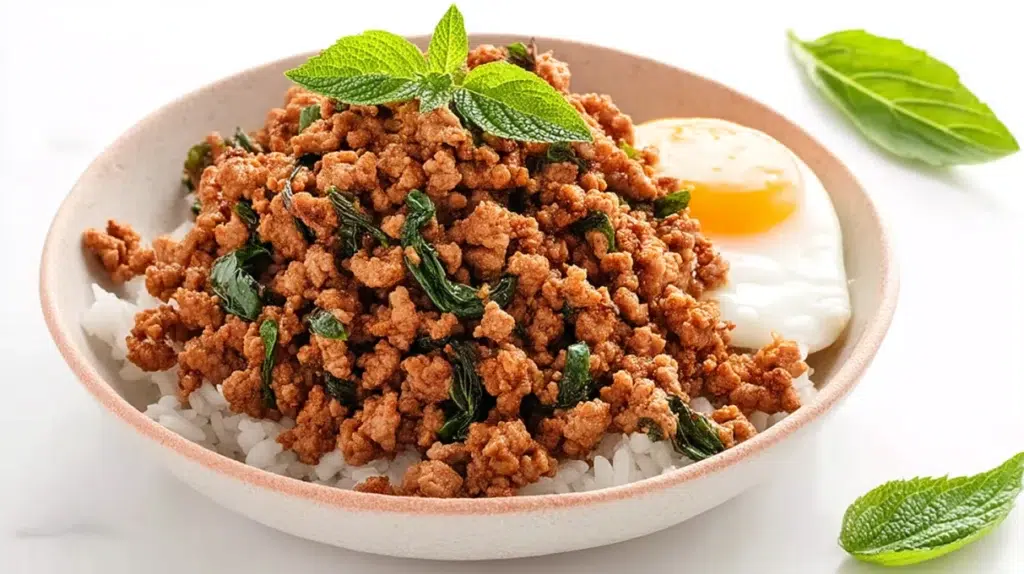
Ground pork stir-fried at screaming heat with roughly smashed garlic and bird’s eye chilies, sauced with oyster sauce, fish sauce and a splash of dark soy, then finished off the flame with holy basil that wilts into the pork in twenty seconds and perfumes the whole dish with its peppery, faintly clove-like character. Over jasmine rice. With a crispy-edged fried egg on top whose yolk breaks into everything and makes a third thing out of the two. Ten minutes from cold pan to table. The dish that proves that the best food rarely requires more time than that.
Ingredients
The sauce, mix this first, before anything goes near the wok
- 1 tablespoon oyster sauce
- 1 tablespoon fish sauce
- 1 teaspoon light soy sauce
- ½ teaspoon dark soy sauce, for color and a faint background sweetness; optional but recommended
- ½ teaspoon sugar, palm sugar is traditional; white sugar works fine
- 2 tablespoons water, loosens the sauce so it coats the pork evenly rather than scorching on the hot wok
The stir-fry
- 300g ground pork, 80/20 fat content minimum; leaner pork fries dry and loses the dish’s character. Ground pork with some fat is what the street stalls use.
- 6 cloves garlic, smashed and roughly chopped, smashed with the flat of a knife, then roughly chopped into uneven pieces, not minced fine. Rough pieces char better in the wok and give visible texture in the finished dish.
- 4–8 Thai bird’s eye chilies, smashed and roughly chopped, adjust to your heat tolerance. 4 is medium, 6 is genuinely hot, 8 is street-stall level. Remove the seeds for less heat without sacrificing much flavour.
- 1½ tablespoons neutral oil —vegetable, rice bran, or canola. Traditional street stalls use lard, it changes the flavour noticeably and is worth trying if you have it.
- 1 large handful holy basil leaves, about 30–40 leaves, stripped from their stems. See the basil section below for the full breakdown of which basil to use and why it matters.
To serve
- Steamed jasmine rice, one generous scoop per person
- 2 eggs, fried separately in very hot oil until the whites are crispy and blistered at the edges and the yolk is still soft. This is kai dao, star egg and it is not optional.
- Prik nam pla, fish sauce with sliced bird’s eye chilies; served in a small dish alongside for seasoning at the table. Traditional and expected.
Step by step
- Mix the sauce first. Combine the oyster sauce, fish sauce, light soy sauce, dark soy sauce, sugar and water in a small bowl. Stir until the sugar dissolves. Set it right next to the stove, this dish moves too fast to measure anything once the heat is on.Having the sauce pre-mixed is not optional. Pad kra pao moo takes about 90 seconds from the garlic hitting the oil to the pork being done. If you are measuring and pouring four separate sauces while that is happening, something burns.
- Prep everything and set it beside the stove. Smash the garlic and chilies roughly, a mortar and pestle is ideal but the flat of a knife works. Roughly chop into uneven pieces. Strip the basil leaves from their stems. Have the pork ready. Have the rice already cooked and waiting. Nothing goes on the wok until everything is within arm’s reach.
- Fry the eggs first, separately. Heat a small pan with a generous pour of oil over medium-high heat until the oil is very hot and shimmering. Crack an egg in. It should spit and sizzle immediately. The whites will blister and puff at the edges while the yolk stays runny. 1–2 minutes. Remove and set aside on a plate. Repeat for the second egg. Keep them warm. Fry the eggs before the pork so they’re ready to go on top the moment the stir-fry is done. Kai dao, the proper Thai crispy fried egg, needs genuinely hot oil to get the blistered white edges that contrast with the soft yolk. Insufficient heat makes a pale, flat egg that has nothing to do with the real thing.
- Get the wok screaming hot. Heat the wok or largest heavy skillet you own over the highest heat your stove will produce. Add the oil and let it heat until it shimmers and just begins to smoke. This is the heat the dish needs. A medium or even medium-high wok produces steamed pork. A screaming-hot wok produces caramelized, slightly charred pork that tastes of the dish.
- Fry the garlic and chilies. Add the smashed garlic and chilies to the hot oil. Stir constantly for 20–30 seconds until deeply fragrant and the garlic is just starting to take on color at the edges. The smell at this stage, the frying chili hitting a screaming-hot pan is extremely strong. This is correct.
- Add the pork, press flat, then break up. Add the ground pork. Immediately press it flat against the wok with your spatula and let it sit untouched for 15 seconds. This contact time with the hot surface gets caramelization on the meat. Then break it apart into small pieces and stir-fry until no pink remains and the edges of some pieces are beginning to color, about 3–4 minutes total.The 15-second press before breaking up is the technique that gives pad kra pao moo its characteristic slightly charred edge on the pork pieces. Stirring immediately from the moment the pork hits the pan produces grey, steamed mince with no caramelization.
- Add the sauce. Pour the pre-mixed sauce over the pork and toss everything together quickly. Cook for 1 minute, stirring constantly, until the sauce reduces slightly and coats every piece of pork. If it looks dry, add a splash more water.
- Basil off the heat. Turn the flame completely off. Add all the basil leaves immediately. Toss for 20 seconds until the leaves are just wilted and smell intensely fragrant. Serve immediately, directly over jasmine rice with the fried egg on top and a small dish of prik nam pla alongside.
The basil question, holy basil, Thai basil, or Italian basil
This is the most important ingredient decision in the dish and worth understanding properly before you shop.
Holy basil (bai kra pao), the authentic choice
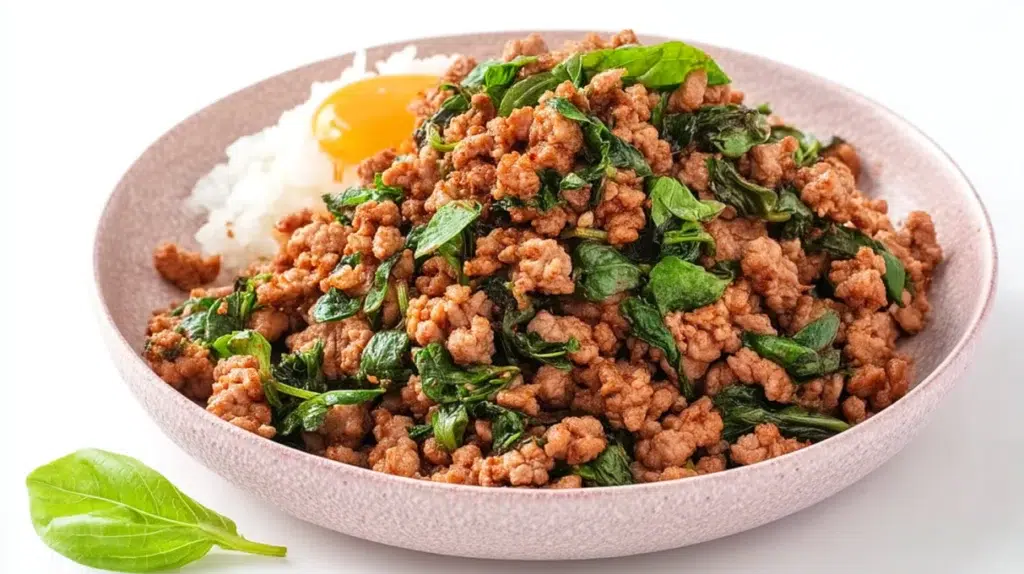
The dish is literally named after this herb. Kra pao means holy basil in Thai. It has a peppery, slightly spicy, faintly clove-like character that is completely distinct from other basils, you can smell it from the street when someone is cooking with it twenty feet away. Available at Thai and Southeast Asian grocery stores. If you can find it, use it. There is no substitute that produces the same dish.
Thai sweet basil (bai horapa), a different dish
This is the basil most commonly sold as “Thai basil” at Asian grocery stores, the one with the purple stems and slightly anise-like, milder fragrance. Thai people consider pad kra pao made with horapa to be a different dish (pad horapa). It is still very good, just not the authentic pad kra pao experience. If this is what you can find, use it and enjoy what you’re making.
Italian basil, the weeknight backup
Interestingly, many Thai cooks consider Italian basil closer in character to holy basil than Thai sweet basil is, its slightly peppery quality is more aligned with the authentic flavour profile. Use a full large handful and add it completely off the heat. The dish will not be pad kra pao but it will be a very satisfying ten-minute pork stir-fry that most people at your table will not complain about.
Make it your own
Claire’s note
The prik nam pla at the table is not a condiment to ignore, it is how Thai people actually season this dish to their own taste at the table. A small dish of fish sauce with three or four sliced bird’s eye chilies soaking in it, served alongside the rice. You drag a spoonful through your rice and pork and it adds a bright, salty, fiery lift that makes the dish taste more like itself.
If you want to make this more substantial, a handful of trimmed green beans or long beans added to the wok with the pork and cooked for two minutes works very well. The dish scales perfectly, make double the quantity in the same time, just use a bigger pan and don’t crowd the pork.
Serve with
Thai basil minced pork is always served over jasmine rice with a crispy fried egg. It works alongside a simple Thai cucumber salad for a slightly more composed plate. For more from the Thai collection the complete Asian recipes collection has everything from across the region.
Add Thai basil minced pork to your weekly meal planner, ten minutes, one pan, the ingredients keep in the fridge all week. This is the most useful recipe in the collection for a weeknight with nothing planned. And for more recipes, follow us on Pinterest.
Print
Thai Basil Minced Pork (Pad Kra Pao Moo)
- Total Time: 18 minutes
- Yield: 2 servings 1x
- Diet: Non-Vegetarian
Description
A quick and flavorful stir-fry of ground pork, garlic, chilies, and holy basil served over jasmine rice with a crispy fried egg.
Ingredients
- 1 tablespoon oyster sauce
- 1 tablespoon fish sauce
- 1 teaspoon light soy sauce
- ½ teaspoon dark soy sauce (optional)
- ½ teaspoon palm sugar or white sugar
- 2 tablespoons water
- 300g ground pork (80/20 fat content minimum)
- 6 cloves garlic, smashed and roughly chopped
- 4–8 Thai bird’s eye chilies, smashed and roughly chopped
- 1½ tablespoons neutral oil (vegetable, rice bran, or canola)
- 1 large handful holy basil leaves (30–40 leaves)
- Steamed jasmine rice (one generous scoop per person)
- 2 eggs (fried separately)
- Prik nam pla (fish sauce with sliced chilies)
Instructions
- Mix the sauce first. Combine the oyster sauce, fish sauce, light soy sauce, dark soy sauce, sugar, and water in a small bowl and stir until dissolved.
- Prep everything and set it beside the stove. Smash the garlic and chilies, then roughly chop. Strip the basil leaves from their stems.
- Fry the eggs first. Heat oil in a pan over medium-high heat until shimmering, then fry the eggs until whites are crispy and yolks are soft.
- Get the wok screaming hot. Heat the wok over the highest heat and add oil until it shimmers.
- Add the smashed garlic and chilies to the hot oil and fry until fragrant, about 20–30 seconds.
- Add the ground pork, press flat, and let sit for 15 seconds to caramelize before breaking apart and stir-frying until no longer pink.
- Pour the pre-mixed sauce over the pork and toss together, cooking for 1 minute.
- Turn off the heat and add the basil leaves, tossing until just wilted.
- Serve immediately over jasmine rice with the fried egg on top and a small dish of prik nam pla alongside.
Notes
For heat adjustment, modify the amount of bird’s eye chilies used. Use holy basil for authenticity; Thai sweet basil or Italian basil can be substitutes but will alter the dish’s character.
- Prep Time: 8 minutes
- Cook Time: 10 minutes
- Category: Main Course
- Method: Stir-Frying
- Cuisine: Thai
Nutrition
- Serving Size: 1 serving
- Calories: 420
- Sugar: 5g
- Sodium: 900mg
- Fat: 24g
- Saturated Fat: 6g
- Unsaturated Fat: 12g
- Trans Fat: 0g
- Carbohydrates: 24g
- Fiber: 2g
- Protein: 30g
- Cholesterol: 186mg