French recipes intimidate more home cooks than any other cuisine in the world, and almost always for the wrong reasons.
The intimidation comes from French cuisine’s reputation: the Michelin stars, the classical technique, the French professional kitchen’s emphasis on precision and formality. This reputation is real and deserved, French cooking has shaped professional kitchens globally and produced the most technically sophisticated culinary tradition in history. But it is the restaurant tradition and the professional tradition that is intimidating. French home cooking, the food that French families actually make on weekday evenings and Sunday lunches, is a different thing entirely. It is earthy, generous, deeply flavorful, and far more approachable than its reputation suggests.
Coq au vin is a chicken braise. Boeuf bourguignon is a beef stew. Soupe à l’oignon is caramelized onions in broth with melted cheese on top. Ratatouille is summer vegetables roasted together. These dishes became French classics not because they are technically demanding but because they are extraordinarily delicious, and the technique involved is straightforward once you understand what each step is actually doing.
What French Cuisine Actually Is
French cuisine is known for its rich flavors, high-quality native ingredients, and emphasis on elegant presentation, with gastronomy inscribed on UNESCO’s Intangible Cultural Heritage list, and this UNESCO inscription is worth understanding because it explains what French food culture actually values. The inscription was not for a specific dish. It was for the French meal as a social practice, the ritual of gathering, the sequence of courses, the pairing of food with wine, the cultural weight placed on sharing food well. This is why French cooking cannot be separated from French culture. The two are inseparable in a way that is unique even among the world’s great food cultures.
French cuisine developed through a specific historical sequence that shaped what it is today. The royal court cuisine of the 16th and 17th centuries, grande cuisine, established the idea that cooking is an art form worthy of serious attention. The French Revolution democratized that cooking, opening restaurants and making sophisticated food accessible beyond the aristocracy. The 19th century produced Carême and Escoffier, who codified classical French technique into a system, mother sauces, kitchen brigade, specific methods for every preparation, that became the foundation of professional cooking worldwide. The 1970s brought nouvelle cuisine, which lightened and liberalized the tradition. What home cooks encounter today is the result of all of these layers, rich and technically grounded but no longer rigid.
What makes French cooking specifically French:
The sauce tradition is the most defining characteristic. French cooking treats sauce as an art form in its own right, built from stocks reduced over hours, emulsified with butter, sharpened with wine or acid. A French cook is often judged first by their sauce.
The butter and cream philosophy sets French cooking apart from olive-oil-centric Mediterranean traditions. Northern France especially is dairy country, rich cream, excellent butter, aged cheeses, and this shapes the flavor of everything.
The wine integration is fundamental. Wine is not just served alongside French food, it is cooked into it. Coq au vin, boeuf bourguignon, mussels in white wine, chicken with Champagne sauce, the wine is part of the dish’s structure, not a separate element.
The respect for ingredients in season is older than farm-to-table as a trend. French cooking has always been built around what is freshest and most local, asparagus in spring, tomatoes in summer, game in autumn, root vegetables in winter. The seasonal logic of French cooking is not a marketing concept. It is how the cuisine was always designed to work.
French Cooking Is Not One Thing: The Regional Diversity
Regional differences in French cuisine are marked, bouillabaisse from Marseille, choucroute from Alsace, magret de canard from Bordeaux, and understanding French regional cooking is as important as understanding Italian regional cooking. The France that appears on menus in Paris and in French restaurants abroad is largely the cooking of the Île-de-France, the Paris region, plus the prestige dishes that became internationally famous. The actual cooking of France is far more diverse.
The key regions and what they produce:
Burgundy: the heartland of French wine and the source of the richest, most wine-saturated cooking. Coq au vin and boeuf bourguignon both come from Burgundy, dishes designed to make the most of the region’s extraordinary red wine. The beef is Charolais. The mustard is Dijon. The wine goes into everything.
Provence: the southern, Mediterranean region where French cooking meets olive oil, tomatoes, garlic, and herbs. Bouillabaisse is the famous dish but the region’s cooking is defined by the herbes de Provence, thyme, rosemary, lavender, savory, marjoram, and by the quality of the local produce in summer.
Alsace: on the German border, with a cuisine that reflects that geography: choucroute garnie (sauerkraut with pork and sausages), flammkuchen (thin tart with crème fraîche and lardons), riesling-braised dishes. The most Germanic of French regional cuisines and the most distinct.
Brittany: on the Atlantic coast, crêpes and galettes are the defining dishes. The salty butter, beurre salé, is specific to Brittany and produces a flavor that no other butter matches. Seafood is central: mussels, oysters, crab, lobster, cooked simply to respect the quality of the ocean produce.
Normandy: dairy country: cream, butter, Camembert, Calvados apple brandy. Chicken Vallée d’Auge, chicken braised in Calvados and cream, is the defining Norman dish. Apple tarts. Rich, cream-based sauces.
Lyon: considered France’s gastronomic capital, producing some of the country’s best chefs and the tradition of the bouchon, the small, unpretentious Lyonnais restaurant serving robust, hearty food: quenelles de brochet (pike dumplings), salade lyonnaise (frisée with lardons and poached egg), andouillette sausage.
The French Kitchen Pantry: What You Actually Need
French cooking requires fewer specialty ingredients than most people assume. The complexity is in the technique, not the ingredient list.
The essentials:
Unsalted butter: buy the best you can find. European-style cultured butter (Plugrá, Kerrygold, or imported French) has a significantly higher fat content and more complex flavor than standard American butter. In French cooking where butter is a primary flavor, the quality matters.
Good wine for cooking: the rule is simple: cook with wine you would drink. The flavor concentrates during cooking. Bad wine becomes more aggressively bad when reduced. A decent bottle of Burgundy or Beaujolais for a coq au vin, a decent white Burgundy or Mâcon for mussels and cream sauces.
Fresh herbs: thyme, bay laurel, flat-leaf parsley, and tarragon are the four essential French herbs. A bouquet garni, a bundle of thyme, bay leaf, and parsley stems tied together or wrapped in cheesecloth, goes into almost every French braise and stock.
Dijon mustard: real Dijon, sharp and pungent, appears in vinaigrettes, pan sauces, and braises. It is one of the most distinctive flavors in French cooking and has no adequate substitute.
Crème fraîche: the cultured cream that is essential for French sauces. Unlike regular cream it does not break when reduced to high heat and has a slight tanginess that brightens heavy dishes. Now widely available in US grocery stores.
Shallots: used far more frequently than onions in French cooking. Milder, more refined, more quickly caramelized. Many classic French sauces begin with a shallot reduction.
Good stock: veal or chicken stock, made or purchased. French cooking uses stock as a building block the way Italian cooking uses olive oil and pasta water, it is the foundation of most sauces and braises. Good stock produces a fundamentally different result than poor stock.
The Recipes: Where to Start
The Braises: The Heart of French Home Cooking
French slow cooking is where the cuisine is most accessible and most rewarding for home cooks. The technique is always the same: brown the meat deeply to build the flavor foundation, cook the aromatics in the fat, deglaze with wine, add stock, braise low and slow until the collagen dissolves into silky richness. The specific ingredients change, chicken versus beef, Burgundy versus Alsace, mushrooms versus root vegetables, but the method is identical.
The dishes that every home cook should know: coq au vin, boeuf bourguignon, blanquette de veau (veal in white cream sauce), lapin à la moutarde (rabbit with Dijon mustard and cream). These are the dishes that define French home cooking in the same way that pasta defines Italian home cooking, not the most technically demanding, but the most deeply satisfying.
→ Both recipes with full method in French classic recipes
The Soups: Underrated and Extraordinary
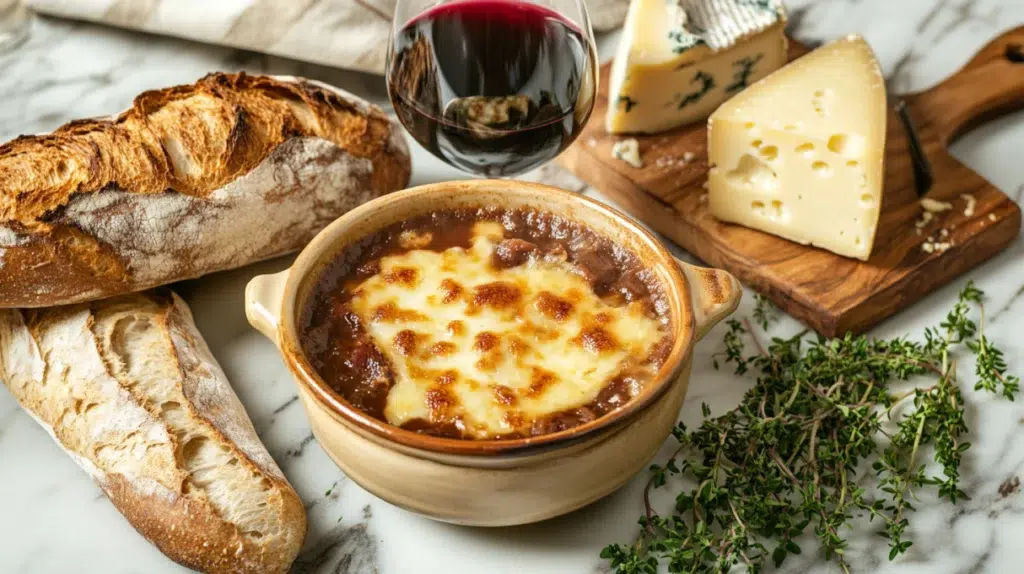
French soup cookery is one of the most underrated aspects of the cuisine. Soupe à l’oignon gratinée, French onion soup, is the dish most Americans know, but it represents a broader tradition of careful, deeply flavored soups built from properly made stocks and patient technique.
The onions in French onion soup must caramelize for 45-60 minutes minimum, not 20 minutes, not 30 minutes. The stock must be good beef stock. The gruyère must be real and it must be browned until bubbling and slightly charred at the edges. Each of these steps is non-negotiable. The dish that results from doing all of them correctly is one of the great simple pleasures in French cooking.
Vichyssoise, cold leek and potato soup, is another French classic that translates perfectly to home cooking. Bisque de homard (lobster bisque), soupe au pistou (the Provençal version of minestrone), and potage parmentier (leek and potato, served hot) round out the essential French soup repertoire.
→ Full recipe and technique in French classic recipes
The Pastry Tradition: Worth Understanding Even If You Never Make It
France’s pastry tradition, pâtisserie, is the most technically demanding in the world and the most influential on how the rest of the world thinks about baking. Croissants, éclairs, macarons, tarte tatin, mille-feuille, Paris-Brest, financiers, madeleines, these are French inventions that have spread to every bakery on the planet.
For home cooks, the accessible entry points are the simpler preparations: crêpes (thin pancakes requiring no special equipment), madeleines (shell-shaped butter cakes requiring a special tin but simple technique), tarte tatin (upside-down apple tart, surprisingly forgiving), and clafoutis (cherry batter pudding, one of the easiest French desserts and one of the best).
The more complex pastry work, laminated doughs, choux pastry, sugar work, is genuinely demanding and benefits from dedicated study rather than casual attempts. For the home cook who wants to go deeper, Julia Child’s Mastering the Art of French Cooking remains the most accessible serious guide to French technique in English.
→ Full recipes in the French pastry guide
French Food Culture: Things Worth Knowing
The meal structure and the cheese course
The formal French meal follows a specific sequence: amuse-bouche (one bite), entrée (starter), plat principal (main), fromage (cheese course), dessert. The cheese course is specifically French, a dedicated course between the main and dessert where a selection of cheeses is served with bread and sometimes fruit.
France has over 300 recognized cheese varieties, Camembert from Normandy, Brie from Île-de-France, Comté from Franche-Comté, Roquefort from Aveyron, Époisses from Burgundy. Eating cheese as a course rather than a garnish or a snack is the French approach — a piece of excellent Comté at the right moment in a meal is a specific pleasure that deserves its own space.
The bistro and the brasserie
The bistro is the informal neighborhood restaurant, modest, unpretentious, serving dishes like steak frites, duck confit, croque monsieur, moules marinières. The brasserie is the larger, livelier version, originally Alsatian beer halls, now serving similar food in a more animated atmosphere. Both serve food that is closer to French home cooking than the haute cuisine of famous Parisian restaurants, and both produce some of the best eating in France.
The daily bread ritual
The baguette is both a staple and a symbol. French law defines what a baguette can contain flour, water, salt, yeast, and specifies that it cannot contain added fat or preservatives. Baguette craftsmanship was inscribed on UNESCO’s Intangible Cultural Heritage list in 2022. The ritual of buying fresh bread daily, carrying it home unwrapped, tearing pieces to eat with meals, this is not nostalgic. It is still how most French people eat bread today.
Wine as part of the meal
French cooking and French wine are designed together. The wines of Burgundy were developed alongside the food of Burgundy. The wines of Bordeaux alongside the food of Bordeaux. The pairing logic, red Burgundy with coq au vin, dry Alsatian riesling with choucroute, Muscadet with Breton oysters, is not arbitrary or pretentious. It is the result of centuries of the same ingredients and the same terroir developing in parallel.
How Claire Cooks French Food
French cooking represents the most technique-dependent cuisine I work with on this site, and the most rewarding when the technique is properly understood.
My approach to every French recipe follows the same pattern: learn what each step is actually doing before following the instructions. Why does boeuf bourguignon need to braise for three hours? Because that is how long collagen needs to dissolve into gelatin. Why does the onion in a French onion soup need a full hour of caramelization? Because the sugars need that time to properly brown and develop. Once the reasoning is clear, the instructions make sense and the recipe becomes predictable.
I test every French recipe three times, traditional, adapted for US ingredients and equipment, then stress-tested in conditions where things can go wrong. The recipes in this collection work in an American home kitchen. The techniques are explained clearly enough that you understand not just what to do but why.
FAQ About French Recipes
Is French cooking really harder than other cuisines?
The professional tradition of French cooking is genuinely demanding, the classical techniques require serious study and practice. French home cooking is not harder than other cuisines and in many ways is more forgiving than, say, Chinese wok cooking or Japanese knife technique. The difficulty of French cooking is overstated by its reputation.
What is the most important French cooking technique to learn?
The sauté and deglaze, cooking protein in butter until browned, removing it, adding aromatics, adding wine or stock and scraping up all the browned bits, reducing to a sauce. This single technique underlies coq au vin, boeuf bourguignon, steak with pan sauce, chicken with mustard sauce, and dozens of other French dishes. Learn this one technique and a large portion of French home cooking becomes accessible.
What is the difference between haute cuisine and home cooking in France?
Haute cuisine is the professional, restaurant tradition, classical technique, multiple courses, elaborate presentations, ingredient combinations at the highest level. French home cooking (cuisine bourgeoise or cuisine de bonne femme) is simpler, more seasonal, more practical, the regional dishes that families actually make. Most of the recipes in this collection are from the home tradition, not the restaurant tradition.
Do I need French cookware to cook French food?
No, a heavy Dutch oven (Le Creuset is ideal but any enameled cast iron works), a good knife, and a wide sauté pan cover everything in this collection. The French kitchen is not a specialized equipment collection. It is a well-chosen small collection of high-quality tools used with skill.
Planning your week? Add a French recipe to your weekly meal planner alongside your everyday staples.