
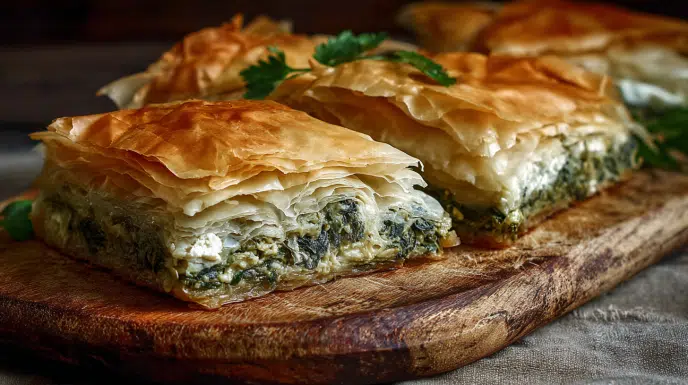
Spanakopita recipe made me understand what phyllo pastry is actually capable of.
I had eaten it dozens of times, at Greek restaurants, at potlucks, frozen from grocery store boxes, without ever fully understanding what made good spanakopita extraordinary rather than merely fine. Then I made it properly, from scratch, with real PDO feta and fresh spinach and butter brushed generously between each layer of phyllo, and I sat with a piece still warm from the oven and understood immediately what had been missing every other time.
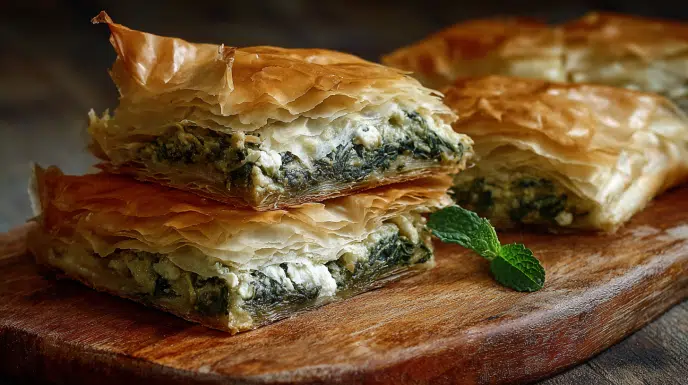
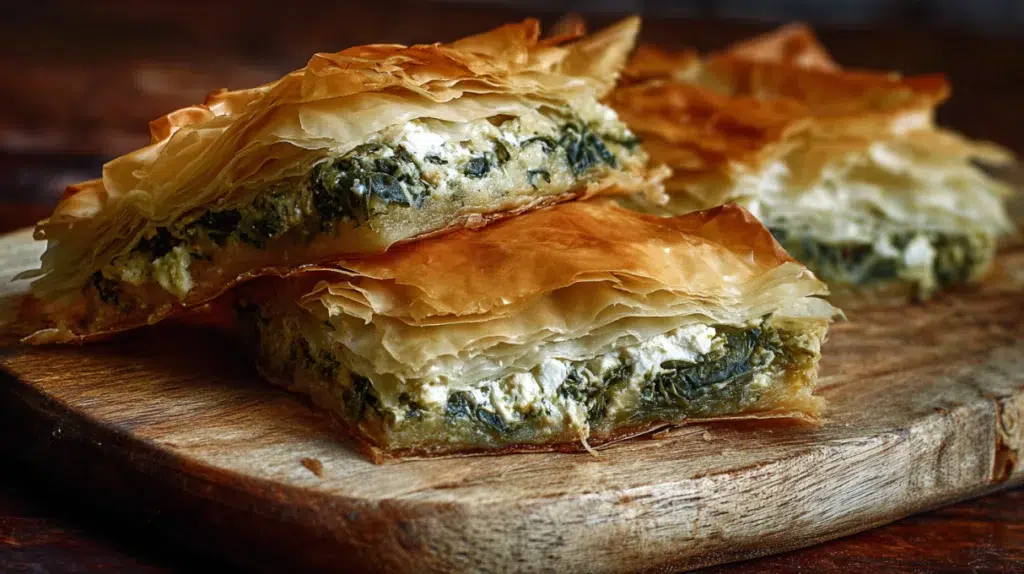
The shattering, impossibly light layers. The dense, salty, herby spinach-feta filling that holds its shape when you cut through it but yields completely when you eat it. The way the phyllo stays crispy even as the filling releases moisture. None of that comes from a frozen box. It comes from a recipe done correctly, with good ingredients and the one technique that matters most, which I will explain in detail below.
This is part of the Greek recipes collection Spanakopita is the dish I make when I want to show someone what Greek baking is. And every time, without exception, the response is the same, when can we have this again?
What Is Spanakopita
Spanakopita, a savory pie of spinach and feta wrapped in phyllo is one of the defining dishes of Greek cuisine, and it has been for centuries. The name comes from spanaki (spinach) and pita (pie). Exactly what it says. Exactly what it is.
The dish exists across the entire country but is particularly associated with northern Greece and the regions where wild greens, horta, have always been a dietary staple. The filling is flexible in ways that matter: some families use only feta, some add ricotta or cottage cheese for a creamier texture, some add pine nuts or raisins in regional variations. The spinach-feta combination is the standard, the most common, and in my view the best.
Spanakopita is made in two main forms. The large baking-dish version, what this recipe covers, produces a slab that can be cut into squares or diamonds and served as a main course, a side dish, or as part of a mezedes spread. The individual triangle version, tiropitakia-style is made by wrapping small portions of filling in folded phyllo triangles, typically served as appetizers. The filling and technique are identical. Only the assembly differs.
Understanding Phyllo: The Part That Intimidates Everyone
Phyllo is a flour-and-water dough stretched to paper thinness, a process so exacting it is frequently left to commercial manufacturers, and the paper-thin sheets that result are extraordinarily fragile. They tear. They dry out. They stick together if they get wet and fall apart if they get dry. At room temperature they degrade within minutes.
This is why phyllo intimidates home cooks. And the intimidation is understandable but unnecessary, because frozen phyllo from the grocery store is excellent, and working with it requires only three things.
The three rules of phyllo:
Rule 1: Thaw slowly. Frozen phyllo sheets must be thawed overnight in the refrigerator, never at room temperature. Room temperature thawing causes condensation that makes the sheets wet and sticky and impossible to separate. Overnight in the fridge produces perfectly workable sheets that unfold cleanly.
Rule 2: Keep a damp towel over the unused sheets. Phyllo dries out within minutes of exposure to air and becomes brittle and unworkable. Every time you take a sheet, re-cover the stack with a barely damp kitchen towel. This single habit is the difference between a successful and a failed phyllo session.
Rule 3: The tears do not matter. Every home cook’s first spanakopita has torn phyllo. The second has torn phyllo. The tenth probably has some torn phyllo too. It does not matter because you are layering eight to twelve sheets and each layer compensates for the tears in the others. The finished pie does not reveal individual sheet quality. Brush butter over each sheet, torn or intact, and continue.
Ingredients
Serves 8-10 | Active time: 45 minutes | Baking time: 45-50 minutes
For the filling:
- 1kg (2.2 lbs) fresh spinach, washed, or 500g (about 1 lb) frozen spinach, fully thawed
- 400g (14 oz) authentic PDO feta cheese, crumbled. The quality of the feta is the quality of the filling. Do not use cow’s milk feta here.
- 3 large eggs
- 1 medium onion, finely diced
- 4 spring onions (green onions), finely sliced, including the green tops
- Large bunch fresh dill, about 4 tablespoons chopped. Dill is the defining herb of spanakopita. Do not substitute with other herbs.
- 2 tablespoons fresh flat-leaf parsley, chopped
- 3 tablespoons olive oil, for cooking the onion
- ¼ teaspoon ground nutmeg, subtle but important
- Black pepper to taste, generously
- Salt to taste, feta is salty so taste before adding
For the phyllo:
- 270g (about 10 oz) package of frozen phyllo sheets, thawed overnight in fridge. Athens brand is widely available and reliable.
- 120g (½ cup / 1 stick) unsalted butter, melted, for brushing between layers
- 3 tablespoons olive oil, mixed with the butter for brushing
Equipment:
- 33x23cm (13×9 inch) baking dish, or similar rectangular dish
- Pastry brush, essential for the butter
- Clean damp kitchen towel
How to Make Spanakopita Recipe: Step by Step
Step 1: Deal With the Spinach First (most important step)
Whether using fresh or frozen spinach, the spinach must be completely, thoroughly dry before it goes into the filling. Wet spinach produces wet filling which produces soggy phyllo. This is the most common spanakopita failure and it is entirely preventable.
Fresh spinach: Wash thoroughly, then cook briefly in a large pan without any added water, the water clinging to the leaves is enough. Stir over medium heat until completely wilted, about 3-4 minutes. Transfer to a colander and press firmly with a wooden spoon to expel as much liquid as possible. Then transfer to a clean kitchen towel, wrap it up, and squeeze as hard as you can. Open it, redistribute the spinach, squeeze again. Repeat until the towel comes out barely damp. The spinach volume will have reduced dramatically. This is correct.
Frozen spinach: Thaw completely, then put it in a clean kitchen towel and squeeze. And squeeze again. And once more. Frozen spinach holds an enormous amount of water and every drop of it needs to come out.
Once the spinach is dry, roughly chop it and set aside.
Step 2: Make the Filling (15 minutes)
Heat the olive oil in a skillet over medium heat. Cook the diced onion until completely soft and translucent, about 8 minutes. Add the spring onions and cook 2 more minutes. Remove from heat and cool for 5 minutes.
In a large bowl combine the crumbled feta, eggs, dill, parsley, nutmeg, and black pepper. Mix well. Add the cooled onion mixture and stir through. Finally add the squeezed, chopped spinach and mix until everything is evenly combined.
Taste the filling. It should be generously seasoned, the feta provides most of the salt, but add a pinch more if needed. The dill flavor should be very present. If you cannot taste the dill, add more. Dill is not a background note in spanakopita. It is a primary flavor.
Set the filling aside and preheat your oven to 190°C / 375°F.
Step 3: Prepare the Pan and Butter
Mix the melted butter and olive oil together in a small bowl, the olive oil extends the butter and adds flavor. Brush the bottom and sides of the baking dish generously with the butter mixture.
Unroll the phyllo sheets and cover immediately with your damp kitchen towel. Have everything ready before you start assembling, filling on the counter, butter beside you, damp towel in place, baking dish in position. Once you start, you want to move with reasonable speed.
Step 4: Assemble (15 minutes)
The bottom layers, 6 to 8 sheets: Take one sheet of phyllo. Lay it in the baking dish, it will likely overhang the sides by several centimetres. Brush with butter. Lay the next sheet, slightly offset so the overhang goes in a different direction. Brush with butter. Repeat until you have 6-8 sheets building up in the base of the dish, each one brushed with butter.
The overhanging phyllo is intentional, you will fold it over the filling later to seal the top.
The filling: Spread the spinach-feta filling evenly over the buttered phyllo base in the dish. Press it gently into an even layer with the back of a spoon.
The top layers, 6 to 8 more sheets: Layer another 6-8 sheets of phyllo on top of the filling, each one brushed with butter. Fold the overhanging sheets from the bottom layer up and over the top sheets to create a sealed border. Brush the top generously with the remaining butter, the top should be noticeably golden with butter before it even goes in the oven.
Score the top layers with a sharp knife into the portions you plan to serve, squares, rectangles, or diamonds. Cut through the top phyllo layers only, not through the filling. This allows the steam to escape during baking and makes the finished pie easier to cut cleanly.
Step 5: Bake (45-50 minutes)
Bake at 190°C / 375°F for 45-50 minutes until the top is deeply golden and the phyllo is visibly crispy and dry rather than shiny. The filling should be set, if you press the center gently it should feel firm.
The color is your guide more than the time. You want genuinely golden, not pale, not light brown, genuinely deep golden and slightly crackling-looking on top.
Rest for 10-15 minutes before cutting. Hot spanakopita cuts messily and the filling needs a few minutes to firm up. Barely warm spanakopita cuts beautifully into clean squares.
How to Serve Spanakopita
Spanakopita is extraordinarily versatile about temperature, it is good warm, at room temperature, and even cold from the fridge the next day (though it loses some phyllo crispiness once refrigerated).
As a main course: cut into large squares, alongside the authentic Greek salad and a bowl of tzatziki for dipping. As part of a mezedes spread: cut into small squares or diamonds, served at room temperature alongside other small dishes. As a party dish: made the day before, reheated uncovered in a 180°C / 350°F oven for 15 minutes to re-crisp the phyllo.
The tzatziki pairing is worth emphasising, the cool, garlicky yogurt against the warm, crispy, salty pie is one of those specific Greek combinations that makes both components better than either is alone.
Claire’s Notes
On the butter vs olive oil question: Traditionalists use only butter. Some modern versions use only olive oil, which produces a slightly different flavor, less rich, more herbaceous. The mixed approach in this recipe produces the best of both, the richness of butter with the fruity depth of olive oil. Do what you prefer with confidence.
On making it ahead: Spanakopita reheats beautifully and in fact benefits from being made the day before for parties, the filling sets more firmly, the flavors deepen, and the pie slices more cleanly. Reheat uncovered at 180°C / 350°F for 15 minutes. The phyllo will re-crisp.
On freezing: Spanakopita freezes well before baking, assemble completely, freeze unbaked, then bake from frozen at 180°C / 350°F for about 70 minutes. Or freeze after baking in portions, reheat uncovered in the oven (never microwave, which makes the phyllo steam and go limp).
On the dill: Fresh dill is significantly better than dried. If you genuinely cannot find fresh dill, dried works but use only 1½ teaspoons and accept a slightly less vibrant result. Dill is not substitutable with any other herb in this dish.
Frequently Asked Questions
Can I use pre-washed baby spinach?
Yes, skip the cooking step and squeeze raw. Baby spinach has less moisture than mature spinach and can sometimes be used raw in the filling if squeezed thoroughly enough. It produces a slightly less rich flavor but works well.
Why is my spanakopita soggy?
The spinach was not squeezed dry enough. This is the answer 95% of the time. See Step 1, the squeezing step needs to be thorough. If you think you have squeezed enough, squeeze once more.
How do I know when it is fully baked?
Deep golden color across the entire top, phyllo that looks dry and crispy rather than shiny or translucent, and a filling that feels firm when pressed gently in the center. When in doubt, give it another 5 minutes.
Can I make individual triangles instead of the large pie?
Yes, take strips of phyllo, brush with butter, place a tablespoon of filling at one end, fold into a triangle (like a flag fold) continuing down the strip. Brush finished triangles with butter. Bake at 190°C / 375°F for 20-25 minutes. These freeze beautifully before baking and can go straight from freezer to oven.
More From the Greek Recipes Collection: