
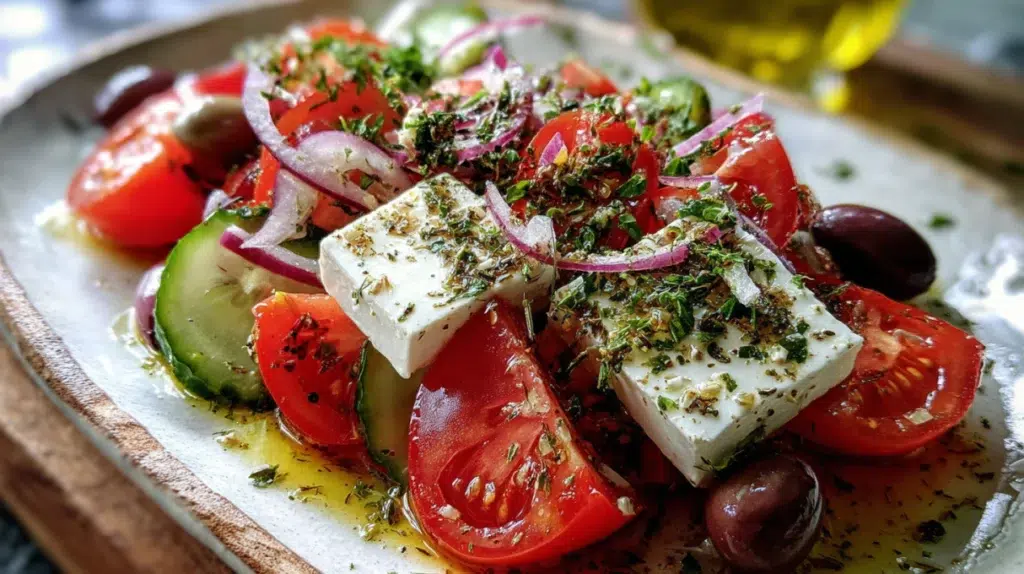
The authentic Greek salad recipe has no lettuce in it. Full stop, no exceptions, not even a little.
I know this comes as a surprise to most Americans who have grown up eating what restaurants call a Greek salad, a bed of iceberg or romaine with some olives and feta and a bottled Italian-adjacent dressing thrown over it. That dish exists. It has its fans. It is not what Greeks eat when they eat Greek salad.
What Greeks eat is horiatiki, the village salad, and it is built entirely on the logic that if your tomatoes are extraordinary, your cucumber is crisp, your feta is real PDO sheep’s milk cheese, and your olive oil is the best you can find, you do not need lettuce. You do not need vinegar in the dressing. You do not need croutons. You do not need anchovies. You need those four things done right. Nothing else.
This is part of the Greek recipes collection, and this salad is where I always tell people to start. Not because it is the most complex dish in Greek cooking but because it will immediately recalibrate what you think Greek food is. If it works, if you make it in summer with good tomatoes and real feta and excellent olive oil, you will understand something about the cuisine that no amount of reading can teach.
What Horiatiki Actually Is
The traditional Greek diet was built on vegetables, olive oil, cheese, and seafood, meat was a luxury eaten only on special occasions, and horiatiki is the direct expression of that philosophy in salad form. It is peasant food. Not in a diminished sense in the sense that it was designed by people who ate what grew around them, used the best local olive oil, and had no interest in complication for its own sake.
The name horiatiki comes from horio, Greek for village. It is the salad of the village, the salad of the country, the salad eaten by farmers and fishermen who wanted something fresh and satisfying made from what the garden and the local market provided.
It arrived on the Greek-American restaurant menu in a considerably altered form, bigger, with more ingredients, built around a lettuce base to stretch the more expensive components. That version has been served in America for so long that many people assume it is authentic. It is not. It is an adaptation. The original is simpler and significantly better.
The six components of a real horiatiki are: ripe tomatoes, cucumber, red onion, Kalamata olives, feta cheese, and extra-virgin olive oil. That is it. The oregano sprinkled on top is traditional. The salt goes on at the table. Everything else is optional at best and wrong at worst.
The Ingredient Truth: Where This Salad Either Lives or Dies
Horiatiki is among the most ingredient-dependent dishes in any cuisine. The technique involved is slicing and arranging. There is nothing else to hide behind. Every ingredient is fully exposed. Which means every ingredient must be excellent.
The tomatoes: the non-negotiable
This is a summer dish. In July and August, when outdoor tomatoes are heavy with sugar and acid and flavor, make it constantly. In February, with supermarket tomatoes that were picked green and gassed to approximate redness, don’t bother. No dressing, no technique, no amount of good feta can compensate for a pale, mealy, flavorless winter tomato.
Use the ripest, most flavorful tomatoes you can find. Heirloom varieties, any color, any shape, work beautifully. Cherry tomatoes halved work in the off-season better than large hothouse tomatoes. Whatever you choose, taste one before you build the salad. If it tastes like nothing, wait for better tomatoes.
Cut tomatoes into large wedges or thick chunks. Greek horiatiki uses generous, substantial pieces, not thin slices, not small dice. The tomato should be something you can pick up on a fork and eat as a whole satisfying mouthful.
The feta: sheep’s milk only
Real feta is made from sheep’s milk (or a mixture of sheep and up to 30% goat’s milk) in specific regions of Greece, Macedonia, Thrace, Thessaly, Epirus, the Peloponnese, Lesbos, and Central Greece. It has been produced this way for thousands of years and received Protected Designation of Origin status from the European Union in 2002.
American “feta” made from cow’s milk at a Wisconsin dairy is a different cheese. Not bad, necessarily, but milder, creamier, less tangy, without the slightly sharp, briny, complex flavor of genuine sheep’s milk feta. In a dish where feta is one of only six ingredients and is placed in a prominent slab on top rather than crumbled through, the difference is very noticeable.
Buy feta labeled PDO or imported from Greece. Whole Foods carries it. Most well-stocked grocery stores carry it. DODONI, Valbreso, and Epiros are reliable brands. It costs slightly more than American feta. It is worth the difference in this dish specifically.
The olive oil: the soul of the whole thing
Olive oil is a central component of the Mediterranean diet, associated with reduced risk of cardiovascular disease and significantly better health outcomes and in horiatiki it is not a dressing ingredient. It is the dressing. The entire dressing. Olive oil, salt, dried Greek oregano. Nothing else.
Which means the olive oil must be genuinely good. Fruity, peppery, slightly grassy, with enough character to be worth tasting on its own. A cheap, bland olive oil will produce a bland salad. A bottle of excellent Greek extra-virgin olive oil, Iliada, Gaea, or any quality Greek cold-pressed variety, will make the salad sing.
Pour it generously. More than you think is enough. Greeks are not timid with olive oil. Neither should you be.
The cucumber: thick, not thin
Greek cucumbers are shorter and thinner-skinned than the long English cucumbers most common in American supermarkets. The closest widely available equivalent is the Persian cucumber, small, crisp, thin-skinned, almost no seeds. Use these if you can find them.
If using English cucumber, peel it partially (strips of peel removed to create a striped pattern, which softens the slightly tough skin while keeping some texture) and cut into thick half-moons. The pieces should be substantial. This is not a finely minced salad.
The red onion: soaked, always
Raw red onion has an aggressive sharpness that overwhelms the other flavors in the salad. Soak the sliced onion in cold water for 10-15 minutes before adding it, this removes the sharpest edge while preserving the onion flavor and the purple color. Drain and dry well before using.
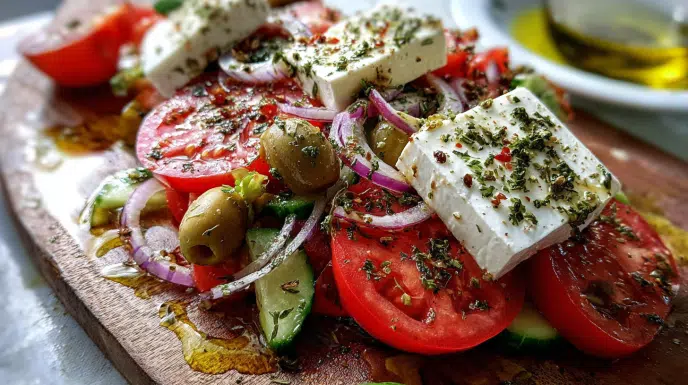
Ingredients For Greek Salad
Serves 2-3 as a main salad, 4-6 as part of a mezedes spread
- 4 large ripe tomatoes, or equivalent volume of heirloom or cherry tomatoes
- 1 medium cucumber, Persian preferred, or half an English cucumber, partially peeled
- ½ medium red onion, very thinly sliced, soaked in cold water 15 minutes, drained
- 80g (about ½ cup) Kalamata olives, whole, with pits. The pits matter, they signal authenticity and the olive has more flavor when unpitted.
- 150-200g (5-7 oz) authentic PDO feta cheese, in one large slab or two pieces, not crumbled
- 4-5 tablespoons excellent extra-virgin olive oil, Greek preferred
- ½ teaspoon dried Greek oregano, crumbled between your fingers before adding to release the oils
- Flaky sea salt, added at the table or just before serving
- Optional: 3-4 pepperoncini (Greek pickled peppers), a few fresh basil leaves in summer
What you do not put in horiatiki: Lettuce. Vinegar. Croutons. Anchovies. Cherry peppers. Capers. Bottled dressing of any kind. These are additions that exist in Greek-American restaurants. They do not exist in Greek horiatiki.
How to Make Horiatiki: The Method
This is assembly, not cooking. The method takes 10 minutes and every second of those 10 minutes should be spent on ingredient quality rather than technique.
Step 1: Prepare the vegetables
Slice the tomatoes into generous wedges, sixths or eighths from a large tomato. Place in a wide, shallow bowl or on a flat plate with a slight rim to catch the olive oil. Cut the cucumber into thick half-moons or large chunks, nothing thinner than 1cm. Drain the soaked red onion slices and scatter over the vegetables. Add the Kalamata olives, whole, with pits.
Step 2: Place the feta
This is the step most people get wrong. In horiatiki, the feta is not crumbled over the salad like a garnish. It is placed on top as a single large slab or in two generous pieces, present as a component of the salad in its own right, sitting proudly on top of the vegetables. The person eating the salad breaks off pieces of feta with their fork and combines them with the vegetables in each bite.
Lay the feta slab on top of the arranged vegetables. It should be visible and substantial.
Step 3: Dress it
Pour the olive oil generously and evenly over everything, the vegetables and the feta. Sprinkle the dried Greek oregano over the feta specifically (this is traditional) and lightly over the vegetables. Add a pinch of flaky salt if your feta is mild, real PDO feta is already quite salty, so taste first.
Do not toss. The salad is served as arranged and combined at the table by each person in their own bowl or on their own plate.
Step 4: Eat immediately
Horiatiki does not hold. The tomatoes release liquid, the salt draws moisture from the cucumber, and the salad becomes watery within 20-30 minutes of dressing. Make it and eat it. Do not make it ahead.
How to Serve Horiatiki the Greek Way
In Greece this salad is eaten in one of two ways. As the centerpiece of a simple lunch, with good bread to mop up the olive oil and tomato juices that pool at the bottom of the plate, perhaps some olives and cheese alongside, a cold beer. Or as part of a mezedes spread, alongside spanakopita, tzatziki and the full range of Greek dips, and grilled meat or fish, as one of many communal dishes shared across the table.
The bread is not optional when eating this salad. The combination of the olive oil, tomato juice, feta brine, and the starchy resistance of good bread is one of the great simple pleasures in Mediterranean eating. The bread goes in the bottom of the bowl and the salad goes on top, or you tear pieces and drag them through the pooled dressing as you eat. Either approach is correct.
Pair with Greek lamb dishes for a complete summer feast that represents Greek home cooking at its most generous and most satisfying.
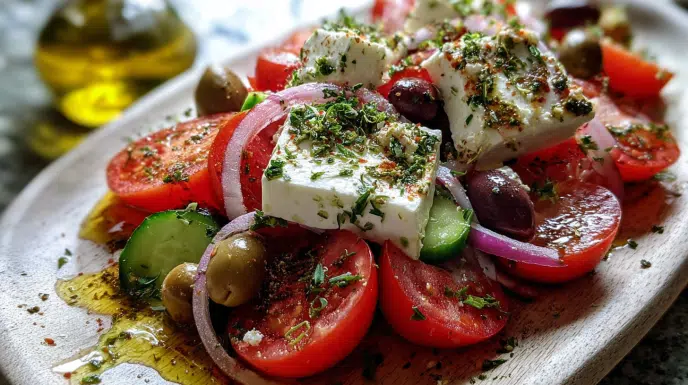
Claire’s Notes
On timing: This is a summer salad. Peak season (July through September in the US) with outdoor-grown tomatoes is when this salad is extraordinary. Outside of that window, manage expectations accordingly or use good cherry tomatoes instead of large ones, they have more consistent flavor year-round.
On the olive oil pool: When you finish the salad, there will be a pool of olive oil, tomato juice, and feta brine in the bottom of the bowl. This is the best part. Soak it up with bread. Do not waste it.
On soaking the onion: Non-negotiable. Raw unsoaked red onion dominates this salad. 15 minutes in cold water is the difference between the onion being an aggressive distraction and a pleasant background note.
On the feta temperature: Take the feta out of the fridge 15-20 minutes before serving. Cold feta straight from the refrigerator has a muted flavor. Room temperature feta tastes like itself.
Frequently Asked Questions
Why is there no lettuce in authentic Greek salad?
Lettuce was not traditionally part of horiatiki, the village salad, which was built from garden vegetables that kept well in warm temperatures. The lettuce-based Greek salad is an American restaurant adaptation designed to stretch the more expensive components. The original is simpler and better.
Can I add cucumber seeds or should I remove them?
Persian cucumbers have minimal seeds and you can use them whole. English cucumber seeds can make the salad slightly watery, scoop them out with a spoon if your cucumber is very seedy.
What if I can’t find Greek oregano?
Mediterranean oregano is the closest substitute. Standard Italian dried oregano is milder, use slightly more of it. Fresh oregano has a completely different flavor profile and is not traditional in horiatiki.
Can I use green olives instead of Kalamata?
Kalamata olives are specific to this salad, their dark, fruity, wine-vinegar-cured flavor is part of what makes horiatiki taste Greek. Green olives produce a different flavor profile. Use Kalamata if you can find them, which is not difficult, they are at most major grocery stores.
More From the Greek Recipes Collection: