Greek vs Turkish food is a comparison that neither Greeks nor Turks particularly enjoy making, and a comparison that most food writing handles badly because it either flattens both cuisines into one undifferentiated “Mediterranean” category or tries to draw sharp lines that history simply does not support.
The honest answer is more complicated and more interesting than either of those approaches. These are two distinct cuisines with deep, historically rooted identities. They are also two cuisines that share an enormous common foundation, because they shared four centuries of political and cultural overlap under the Ottoman Empire, and food does not respect political borders.
This guide attempts to answer the question properly, what each cuisine specifically is, where they overlap, where they genuinely diverge, and why both deserve to be understood on their own terms rather than as reflections of each other.
This is part of the Greek recipes collection and understanding how Greek food relates to its Turkish neighbor is part of understanding what makes Greek cuisine specifically and distinctively Greek.
Why They Are So Similar: The Ottoman History
Greece was under Ottoman rule for nearly four centuries, a period that fundamentally shaped its food culture from the fall of Constantinople in 1453 until Greek independence in the early 19th century. Four hundred years of shared political space produced shared culinary traditions that run deep enough that attributing specific dishes to one country or the other is genuinely contested and often unanswerable.
Baklava. Dolmades. Börek and its Greek cousin spanakopita. Stuffed peppers and eggplant. Lamb cooked with yogurt. The mezze tradition of many small shared dishes. Thick coffee made in a small pot over heat. These traditions developed across the Ottoman world and were claimed, adapted, and made their own by Greek and Turkish cooks simultaneously.
When Greeks and Turks argue about who invented baklava, they are both right and both wrong, the dish developed in an Ottoman kitchen context where Greek, Turkish, and other cooks from across the empire worked alongside each other. Claiming it for one nation is a modern political act applied to a pre-modern culinary reality.
Understanding this shared history does not diminish either cuisine. It explains them.
What Turkish Cuisine Actually Is
Turkey’s culinary tradition reflects centuries of Ottoman influence, with mezze, dolma, börek, and lamb at the center of the table but Turkish cuisine is significantly more than its Ottoman legacy. It draws on the cooking traditions of Anatolia, Central Asia, the Caucasus, the Levant, and the Balkans a genuinely diverse range of culinary influences that produces one of the most sophisticated and regionally varied food cultures in the world.
Turkish cuisine is built on several pillars that distinguish it from its Greek counterpart:
Spice complexity: Turkish cooking uses a more varied spice palette than Greek cooking, sumac, Aleppo pepper, dried mint, cumin, allspice, and dried chiles all appear with regularity. Greek cooking is more restrained in its spice use, relying primarily on oregano, cinnamon in savory dishes, and the inherent flavors of good olive oil and fresh produce.
The bread tradition: Turkey has an extraordinary bread culture, simit (sesame rings), pide (flatbread baked in wood ovens), açma (soft bread rolls), lahmacun (thin flatbread with spiced meat topping), that has no direct equivalent in Greek cooking. Greek bread is good but unremarkable compared to Turkish bread culture at its best.
Dairy traditions: Turkey uses yogurt in a wider range of applications than Greece as a sauce base, as a soup component, as a cooking medium for lamb, as a breakfast food in its own right. The Turkish yogurt tradition is arguably richer and more central than even the Greek one.
The kebab vocabulary: Turkey’s kebab tradition is more diverse and more regionally varied than anything in Greek cooking, Adana kebab, İskender kebab, döner, şiş kebab, köfte, cağ kebabi, each with specific regional origin stories and specific techniques. Greek souvlaki is excellent but far simpler in its variety.
What Greek Cuisine Specifically Does
Greek cooking has its own specific characteristics that distinguish it from Turkish cooking in meaningful ways:
The olive oil intensity: No cuisine in the world uses olive oil quite as centrally and as generously as Greek cooking. Greek cooks use olive oil in quantities that Turkish and even Italian cooks do not match. It is not a cooking medium, it is a primary flavor and a finishing element of almost every dish.
The freshness orientation: Greek cooking pushes the fresh herb and fresh vegetable principle further than Turkish cooking. Real horiatiki, the Greek village salad uses only what is perfectly fresh and seasonal. There is no equivalent of the heavily spiced Turkish ezme or muhammara in Greek cooking, Greek dips and salads tend toward simpler, cleaner flavor profiles.
The seafood tradition: Greece’s extraordinary coastline and island geography have produced a seafood tradition, simply grilled fish with lemon and olive oil, octopus dried and grilled, shellfish in tomato sauce that Turkish cooking cannot match, even though Turkey also has extensive coastline. The Greek relationship with seafood is more central, more varied, and more culturally important.
The cheese culture: Greece’s specific cheese tradition, PDO feta, graviera, kasseri, manouri, myzithra is distinct from Turkish cheese culture and more internationally recognized. Spanakopita and its feta-forward filling is specifically, distinctively Greek.
The lemon philosophy: Greek cooking uses lemon more aggressively and more ubiquitously than Turkish cooking. Avgolemono sauce, the egg-lemon emulsion used in soups and to finish stuffed vine leaves has no direct Turkish equivalent. The tartness is different in character and more present.
The Dishes That Appear in Both, And How They Differ
Dolmades vs Dolma Both cuisines make stuffed vine leaves. Greek dolmades tend toward a lemony rice filling, served cold or at room temperature with avgolemono sauce or olive oil and lemon. Turkish dolma is more varied, rice, meat, or combination fillings, sometimes hot and sometimes cold, often without the avgolemono component. Both are excellent. They taste different.
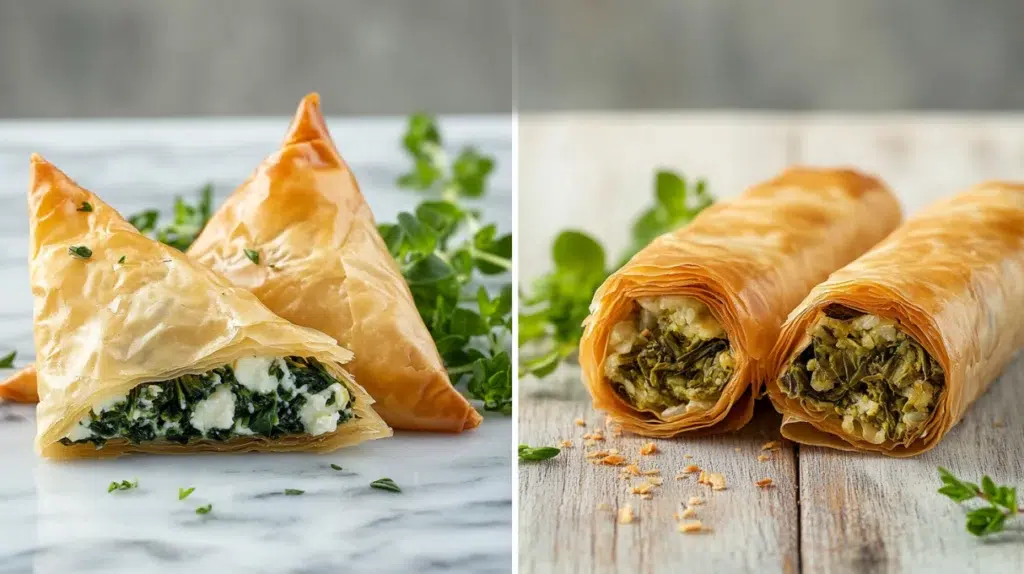
Spanakopita vs Börek Both are phyllo pastries with cheese and vegetable fillings. Greek spanakopita is specifically spinach and feta, made in a baking dish or as triangles. Turkish börek has a wider range of fillings, cheese, meat, potato, spinach and appears in more forms (spiral su böreği, cigar börek, tray börek). The pastry is the same. The filling traditions diverge.
Tzatziki vs Cacık Greek tzatziki is thicker, made with strained yogurt and uses dill as the primary herb. Turkish cacık is thinner and often served as a cold soup in summer, uses mint rather than dill, and has a different overall character. Both are cucumber and yogurt based. They are genuinely distinct preparations.
Moussaka Appears in both cuisines in different forms. The Greek version with béchamel is the internationally known version. Turkish musakka is typically made without the béchamel topping and has a different spice profile. Both claim it. Both are correct that their version exists and is genuine.
Baklava Present in both cuisines, across the entire former Ottoman world, and into the Levant and Central Asia. The Greek version tends toward honey-based syrup and walnuts. The Turkish version uses sugar syrup and pistachios in the most celebrated versions. Both are extraordinary. The origin debate is unanswerable and not worth having.
The Practical Answer for Home Cooks
If you are cooking Greek food, use Greek oregano, good olive oil, fresh lemon, feta specifically, and the restraint of spice that characterizes the cuisine. Follow the Greek recipes in this collection as written.
If you are cooking Turkish food, embrace the broader spice vocabulary, the yogurt-as-sauce tradition, the bread culture, and the regional diversity of the kebab tradition.
Do not substitute Turkish spice blends into Greek recipes or vice versa. The cuisines share ingredients but not always their applications or proportions. Respect the specific character of each.
And if someone at your table starts an argument about which country invented baklava change the subject. Serve more of both. The argument is old, unresolvable, and significantly less interesting than the food itself.
FAQ About Greek vs Turkish Food
Are Greek and Turkish food the same?
No, they share common roots and many dishes but are genuinely distinct cuisines with different spice palettes, different dairy traditions, different bread cultures, and different relationships to seafood and olive oil. Think of them as cousins raised in the same house for four hundred years, now living separately and cooking differently.
Which is better, Greek or Turkish food?
This is the wrong question. Both are among the great food cultures of the world. Asking which is better is like asking whether jazz is better than blues, they come from the same roots and belong to the same conversation. Cook both. Eat both. Form your own view.
Is baklava Greek or Turkish?
It is Ottoman, which means it belongs to the shared culinary heritage of a dozen countries. Both Greek and Turkish versions are authentic within their own traditions. Both are delicious. This answer will satisfy neither Greeks nor Turks. It is nonetheless correct.
What is the biggest practical difference for a home cook?
Spice range. Turkish cooking uses a wider, more varied spice palette. Greek cooking is more restrained, relying on olive oil and herbs rather than spice complexity for its depth. If a recipe calls for sumac, Aleppo pepper, or dried mint as primary flavors, it is Turkish in character. If it calls primarily for oregano, cinnamon in savory contexts, and lemon, it is Greek.
More From the Greek Recipes Collection: