Lebanese vs Syrian food is one of the most genuinely interesting culinary comparisons in the Middle East and one of the least accurately discussed in English-language food writing.
Most comparisons either flatten both cuisines into a single undifferentiated category called “Middle Eastern food”, which helps nobody and respects neither tradition, or overstate the differences in ways that ignore the deep, real, historically rooted connections between two neighboring cuisines that have been in conversation with each other for centuries.
This guide tries to do neither. It tries to be specific, honest, and respectful about what each cuisine actually is, where they overlap, where they genuinely diverge, and why those differences exist.
This is part of my Lebanese recipes collection a site built on the principle that food traditions deserve to be understood properly before they are cooked. That principle applies especially here, where two cuisines are often conflated in ways that neither their home cooks nor their culinary histories deserve.
The Common Foundation: What They Share
Lebanon and Syria share a history of Phoenician, Arab and Ottoman cultural influence that spans millennia and this shared history produced shared culinary foundations that run deeper than any surface differences between the two cuisines.
Both cuisines are built on the same core ingredients. Olive oil generous, high quality, present at every meal. Fresh herbs, flat-leaf parsley, mint, cilantro used in large quantities as primary ingredients rather than garnishes. Lemon, squeezed over everything, always fresh. Bulgur wheat in tabbouleh, in kibbeh, in side dishes. Chickpeas in hummus, in soups, in stews. Lamb, the preferred meat in both cuisines for significant occasions. Mezz, the shared tradition of many small dishes at the center of the table, communal and generous.
The mezze tradition that defines both tables, see the full Lebanese mezze collection is perhaps the most important shared cultural element. Both Lebanese and Syrian families eat mezze at celebrations, at family gatherings, at any moment that deserves abundance. The specific dishes vary. The philosophy of generosity and sharing is identical.
Kibbeh is another deeply shared dish, ground lamb and bulgur, spiced and shaped, eaten across both countries in many variations. Hummus appears on both tables. Fattoush, baba ghanoush, stuffed vine leaves, grilled meats with garlic sauce, these exist in both cuisines, with variations in spicing, texture, and presentation that reflect regional traditions rather than fundamental differences.
What Lebanese Cuisine Does Specifically
Lebanese cuisine has a few specific characteristics that distinguish it within the shared Levantine culinary tradition.
The French influence. Lebanon was under French Mandate from 1920 to 1943, and the French culinary influence is visible in Lebanese cooking in a way that has no parallel in Syrian cuisine. Lebanese cooking shows more refined technique, more attention to presentation, more integration of French-influenced pastry and bread traditions. Lebanese cities, particularly Beirut, developed a sophisticated restaurant culture with French influence that shaped how Lebanese cuisine presents itself to the world.
The freshness obsession. Lebanese cooking pushes the fresh herb principle further than almost any other cuisine. Tabbouleh in its most authentic Lebanese form is almost entirely parsley, a dish that would read as overwhelmingly herby in most other culinary traditions. This extreme freshness orientation is specifically Lebanese.
The citrus brightness. Lebanese cooking uses lemon more aggressively than Syrian cooking, the tartness is sharper, more present, more defining. Sumac too, see the Lebanese seven spice blend and sumac guide, appears in Lebanese cooking with a frequency and prominence that makes it a defining flavor rather than an occasional accent.
The seafood tradition. Lebanon’s Mediterranean coastline and its fishing culture have produced a seafood tradition that is significantly more developed than Syria’s. Grilled fish with garlic sauce, seafood mezze, fish kibbeh, these are specifically Lebanese coastal dishes with no strong Syrian equivalent.
The hospitality performance. Lebanese hospitality “karam” is expressed through an almost theatrical generosity of food. The Lebanese table tends toward more dishes, more abundance, more visual drama than a comparable Syrian table. This is cultural as much as culinary Lebanese social culture places enormous emphasis on how the table looks and how generously guests are served.
What Syrian Cuisine Does Specifically
Syrian cuisine is built on lemon, garlic, onions and a wide range of spices and within that shared Levantine foundation, Syria has developed several specific culinary traditions that are distinct from Lebanese cooking.
The Aleppo pepper tradition. Aleppo, one of Syria’s great culinary cities has given the world Aleppo pepper (pul biber): a mildly spicy, slightly fruity, deeply red dried chile flake that is now available globally and used throughout Syrian cooking for heat and color. Lebanese cooking uses dried chiles too, but Aleppo pepper specifically is a Syrian contribution to the Levantine spice vocabulary.
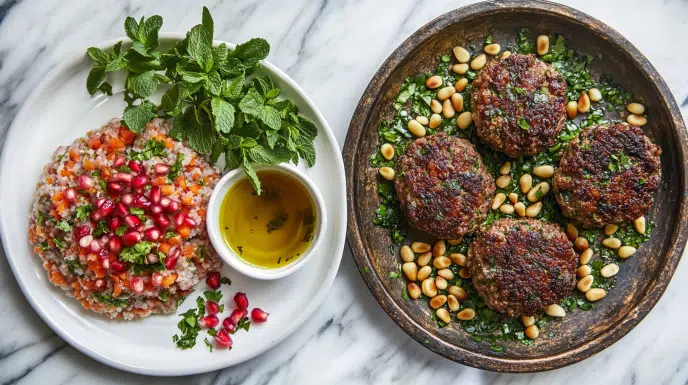
The Damascus sweet and savory tradition. Damascus has a specific culinary tradition of combining sweet and savory more aggressively than Lebanese cooking, pomegranate seeds in meat dishes, dried fruits in rice, honey and nuts in savory pastries. This sweet-savory integration is present in Lebanese cooking too but more pronounced in the Syrian tradition from Damascus and its surroundings.
The inland meat tradition. Syria’s geography, less coastline, more inland agricultural plains, produces a cuisine more oriented toward lamb, beef, and poultry than seafood. Syrian meat dishes tend toward longer braises, slower cooking, richer sauces. The Syrian version of kibbeh, for example, often appears in larger, more rustic forms than the refined Lebanese versions served at mezze.
The flatbread diversity. Syria produces a wider variety of flatbreads than Lebanon, from the thin Syrian flatbread to the thicker, chewier breads of Aleppo to the sesame-crusted breads of Damascus. Bread culture is deeply embedded in both cuisines but Syrian bread diversity is particularly rich.
The muhammara origin. Muhammara, the red pepper and walnut dip that appears on Lebanese mezze tables is actually Syrian in origin, from Aleppo specifically. It traveled to Lebanon through the shared culinary conversation between these two neighboring cuisines and is now so embedded in Lebanese mezze that most people think of it as Lebanese. This kind of cross-border culinary migration is the real story of Levantine food history.
The Dishes That Appear in Both, And How They Differ
Hummus: Present in both cuisines. Lebanese hummus tends toward more tahini, more lemon, smoother texture, served warm. Syrian hummus often has a slightly coarser texture and is seasoned differently by region. The authentic hummus debate that crosses both cuisines, which country makes it best, is ultimately unanswerable because both make extraordinary versions with different characters.
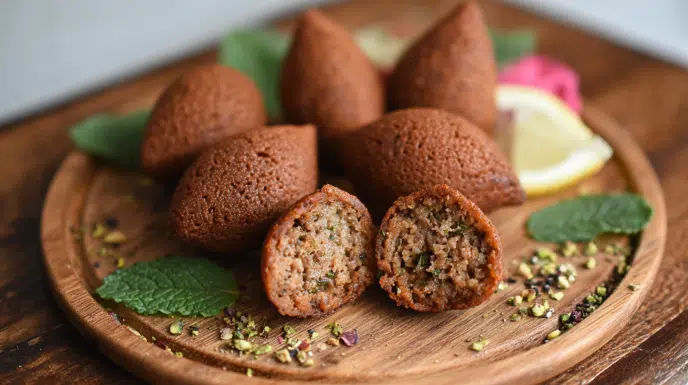
Kibbeh: Present in both cuisines in many forms. Lebanese kibbeh tends toward the refined oval-shaped version served as mezze, thin-walled, precisely shaped, elegantly presented. Syrian kibbeh appears in more rustic forms, larger, baked in trays, or simmered in yogurt sauce (kibbeh labaniyeh) with more regional variation in spicing.
Tabbouleh: Present in both cuisines. Lebanese tabbouleh is overwhelmingly herb-forward, mostly parsley, small amount of bulgur. Syrian tabbouleh tends toward more bulgur, less parsley, closer to what most Westerners think of as tabbouleh. Both are correct within their own traditions.
Shawarma: Present in both cuisines and across the whole Middle East. The Lebanese chicken shawarma uses specific spicing, seven spice, cinnamon, turmeric, while Syrian shawarma uses slightly different spice combinations by region. The technique is identical. The flavor differs by spice blend.
Fattoush: Present in both cuisines. Essentially identical in both countries, the differences are in the specific vegetables used and the ratio of sumac to lemon in the dressing.
Why This Distinction Matters for Home Cooks
Understanding that Lebanese and Syrian food are related but distinct cuisines matters practically for one specific reason, spicing.
If you are cooking from a Lebanese recipe and substitute Syrian baharat for Lebanese seven spice, or add Aleppo pepper where a Lebanese recipe doesn’t call for it, or adjust the lemon-to-herb ratio based on a Syrian flavor memory rather than a Lebanese one the dish will still be good but it will taste Syrian rather than Lebanese. That is not a failure. It is a different dish.
The best approach is to cook each cuisine on its own terms, understanding what makes Lebanese food specifically Lebanese and what makes Syrian food specifically Syrian rather than treating them as interchangeable. Both reward that respect with extraordinary results.
Everything you need to cook Lebanese food properly is in the complete Lebanese cooking collection, the spices, the techniques, the dishes, the cultural context.
FAQ About Lebanese vs Syrian Food
Are Lebanese and Syrian food the same?
No, they share deep common roots and many dishes but are distinct regional cuisines with specific differences in spicing, technique, and culinary philosophy. Think of them the way you’d think of Italian and French cooking, same European culinary family, genuinely different traditions.
Which cuisine uses more spice?
Syrian cuisine tends toward slightly more assertive spicing in some regional traditions, particularly in dishes from Aleppo and Damascus. Lebanese cuisine uses spice with more restraint overall, emphasizing freshness and acidity rather than spice depth.
Is shawarma Lebanese or Syrian?
Shawarma originated in Turkey and spread throughout the entire Levant, it belongs to both cuisines and to the whole region. The specific spicing differs by country and by cook.
Which is better for vegetarians?
Both are excellent for vegetarians, the mezze tradition in both cuisines produces naturally plant-forward meals. Lebanese cuisine may be slightly more vegetarian-friendly due to its extreme fresh herb orientation and seafood tradition that gives non-meat eaters more variety.
More From the Lebanese Recipes Collection:
- Authentic Hummus Recipe: The Lebanese Method That Changes Everything
- Lebanese Mezze: 12 Essential Dishes for an Unforgettable Spread
- Lebanese Spices Guide: Seven Spice, Sumac and Everything Else
- Lebanese Chicken Recipes: Bold, Juicy and Perfect