Mexican vs Tex-Mex is one of the most searched food questions on the internet, and most of the answers get it wrong in one of two directions.
Either they dismiss Tex-Mex entirely as a fake, dumbed-down version of real Mexican food that serious cooks should ignore. Or they treat Mexican food and Tex-Mex as essentially the same thing with minor regional variations. Both positions are wrong. Both are disrespectful, to different things and different people.
Here is the honest answer, as someone who has spent serious time learning both traditions and who cares about getting this right.
This is part of my Mexican recipes collection, a site built on the principle that authentic food traditions deserve to be understood properly before they are cooked. That principle applies here too.
What Tex-Mex Actually Is? And Why It Deserves Respect
Let’s start with Tex-Mex because it is the more misunderstood of the two.
Tex-Mex is officially recognized as a regional American cuisine, not a corruption of Mexican food, not an inferior imitation, but a genuine, distinct food culture that developed over centuries along the Texas-Mexico border and represents the culinary traditions of Tejano people, Mexican Americans who have lived in Texas since before Texas was part of the United States.
When people dismiss Tex-Mex as “not real Mexican food” they are, often without realizing it, dismissing the food culture of a community that has been cooking this way for generations. That dismissal is worth examining.
Tex-Mex is real food. It has real history. It has real technique. It just is not Mexican food, and understanding that distinction, clearly and without judgment, is what this article is about.
Where Tex-Mex Came From: The Real History
The Texas-Mexico border region has a 400-year shared culinary history that predates both the United States and modern Mexico as political entities. Spanish colonial settlers, indigenous communities, and later waves of Mexican immigrants all contributed to a cooking tradition that blended indigenous Mesoamerican ingredients with Spanish cooking techniques and later American influences.
The word “Tex-Mex” itself wasn’t widely used as a food descriptor until the 1970s, before that, this food was simply what people in south Texas ate. It was home cooking. Family food. The food of a specific place and a specific community.
What we now call Tex-Mex crystallized as a recognizable style in American restaurants during the 20th century, and that commercial restaurant version is what most Americans mean when they say “Mexican food.” The combination plate. The crispy taco shell. The heavily cheese-laden enchilada. The chili con carne. These are Tex-Mex restaurant dishes, not traditional Mexican dishes, and the distinction matters.
The Clearest Differences: Mexican vs Tex-Mex Side by Side
Let me make this as clear and specific as possible. Here are the sharpest distinctions between authentic Mexican cuisine and Tex-Mex:
Cheese: the most obvious difference
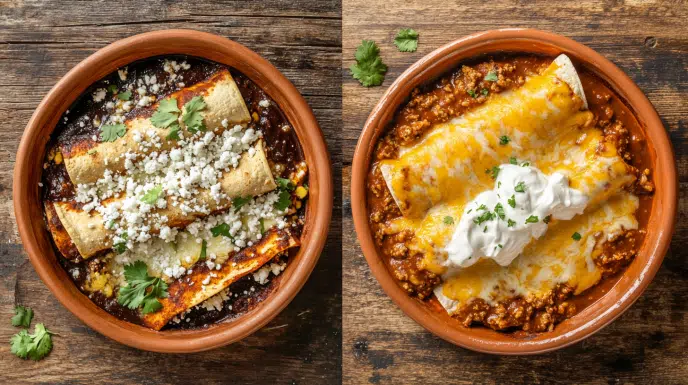
Tex-Mex uses enormous quantities of yellow melted cheese, typically cheddar, Monterey Jack, or processed cheese blends. Cheese features heavily in enchiladas, nachos, queso dip, and burritos.
Authentic Mexican cooking uses cheese much more sparingly and uses entirely different varieties, cotija (dry, crumbly, salty), queso fresco (soft, mild, fresh), queso Oaxaca (stringy, melting). Melted yellow cheese is not traditional in Mexican cuisine.
The flour tortilla question
Flour tortillas are central to Tex-Mex cooking, burritos, quesadillas, fajitas all use flour tortillas. Flour tortillas do exist in some regions of northern Mexico where wheat grew successfully, but they are not the foundation of Mexican cooking the way corn tortillas are.
Traditional Mexican cooking is built almost entirely on corn tortillas, made from nixtamalized masa, pressed thin, cooked on a dry comal. If a dish uses a flour tortilla in central or southern Mexico, it is almost certainly a regional variation or a modern adaptation.
Cumin and chili powder
Tex-Mex cooking uses cumin heavily and relies on commercial chili powder blends as a primary seasoning, a blend that typically contains cumin, dried chile, garlic powder, and other spices.
Mexican cooking uses cumin but in smaller quantities, and seasons with individual whole or dried chiles rather than a pre-mixed powder. The complexity of flavor in authentic Mexican cooking comes from the specific combination of different dried chile varieties, each contributing something distinct, rather than from a single blended spice.
The chile vocabulary
This is the biggest flavor difference of all. Mexican cooking has an enormous vocabulary of dried chiles, ancho, guajillo, mulato, pasilla, chilhuacle, árbol, cascabel, each used for specific purposes and specific dishes. See the full Mexican pantry guide for the complete breakdown.
Tex-Mex cooking simplifies this dramatically, using primarily jalapeños for heat and commercial chili powder for flavor, which produces a recognizably good but fundamentally different flavor profile.
The dishes themselves
Some dishes that Americans associate with Mexican food are actually Tex-Mex inventions or adaptations:
Nachos, invented in Piedras Negras, Mexico in 1943, but developed into the stadium-food version in the US Chili con carne, definitively Tex-Mex, not found in traditional Mexican cooking The crunchy taco shell, a commercial American invention Chimichangas, disputed origin but definitively a Tex-Mex/Southwestern American dish Fajitas, originated with Mexican ranch workers in Texas, developed into restaurant-style by Tex-Mex chefs
Genuinely Mexican dishes that are rarely seen in American Tex-Mex restaurants: Mole negro, mole verde, mole amarillo Chiles en nogada Cochinita pibil Pozole Tlayudas Regional tamale varieties
What They Actually Share: Because It Is Significant
I want to be careful not to draw the line so sharply that it obscures the genuine connections between these two food traditions.
Both are built on corn and chiles and beans and the flavor logic of Mesoamerican cooking. Both use many of the same ingredients. Both reflect the food culture of a border region where two culinary traditions have been in conversation for centuries. The best Tex-Mex cooking, the real stuff, not the chain restaurant version, is made by people who understand Mexican culinary tradition deeply and have adapted it intelligently for a specific place and community.
The problem is not Tex-Mex itself. The problem is when Tex-Mex restaurant food gets presented as representative of Mexican cuisine, which does a disservice to both traditions. It tells Americans that Mexican food is simpler than it is. And it erases the specificity and depth of what Mexican cooking actually is.
Why This Distinction Matters for Home Cooks
Here is the practical reason this matters if you are learning to cook Mexican food at home.
If you approach Mexican cooking through a Tex-Mex framework, expecting yellow melted cheese, flour tortillas, heavy cumin seasoning, mild flavors, you will be consistently surprised and confused by authentic Mexican recipes. The flavor logic is different. The ingredients are different. The techniques are different.
Understanding that these are two distinct cuisines means you can appreciate each on its own terms. You can make an excellent Tex-Mex queso dip for game day and an authentic mole negro for a Sunday dinner party and feel good about both, without confusing one for the other.
Both are real. Both are good. They are just not the same thing.
Where to Start With Authentic Mexican Cooking
If this article has made you want to explore authentic Mexican cuisine properly, start with the complete Mexican recipes collection. My recommendations for where to begin:
The corn tortillas recipe, because understanding masa is the foundation of everything. The Mexican street food recipes, because tacos al pastor and elote are the most joyful entry point into the cuisine. And eventually, when you’re ready for the most ambitious and rewarding Mexican cooking project imaginable, the mole negro recipe.
That last one will change how you think about cooking entirely. It changed how I think about cooking. Dona Carmen did that.