
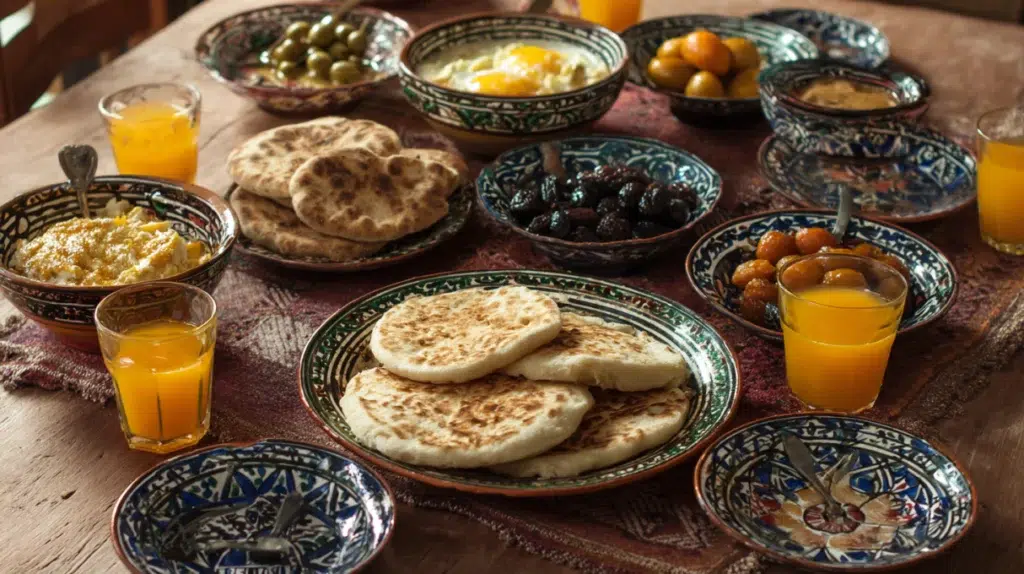
The first food I ever ate in Morocco was breakfast.
Not intentionally. I landed in Marrakesh late at night, got to my riad, collapsed into bed, and woke up the next morning to the smell of something frying on a griddle somewhere nearby, this warm, buttery, faintly spiced smell drifting through the open window that made my stomach do something urgent and insistent.
I followed my nose down to a small cart just outside the medina walls. A woman was making msemen, that folded, layered, griddle-fried flatbread that I would later learn is Morocco’s most beloved breakfast food, and she handed me one still steaming from the pan, folded around a smear of honey and argan oil.
I ate it standing on the street at seven in the morning, slightly jet-lagged, not entirely sure what country I was in yet. And it was, I’m going to say this plainly, one of the best things I have ever eaten in my life.
That moment is why Moroccan breakfast recipes holds such a specific place in my heart. And why I think it might be the most underrated meal in the entire Moroccan recipes collection. Everyone talks about the tagines, the couscous, the spice markets. Nobody talks about the breakfast. And y’all, the breakfast is something else entirely.
What Makes Moroccan Breakfast Different
Moroccan breakfast is not a quick meal. It is not grab-and-go. It is not something you eat standing over the kitchen sink before you rush out the door.
It is a spread. A ritual. A slow, generous, warm thing that happens around a low table with mint tea poured from height into small glasses, and multiple dishes, breads, dips, honey, butter, argan oil, jam, olives, arranged around the center. You sit down. You stay a while. The tea gets refilled. Someone passes you more bread before you’ve finished what’s already on your plate.
In Morocco this happens every single morning. Not just on weekends. Every day.
I can’t recreate the full Moroccan breakfast experience in Nashville on a Tuesday, I have things to do, same as everyone else. But on a Saturday or Sunday morning, when I have nowhere to be? This is what I make. And it makes the whole weekend feel different. Better. More like a choice and less like something that’s just happening to me.
Let me walk you through everything.
The Moroccan Breakfast Table: What Goes On It
A proper Moroccan breakfast spread typically includes:
- Breads, msemen, baghrir, harcha, or khobz (or some combination of all of them)
- Honey, ideally good quality raw honey, drizzled generously.
- Argan oil, for dipping bread, mixed with honey as amlou (more on this below) Butter, real butter, soft, plenty of it.
- Jam, fig jam, orange jam, or whatever’s good.
- Olives, yes, olives at breakfast. Morocco does this. It is correct.
- Cheese, a soft fresh cheese or a mild spreadable kind.
- Hard boiled eggs, sometimes, not always.
- Mint tea, always. Non-negotiable. The whole table waits for the tea.
You do not need to make all of this every time. Two or three breads, tea, honey, butter, and argan oil is already a magnificent Moroccan breakfast. Start there and build from it.
The Moroccan Breakfast Recipes: Everything You Need
Msemen: The Layered Moroccan Flatbread
This is the one. The bread that started everything for me.
Msemen is a square, folded, griddle-fried flatbread made from a combination of fine semolina and all-purpose flour. The dough is rolled thin, brushed with melted butter and oil, folded into a square packet, then flattened again and cooked on a dry griddle until golden and crispy on the outside with those characteristic flaky, pull-apart layers inside.
The technique sounds fiddly the first time you read it. It is a little fiddly. But, and I say this as someone who burned her first three batches and whose fourth batch came out completely flat, once you get it, you really get it. The muscle memory clicks into place and after that you can make msemen almost without thinking.
The smell when it hits the dry pan… I cannot describe it. Warm and buttery and slightly toasty. It smells like somewhere you want to be.
How to eat it: Drizzled with honey and argan oil is the classic. Or spread with butter and jam. Or, and this is my personal favorite at eleven o’clock on a Saturday morning, folded around a smear of amlou (that almond-argan-honey paste I’m about to tell you about) and eaten slowly with a glass of mint tea.
Key ingredients: fine semolina, all-purpose flour, salt, warm water, melted butter, vegetable oil Time: 1 hour including resting | Difficulty: Medium, technique takes practice
Baghrir: The Thousand-Hole Pancake
Oh, baghrir. Where do I even begin.
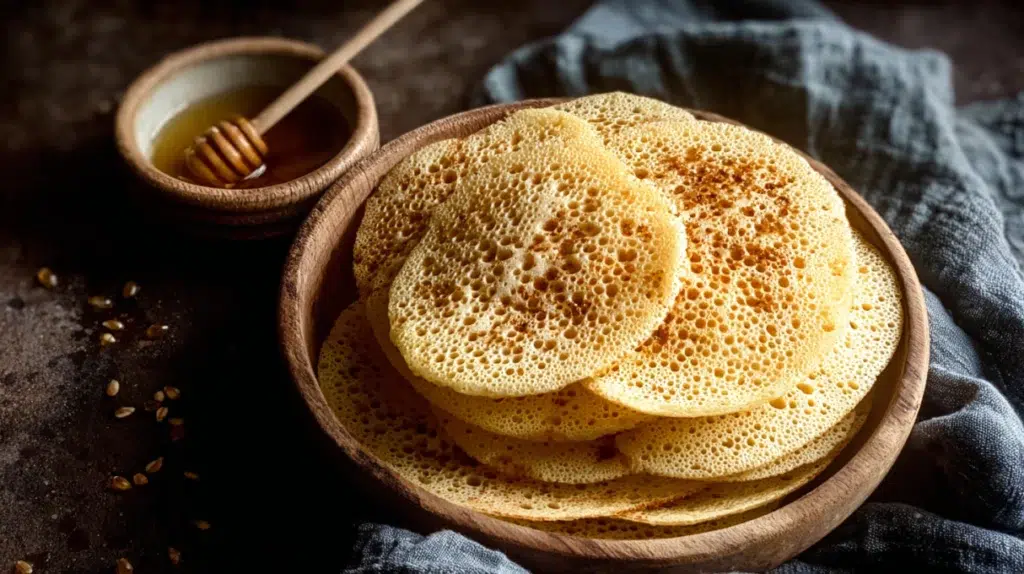
Baghrir is a Moroccan pancake made from fine semolina and yeast that, when cooked correctly, develops hundreds of tiny holes across its surface, like a crumpet had a very elegant Moroccan cousin. People actually call it the thousand-hole pancake. It is a completely accurate description and also a beautiful one.
Here’s the thing about baghrir that makes it unlike any pancake you’ve made before: you only cook it on one side. You pour the batter into a pan, the holes form as it cooks, and when the surface is set and the holes are open and dry, it’s done. You don’t flip it. The bottom is golden, the top is spongy and porous, and that porous surface is specifically designed to absorb whatever you pour over it.
Which should be honey and butter, melted together. Drizzled over the top. Soaking into every single one of those thousand holes.
I don’t usually get emotional about breakfast food but the first time I made baghrir correctly in my Nashville kitchen, those holes forming right in front of me, exactly like they were supposed to, I may have done a small victory lap around my kitchen island.
Key ingredients: fine semolina, all-purpose flour, yeast, baking powder, salt, warm water Time: 45 minutes including resting | Difficulty: Easy once you get the batter right Note: The batter should be thin, thinner than you think. If your baghrir isn’t forming holes, add a splash more water.
Harcha: Moroccan Semolina Flatbread
Harcha is simpler than msemen, no folding, no layering, no technique to master. It’s a thick, crumbly semolina flatbread with a golden crust and a soft, slightly grainy interior that’s completely different in texture from any other bread on this list.
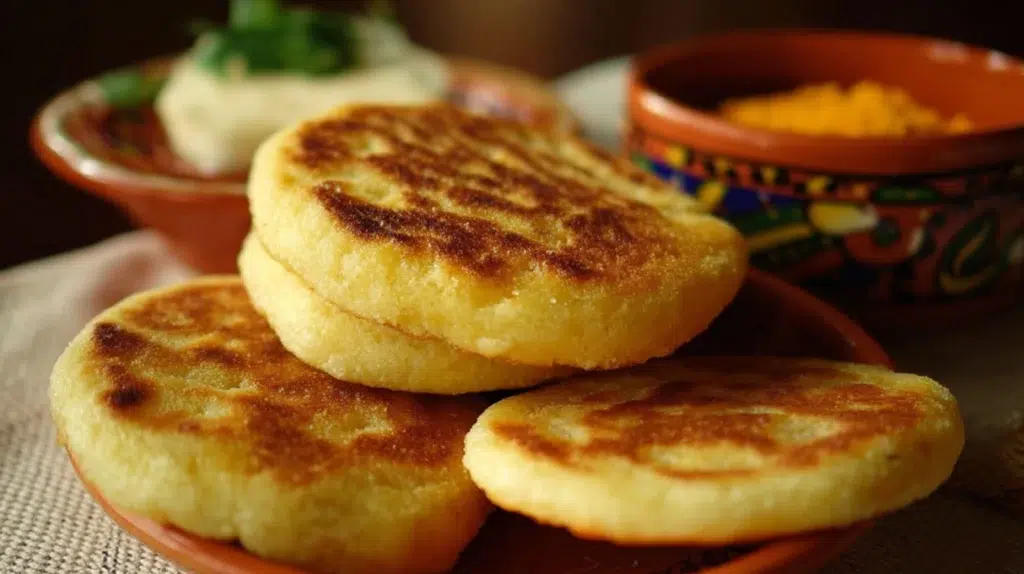
It comes together in about 20 minutes total. You mix the dough, shape it into rounds, and cook it in a dry pan like a very thick pancake. That’s it. The result is this dense, satisfying bread that eats almost like a biscuit, which makes sense because harcha occupies the same cultural space in Morocco that biscuits occupy in the American South. Morning bread. Comfort bread. The thing you make when you want something fast and warming.
Eat it with butter and honey or dip it in olive oil. It’s very good either way.
Key ingredients: fine semolina, butter, milk, baking powder, salt, sugar Time: 20 minutes | Difficulty: Very easy
Amlou: Moroccan Almond Butter with Argan Oil and Honey
Amlou is not technically a bread, it’s a dip, a spread, a condiment, but it belongs on every Moroccan breakfast table and I refuse to write this post without talking about it.
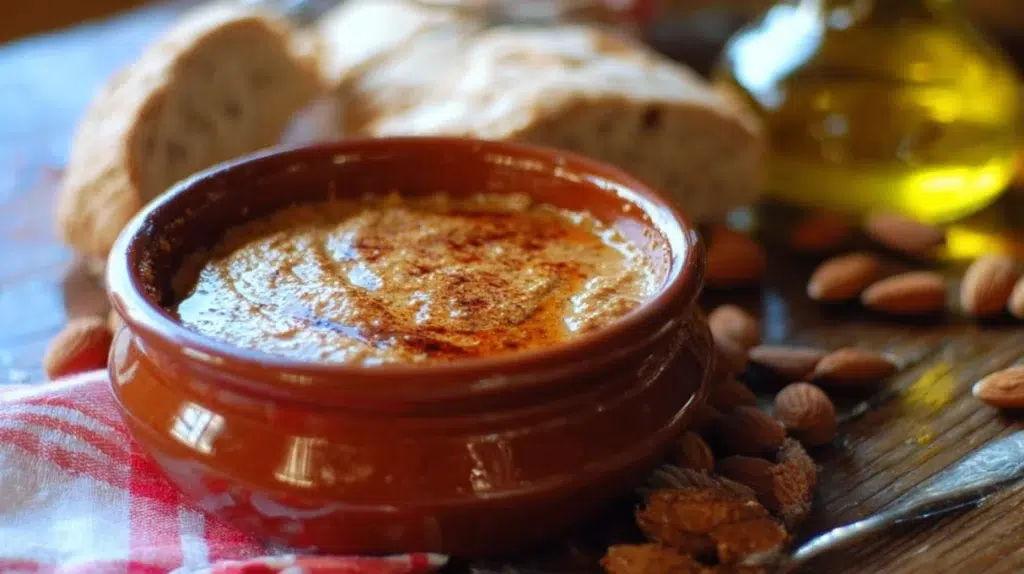
It’s made from toasted almonds blended with argan oil and honey until you get something with the consistency of peanut butter but a flavor that’s… more complex. Nuttier. Warmer. Slightly smoky from the toasted almonds, floral from the argan oil, sweet from the honey. It’s traditionally served as a dip for msemen or harcha.
Argan oil is available at Whole Foods and online, it has a distinctive nutty, slightly smoky flavor that cannot be substituted. If you genuinely can’t find it, good toasted sesame oil is the closest alternative in terms of nuttiness, though the flavor is different.
Key ingredients: blanched almonds, argan oil, honey, pinch of salt Time: 15 minutes | Difficulty: Laughably easy
Moroccan Mint Tea: The Soul of the Breakfast Table
Everything else on this table is negotiable. The mint tea is not.
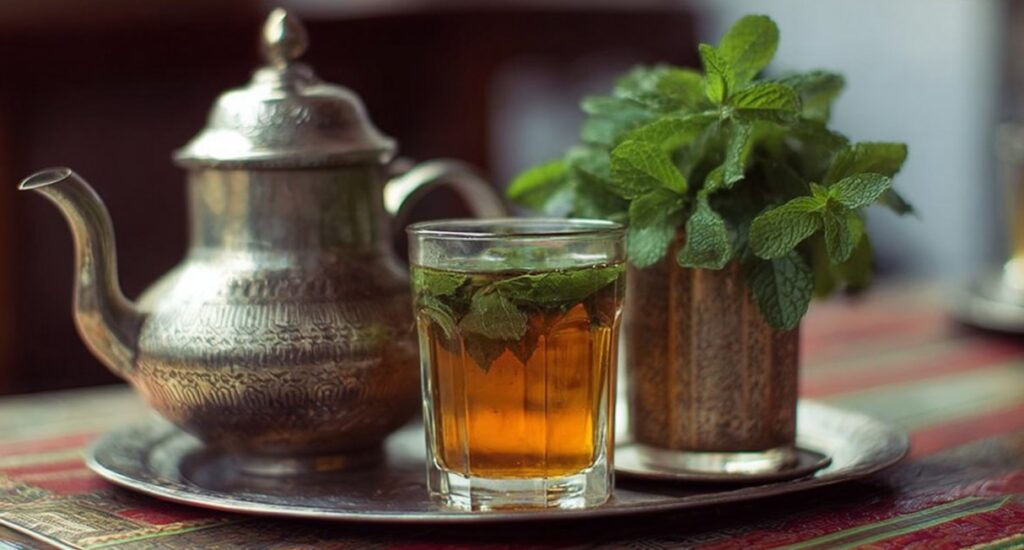
Moroccan mint tea is made from Chinese gunpowder green tea, that specific variety, not just any green tea, brewed strong, sweetened generously with sugar, and packed with fresh spearmint leaves. It is poured from height, the server lifting the teapot high above the glass and pouring in a thin stream to create foam, which aerates the tea and changes the texture in a way that’s genuinely noticeable.
The sugar is traditional and not small. I know that’s a lot for some people. You can adjust it to your taste in your own kitchen, just know that less sugar changes the experience noticeably. In Morocco, sweet tea is the point.
How to make it properly:
Rinse the teapot with boiling water to warm it. Add 2 teaspoons of gunpowder green tea. Pour in a small amount of boiling water, swirl, and discard, this rinses the tea leaves and removes any bitterness. Add a large handful of fresh spearmint sprigs, stems and all. Add sugar to taste, starting with 2-3 tablespoons for a pot that serves four. Pour in 4 cups of boiling water. Let steep for 3-4 minutes. Pour into one glass and back into the pot twice, this mixes the tea and checks the flavor. Adjust sugar if needed. Pour from height into small tea glasses.
That’s it. That’s the whole thing. But do it with care and it produces something completely different from tea-bag-in-a-mug. The mint is bright and cool against the warmth of the tea. The foam from the high pour sits on top and slowly dissolves. It is, as I’ve said about several things in Moroccan food, not quite like anything else.
Key ingredients: Chinese gunpowder green tea, fresh spearmint, sugar, boiling water Time: 10 minutes | Difficulty: Very easy
How to Build a Moroccan Breakfast at Home: My Suggestions
If you’re making this for the first time and you want to keep it manageable, here’s exactly how I’d approach it:
Easiest version (30 minutes total): Make harcha, it’s the fastest bread on this list. Make the mint tea. Put out honey, butter, and good jam. Done. This is already a beautiful breakfast.
Weekend version (1.5 hours, completely worth it): Make baghrir and msemen, they have different textures and flavors and work beautifully together. Make a batch of amlou. Make the mint tea. Add olives, soft cheese, and hard-boiled eggs to the table. This is the full spread. This is the experience.
The full production (if you really want to go there): All of the above plus khobz, the round Moroccan bread that’s a whole separate recipe I’ll be publishing soon. This is a proper Moroccan breakfast in the fullest sense and it will make everyone at your table very happy and slightly unable to move afterward.
A Note on Slow Mornings
I want to say one more thing before I send you off to cook.
Moroccan breakfast is not just about the food. It’s about the pace. The deliberateness. The fact that this is a culture that decided, collectively, that the morning meal deserves time and care and real ingredients and a pot of tea that takes ten minutes to make properly.
I think about that sometimes when I’m rushing through breakfast in Nashville, eating standing up, staring at my phone, technically consuming calories but not really experiencing anything. And then I remember that harcha takes twenty minutes and baghrir takes forty-five and the tea takes ten and none of that is wasted time.
It’s just breakfast. Done right.
Head back to the complete Moroccan recipes collection when you’re ready for more, or dive into the authentic Moroccan couscous for the Friday meal that follows the same slow, generous spirit as this breakfast. And if you’re just building your Moroccan pantry, start with the Moroccan spice guide, most of what you need for these recipes is already there.
More from the Moroccan Recipes Collection: