
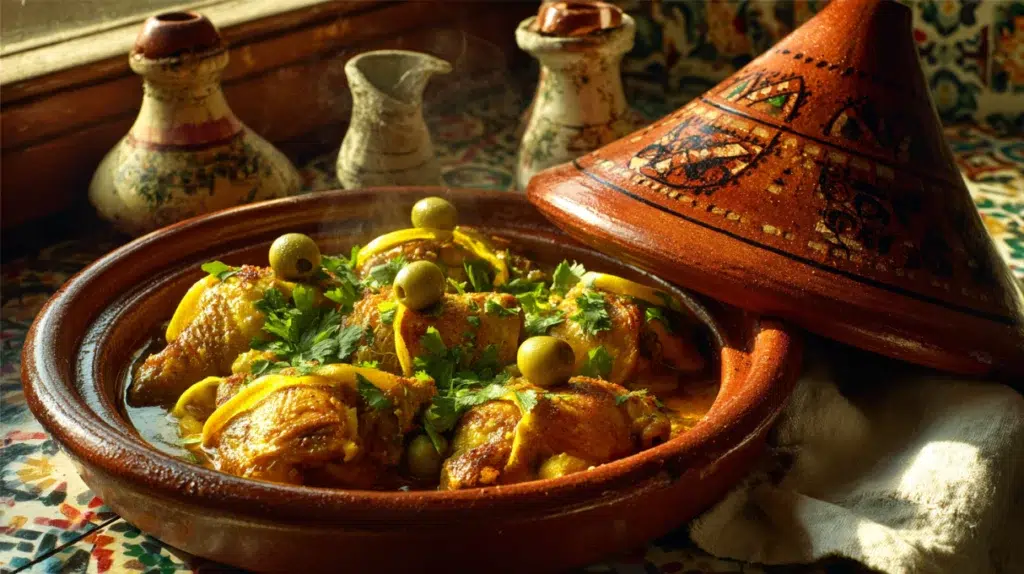
Moroccan chicken tagine is the recipe that started it all for me. Not just on this site, I mean in my life.
It was my third day in Marrakesh. I’d already wandered the souks twice, gotten completely lost in the medina (twice), and eaten my weight in msemen off a street griddle. But nothing, nothing, had prepared me for sitting down to a proper Moroccan chicken tagine in a family home outside the city, watching the host lift the cone-shaped lid off the clay pot and release a cloud of saffron-scented steam that hit me somewhere in the chest and just… stayed there.
That smell. I can’t describe it except to say it smelled like somewhere I wanted to be forever.
I’ve been chasing that moment in my Nashville kitchen ever since. And after three years and more attempts than I’m going to admit here, I think this version, adapted for a regular US home kitchen, tested an embarrassing number of times, is as close as I’ve gotten.
This is part of my full Moroccan recipes collection here on RecipeWorldly. If you’re new to Moroccan cooking, start there, I cover all the essential spices, the pantry basics, and why Moroccan food is genuinely one of the most rewarding cuisines you can learn to cook at home.
But if you’re ready to just make the tagine? Let’s go.
Why This Moroccan Chicken Tagine Recipe Works
Okay so I want to explain a few things before we get into the method, because this recipe has some specific elements that confuse people the first time and I’d rather you understand why before you’re standing at the stove second-guessing yourself.
The preserved lemons aren’t optional. I know they sound exotic and maybe a little scary to source, but they are the soul of this dish. That sharp, intensely salty-citrusy flavor they add is completely irreplaceable, regular lemon juice is not a substitute, lemon zest is not a substitute, nothing is a substitute. You can find preserved lemons at Whole Foods, at Middle Eastern grocery stores, or on Amazon. Or make your own, it takes 10 minutes and three weeks of waiting and they last for months in your fridge. Worth it. Every time.
The saffron matters too. I know it’s expensive. I know. But we’re talking about 8-10 threads, a tiny pinch, for the whole dish. A small jar of saffron lasts a very long time if you use it this way. And what it does to the broth, that deep golden color, that floral warmth, you just can’t fake it. I’ve tried. It doesn’t work.
You do not need a tagine pot. I cook this in my Le Creuset Dutch oven every single time. A heavy-bottomed pot with a tight lid is all you need. The technique is what matters, not the vessel. I wrote a whole guide on tagine pot substitutes if you want the full breakdown, but the short answer is: use what you have.
Low and slow is the only speed. This is a two-hour dish. An hour and forty-five minutes of that is the pot sitting on your stove doing its thing while you do yours. The active cooking time is maybe 25 minutes. Don’t rush the simmer. Don’t crank the heat when you’re impatient (I’ve done this, the chicken gets tough and the sauce breaks and you end up sad). Trust the process.
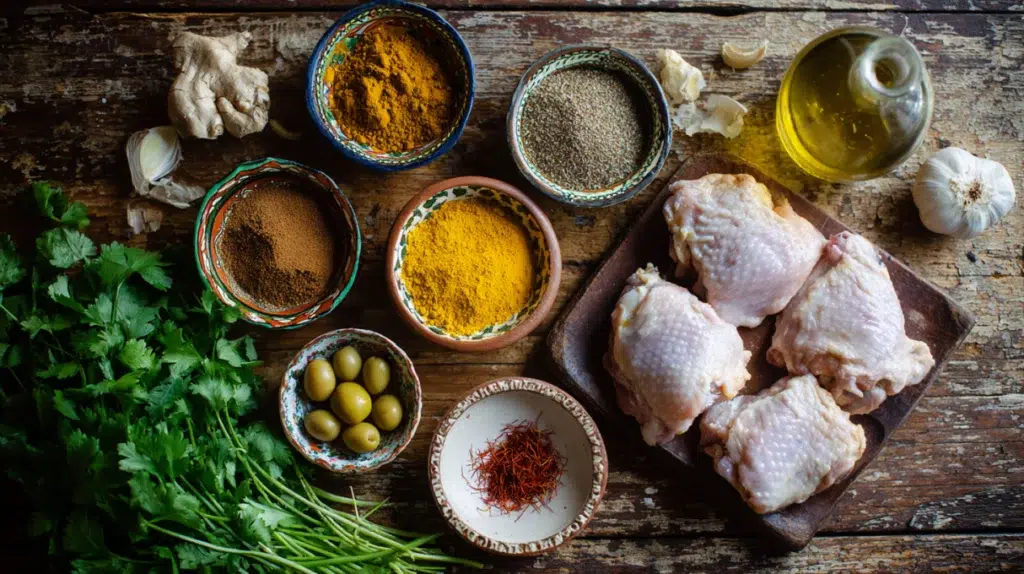
Ingredients Needed For Moroccan Chicken Tagine
Serves 4-6 | Prep time: 20 minutes | Cook time: 1 hour 45 minutes | Total: ~2 hours
For the chicken marinade:
- 1.5 kg (about 3.3 lbs) bone-in, skin-on chicken pieces, thighs and drumsticks work best
- 3 cloves garlic, minced
- 2 tablespoons olive oil
- 1 teaspoon ground cumin
- 1 teaspoon ground ginger
- 1 teaspoon sweet paprika
- ½ teaspoon ground turmeric
- ½ teaspoon ground cinnamon
- ½ teaspoon black pepper
- 1 teaspoon salt
- Small handful fresh cilantro, roughly chopped
- Small handful fresh flat-leaf parsley, roughly chopped
For the tagine:
- 2 tablespoons olive oil
- 2 medium onions, thinly sliced
- 4 cloves garlic, minced
- 1 preserved lemon, rinse it, discard the pulp, slice the rind into thin strips
- 1 cup (240ml) chicken stock
- ½ cup (120ml) water
- 8-10 saffron threads, crumbled into 2 tablespoons warm water
- 1 cup (about 150g) green olives, pitted, Castelvetrano or any good quality green olive
- 1 tablespoon honey
- Salt and black pepper to taste
To serve:
- Fresh cilantro and flat-leaf parsley
- Crusty bread
- Lemon wedges on the side
How to Make Moroccan Chicken Tagine: Step by Step
Step 1: Marinate the Chicken (ideally overnight, minimum 2 hours)
Combine all the marinade ingredients in a large bowl and mix until you have a thick, fragrant paste. Add the chicken pieces and get in there with your hands, really coat every surface, get under the skin where you can. This isn’t a delicate operation. Cover the bowl, put it in the fridge, and let it sit.
Overnight is ideal. Genuinely. The difference between two-hour marinated chicken and overnight marinated chicken in this dish is significant, you can taste the spices all the way through the meat rather than just on the surface. But if you’re making this on a weeknight and two hours is all you have, it still works. I’ve done it both ways plenty of times.
Step 2: Build the Base (20 minutes)
Heat 2 tablespoons of olive oil in your Dutch oven (or tagine pot if you have one) over medium heat. Add the sliced onions and cook, stirring occasionally, for about 15 minutes until they’re soft, golden, and starting to caramelize at the edges. Don’t rush this. Soft, sweet onions are the foundation of the sauce, they dissolve into the broth and give it body and depth. Hard, barely-cooked onions are a missed opportunity.
Add the minced garlic and cook for another 2 minutes, stirring, until fragrant. Your kitchen should smell absolutely amazing right now. If it doesn’t, check your spices. Old, stale spices are the number one reason Moroccan food falls flat for home cooks.
Step 3: Brown the Chicken (10 minutes)
Push the onions to the edges of the pot and increase the heat to medium-high. Add the marinated chicken pieces skin-side down and sear for 3-4 minutes without moving them, until the skin is golden brown. Flip and sear the other side for another 2-3 minutes.
You’re not cooking the chicken through here, you’re building flavor. That golden crust on the outside is going to enrich the entire sauce. Don’t skip this step. I skipped it once when I was in a hurry and the whole dish was noticeably less good. Lesson learned.
Step 4: Add the Liquid and Aromatics (5 minutes)
Reduce the heat back to medium-low. Add the chicken stock, water, and the saffron-infused warm water. Stir to combine, scraping up any browned bits from the bottom of the pot, those bits are gold, flavor-wise. Add the preserved lemon rind strips and the honey. Give everything a gentle stir.
The liquid should come about halfway up the chicken pieces. Not covering them completely, you want braising, not boiling.
Step 5: The Long Simmer (1 hour 30 minutes)
Put the lid on. Reduce to the lowest heat that maintains a gentle simmer, you should see small bubbles breaking the surface occasionally, not a rolling boil. Walk away.
Seriously. Walk away. Do something else. Watch something. Call someone. Come back in 45 minutes, add the olives, put the lid back on, and walk away again for another 45 minutes.
At the 1 hour 30 minute mark, remove the lid. The sauce should have reduced and thickened slightly. The chicken should be completely tender, it should be pulling away from the bone at the slightest touch. If it’s not there yet, put the lid back on and give it another 15-20 minutes.
Step 6: Taste, Adjust, Serve
Taste the sauce. Adjust salt if needed. If the sauce feels too thin, increase the heat to medium and simmer uncovered for 5-10 minutes until it reduces to your liking. If it seems too concentrated, add a splash of water or stock.
Serve directly from the pot if you’re going for the full Moroccan communal experience, which I highly recommend. Scatter fresh cilantro and parsley over the top. Put lemon wedges alongside. Have lots of crusty bread or a pile of couscous ready.
And then sit back and wait for the silence. The good kind.
Claire’s Notes: Things I Learned the Hard Way
On the chicken cuts: Bone-in, skin-on thighs and drumsticks are the move here. Boneless chicken breast will dry out and get rubbery over that long cook time. I’ve tried it. It’s not great. Stick with dark meat on the bone.
On the olives: Quality matters more than you’d think. Cheap canned olives can turn bitter and metallic after a long braise. Spend a little more on good Castelvetrano or Picholine olives and you’ll notice the difference. They should be added in the last 45 minutes, not from the beginning, or they’ll go mushy.
On the preserved lemons: Only use the rind, not the pulp. The pulp is intensely salty and can overwhelm the dish. Rinse the rind well before slicing.
On making it ahead: This dish is genuinely better the next day. I make it the night before when I’m serving it for guests. The flavors deepen overnight in a way that’s almost unfair. Reheat gently on the stove with a splash of water if needed.
On the saffron: Crumble the threads into warm (not boiling) water and let them steep for at least 5 minutes before adding to the pot. This blooming technique is recommended by food scientists as the most effective way to extract saffron’s color and flavor compounds before cooking.
What to Serve with Moroccan Chicken Tagine
Couscous is the traditional accompaniment, specifically the steamed-twice kind that’s a whole beautiful production on its own. I have a full authentic Moroccan couscous recipe that’s worth making when you have the time.
For a weeknight, the quickest option is the box couscous, just pour boiling salted water over it, let it sit for 5 minutes, fluff with a fork, add a knob of butter and a pinch of cinnamon. Not traditional but it works and it’s ready in 8 minutes.
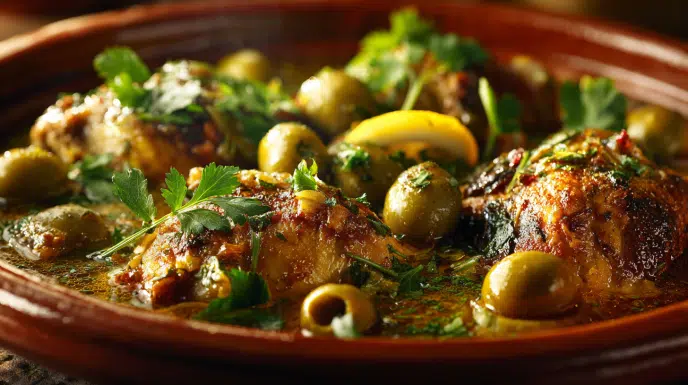
Crusty bread also works beautifully, use it to scoop up the sauce. That’s very much the Moroccan way.
A simple tomato and cucumber salad dressed with olive oil, cumin, and a splash of lemon juice alongside keeps things fresh and cuts through the richness of the tagine.
Frequently Asked Questions
Can I make this in a slow cooker?
Yes, with one adjustment, still do steps 1-3 on the stovetop (the searing and the onion base are important and can’t be done in a slow cooker). Then transfer everything to the slow cooker and cook on low for 6-8 hours or high for 3-4 hours. Add the olives in the last hour.
Can I use chicken breast instead of thighs?
Technically yes, but I’d strongly advise against it. Chicken breast dries out badly over the long cook time. If breast is what you have, reduce the cook time to about 45 minutes and keep a close eye on it. Thighs are the right call for this dish.
Where do I find preserved lemons?
Whole Foods, World Market, Middle Eastern grocery stores, or Amazon. Or make your own, I’ll be publishing a guide to this soon.
Can I freeze this?
Yes, beautifully. Freeze in portions without the fresh herb garnish. Defrost in the fridge overnight and reheat gently. I’d add a squeeze of fresh lemon when reheating to brighten it back up.
How spicy is this?
Not spicy at all in the heat sense. Moroccan tagines are warmly spiced (cumin, cinnamon, ginger) but not hot-spicy. If you want heat, serve harissa paste on the side and let people add their own.
The Full Moroccan Recipes Collection
This chicken tagine is just the beginning. Head back to the complete Moroccan recipes guide to explore everything, from the spice guide that’ll transform your pantry to the breakfast recipes that’ll change your weekend mornings forever.
Other recipes and guides you might love:
- Complete Moroccan Spice Guide: Ras el Hanout and Everything You Need
- Authentic Moroccan Couscous: The Friday Meal
- Do You Need a Tagine Pot? Honest Substitutes Guide
- Moroccan Breakfast Recipes: Msemen, Baghrir & Mint Tea