A risotto recipe is not hard to follow. Risotto itself, done properly, done patiently, done with the attention it requires, is one of the most satisfying things you can cook in a kitchen.
The gap between these two statements is where most home cooks get into trouble. They follow the recipe. The risotto is fine. It is not what it could be, not the flowing, creamy, intensely flavored result that a bowl of risotto in Milan or Verona produces. The difference is almost never the ingredients. It is the time spent at the stove, the attention given to the rice, and one final step, the mantecatura, that most home cooks either skip or do not know to include.
This guide covers all of it. The rice, the technique, three classic recipes, and the mantecatura, because without the mantecatura you have made something good and not something extraordinary.
This is part of the Italian recipes collection, northern Italy in particular, where rice has been grown and cooked for centuries and where risotto was developed into the sophisticated, specific dish it is today.
What Risotto Is? And Why It Is Northern Italian Specifically
Risotto is a traditional staple of northern Italian cuisine, developed in the Po Valley where the Moors introduced rice cultivation in the medieval era. The great fertile plain of the Po River, running through Turin, Milan, Cremona, and Ferrara, created the ideal conditions for rice cultivation: flat land, abundant water, mild climate. By the medieval period each city along the Po had developed its own regional style of rice cooking, and the Milanese version eventually became the template for what the world now calls risotto.
The technique is entirely different from all other rice cooking traditions. In pilaf, boiling water or stock is added all at once and the rice steams undisturbed. In risotto, hot stock is added one ladle at a time and the rice is stirred constantly, this constant agitation releases the surface starch from the rice grains into the liquid, creating the characteristic creamy consistency without any added cream. The creaminess is structural, not added.
This is why the specific rice variety matters: Arborio, Carnaroli, and Vialone Nano are the three traditional Po Valley varieties. All three have a high surface starch content that releases during cooking while the interior of each grain remains distinct and slightly firm. Long-grain rice, jasmine rice, or basmati do not work, they lack the right starch composition. Short-grain Japanese rice works as an emergency substitute but produces a different flavor profile.
The Five Stages of Risotto: Know These Before You Start
Every risotto, regardless of the specific recipe, follows the same five stages. Understanding them before you cook makes the process significantly less stressful.
Stage 1: The soffritto: Finely diced onion (sometimes shallot) cooked very slowly in butter until completely soft, translucent, and sweet, but never browned. The soffritto is the flavor foundation. If it browns, the risotto will have a different character. Low heat, 8-10 minutes minimum.
Stage 2: The tostatura: The dry rice added to the soffritto and toasted briefly, 2-3 minutes, stirring, until the edges of the grains become slightly translucent and the rice smells faintly nutty. This toasting step sets the structure of each grain and helps it absorb liquid evenly rather than becoming mushy on the outside before the interior is cooked.
Stage 3: The sfumatura: White wine (or vermouth) added to the toasted rice and stirred until fully absorbed before the first ladle of stock is added. The wine adds acidity and depth. Do not skip it, the difference is noticeable.
Stage 4: The cottura: The main cooking stage. Hot stock added one ladle at a time, each addition absorbed before the next goes in. Constant or near-constant stirring. Medium heat throughout, not too high (the stock evaporates before it can be absorbed), not too low (the rice steams unevenly). This stage takes 16-20 minutes depending on the rice variety. Taste frequently from the 15-minute mark.
Stage 5: The mantecatura: The final stage, the most important, the one most often skipped. Remove the pan completely from heat. Add cold butter cut into small cubes and grated Parmigiano. Beat vigorously, shaking the pan in a circular motion and using a wooden spoon simultaneously, for 60-90 seconds until the butter and cheese are fully incorporated and the risotto flows in waves when the pan is tilted. This is all’onda, like a wave. This is the correct consistency. Without mantecatura the risotto is stiff and clumpy. With it, the risotto is silky, flowing, and alive.
Rest the risotto covered for 1-2 minutes before serving. It will continue to tighten slightly, serve it when it flows slowly off the spoon.
The Three Essential Risottos
Risotto alla Milanese: Saffron and Bone Marrow
The original, the most famous, the one most closely tied to Milanese identity. Golden yellow from saffron. Rich from bone marrow dissolved into the soffritto. Deeply flavored from good beef or veal stock. Traditionally served alongside ossobuco, the braised veal shank that is Milan’s other great dish.
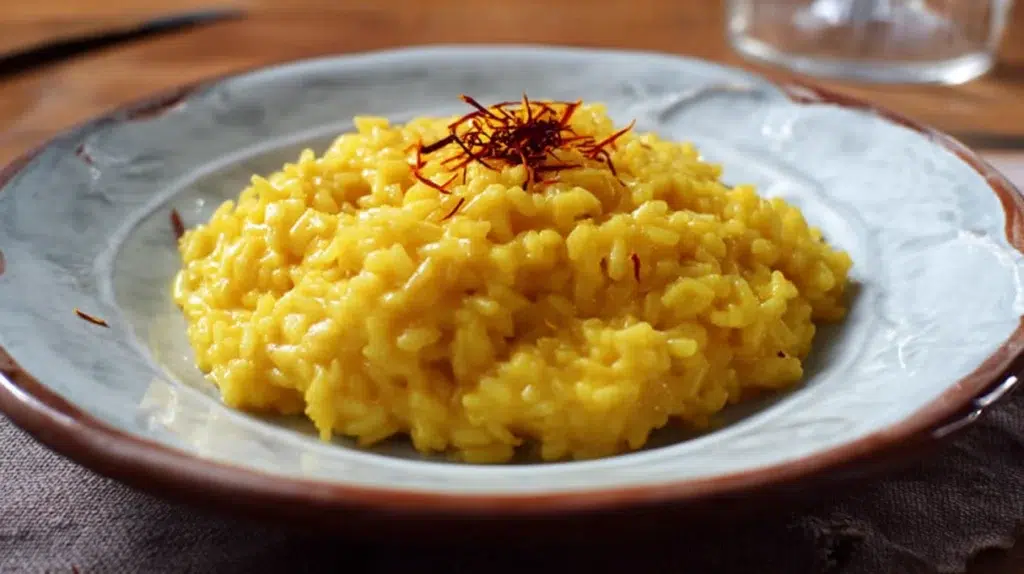
The saffron must be bloomed, steeped in a small amount of warm stock for 10-15 minutes before adding. This releases the color compounds and the flavor fully. Saffron added dry directly to the risotto produces uneven color and muted flavor.
Ingredients (serves 4)
- 320g (1⅔ cups) Carnaroli or Arborio rice
- 1 medium white onion, very finely diced
- 60g (4 tablespoons) unsalted butter, half for the soffritto, half for the mantecatura
- 80ml (⅓ cup) dry white wine
- 1.2 litres (5 cups) good beef or veal stock, kept at a gentle simmer in a separate pot
- ½ teaspoon saffron threads, bloomed in 3 tablespoons warm stock for 15 minutes
- 30g bone marrow, optional but traditional, ask your butcher
- 60g Parmigiano-Reggiano, finely grated
- Salt and white pepper
Method: Melt half the butter in a wide, heavy pan. Add the bone marrow if using and let it dissolve into the butter. Add the onion and cook over low heat 10 minutes. Add the rice and toast 2 minutes. Add the wine and stir until absorbed. Begin adding hot stock, one ladle at a time, stirring constantly. After 10 minutes, add the bloomed saffron with its liquid. Continue cooking and adding stock for 6-8 more minutes until the rice is al dente, tender but with a slight firmness at the center of each grain. Remove from heat. Mantecatura: beat in the cold butter and Parmigiano vigorously for 90 seconds. Rest 1-2 minutes. Serve immediately.
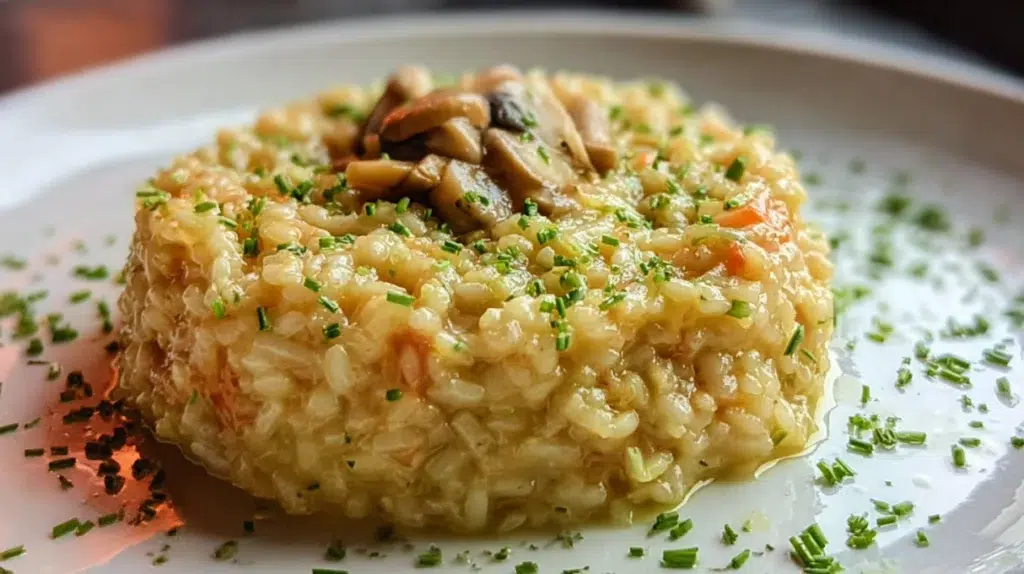
Risotto ai Funghi Porcini: Porcini Mushroom
The most universally loved risotto, deeply savory, woodsy, the dried porcini providing a concentrated mushroom intensity that fresh mushrooms alone cannot produce.
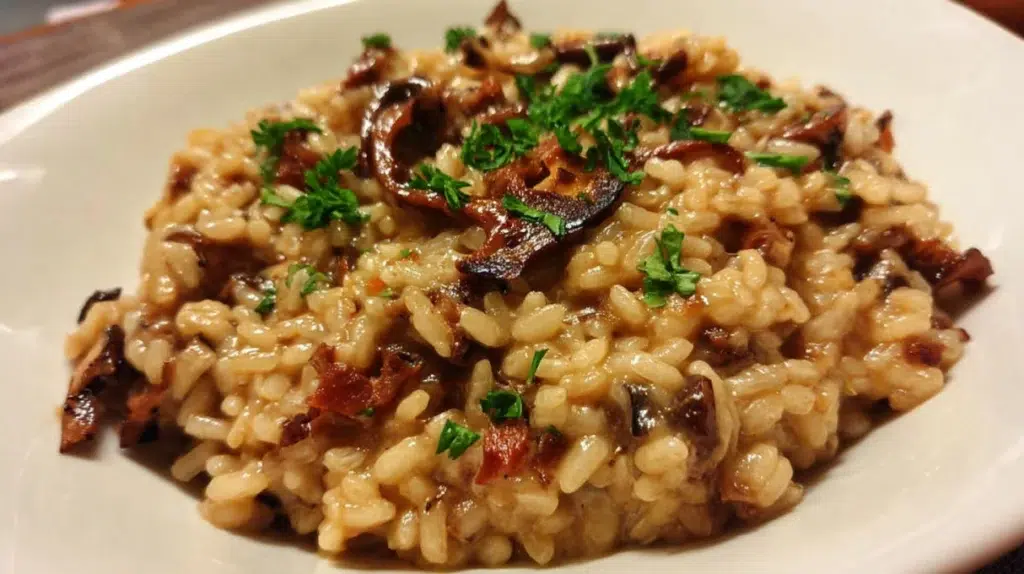
The technique here uses both dried porcini (for depth) and fresh mushrooms (for texture). The porcini soaking liquid, fragrant, dark, deeply flavored, is used as part of the stock, which carries the mushroom intensity through every grain of the risotto.
Ingredients (serves 4)
- 320g Arborio or Carnaroli rice
- 25g dried porcini mushrooms, soaked in 300ml warm water for 30 minutes, soaking liquid reserved
- 300g fresh cremini or mixed mushrooms, sliced
- 1 medium shallot, very finely diced
- 2 cloves garlic, minced, risotto ai funghi is one of the few risottos where garlic is appropriate
- 60g butter, split
- 80ml dry white wine
- 1 litre good vegetable or chicken stock, kept hot
- 60g Parmigiano-Reggiano, grated
- Fresh flat-leaf parsley, chopped, for serving
- Salt and black pepper
Method: Squeeze the soaked porcini, roughly chop them. Strain the soaking liquid through a fine sieve or coffee filter to remove any grit, keep this liquid, it is gold. Sauté the fresh mushrooms in 20g butter over high heat until golden and any moisture has evaporated, 5-7 minutes. Set aside. In the same pan, melt another 20g butter. Cook the shallot 8 minutes until soft. Add the garlic, cook 1 minute. Add the rice, toast 2 minutes. Add wine, stir until absorbed. Begin adding the mushroom soaking liquid first, then the hot stock, ladle by ladle, stirring constantly. After 10 minutes, add the porcini and the sautéed fresh mushrooms. Continue until al dente, about 18 minutes total. Remove from heat. Mantecatura with remaining butter and Parmigiano. Finish with parsley.
Risotto Primavera: Spring Vegetables
The seasonal risotto, made differently depending on what is growing, what is at the market, what the week has produced. The version below is a spring guide; adapt it completely to what is freshest in your kitchen.
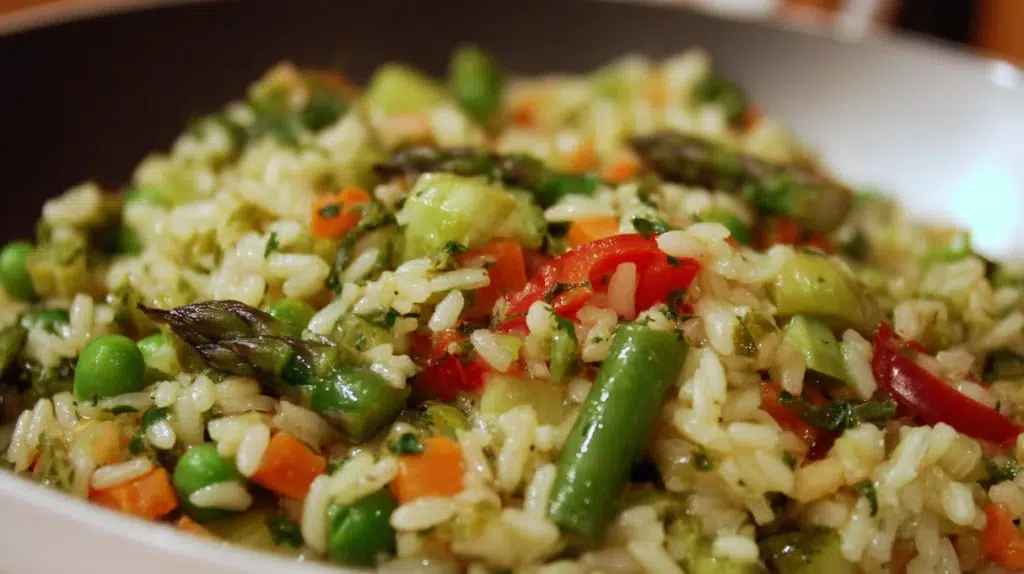
The principle: the vegetables are cooked separately and added at the end, not during the main cooking, so they retain their color and texture rather than turning grey and soft from the 18-minute cooking process.
Spring vegetables that work: Asparagus tips, fresh peas, broad beans, young courgette, pea shoots, fresh mint, baby spinach wilted in at the mantecatura stage.
Ingredients (serves 4)
- 320g Arborio rice
- 1 medium white onion, finely diced
- 60g butter, split
- 80ml dry white wine
- 1.2 litres light vegetable stock, kept hot
- 200g spring vegetables of your choice, blanched and refreshed
- 60g Parmigiano-Reggiano, grated
- Zest of ½ lemon, added at the mantecatura for brightness
- Fresh herbs, mint, parsley, basil
- Salt and white pepper
Method: Make the risotto base through Stage 4, soffritto, toast, wine, stock, without adding vegetables during cooking. The risotto should be plain and clean at this stage. Remove from heat. Add the blanched vegetables. Mantecatura with butter, Parmigiano, and lemon zest. The vegetables warm through in the residual heat. Finish with herbs.
The Equipment That Makes Risotto Easier
A wide, heavy pan or sauté pan, not a deep saucepan. The wide surface allows even evaporation of the stock and more efficient starch release from constant stirring. A 28-30cm sauté pan with straight sides is ideal.
A separate pot for the stock, kept at a bare simmer throughout. Cold stock added to hot risotto drops the temperature and disrupts the cooking. The stock must be hot.
A wooden spoon, for stirring and for the mantecatura. The wood is gentler on the rice grains than metal and less likely to break them.
Claire’s Notes
On the stock: The single biggest determinant of risotto quality after technique is stock quality. Good homemade or good-quality purchased stock produces a noticeably better result than stock cubes. If using stock cubes, dilute more than the packet suggests and taste for salt before starting.
On Carnaroli vs Arborio: Carnaroli is my preference. It has a slightly firmer interior and holds its structure better throughout the cooking process. Arborio is more forgiving for beginners, it releases starch more readily and produces a creamier result even with less precise technique.
On serving: Risotto waits for nobody. The moment it reaches all’onda consistency it begins to tighten as the starch continues to set. Serve immediately, in warm bowls, with the remaining Parmigiano at the table.
On leftovers: Leftover risotto becomes arancini, the Sicilian fried rice balls. Form cold risotto into balls, press a cube of mozzarella into the center, coat in breadcrumbs, fry in hot oil until golden. One of the best things you can do with day-old risotto.
FAQ About Risotto Recipe
Can I make risotto without wine?
Yes, replace with an equal amount of stock and add a small squeeze of lemon juice at the end for acidity. The result is slightly less complex but perfectly good.
Can I make risotto ahead?
Traditional chefs parcook risotto, stop after 12-13 minutes, spread on a tray to cool, refrigerate. Finish with the remaining stock and mantecatura to order. Works well for dinner parties. The technique is called risotto all’onda al momento.
Why is my risotto gluey?
Either too much stirring at too high heat (broke the grain structure), or you cooked it too long past al dente. The rice should have resistance, not hardness, at the center when done.
What does all’onda mean?
“Like a wave.” The correct consistency of a finished risotto, when you shake the pan gently, the risotto should flow in a slow wave rather than sitting as a solid mass. If it sits solid, it needs more stock. If it flows like soup, it needs another minute of cooking.
More From the Italian Recipes Collection:
- Authentic Italian Pasta Recipes: The Essential Six
- Italian Pizza Recipe: Neapolitan, Roman and the Home Version
- Italian Braised Meat: Ossobuco, Porchetta and More
- Italian vs French Food: The Honest Differences