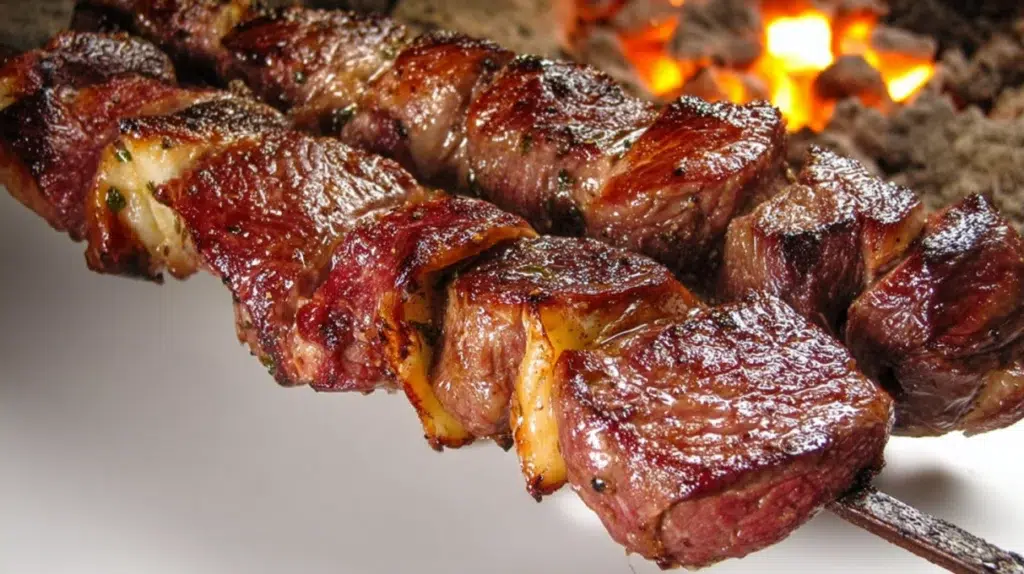
Brazilian churrasco is the most misunderstood grill tradition outside Brazil and the most imitated. Every Brazilian steakhouse (churrascaria) that has opened in the US, in Europe, in Asia, is built around the same principle: meat on skewers, carved at the table in an endless relay, seasoned with nothing but rock salt. What looks like simplicity from the outside is actually a deeply considered philosophy about the relationship between fire, fat and beef.
Understanding churrasco means understanding three things: why the cuts matter more here than in almost any other grill tradition, why rock salt and nothing else is the correct seasoning, and why the fire management, the height, the heat, the timing is where all the skill lives.
This is part of the Brazilian recipes collection, the outdoor cooking tradition that defines the culture of southern Brazil and has spread to every corner of the country and the world.
Where Churrasco Comes From
The gaucho, the nomadic horseman and cowhand of the South American Pampas is the cultural ancestor of Brazilian churrasco, a figure who subsisted largely on meat and whose cattle traditions in Rio Grande do Sul became the foundation of the churrascaria system. The gaucho’s method of cooking was elemental by necessity: a spit or a skewer, an open fire, rock salt from the land. Nothing else was available or needed. The meat was the event and the fire was the tool.
Cattle were of enormous cultural and economic importance across South America, stock raising flourishes particularly in eastern and southern Brazil, the heartland of the churrasco tradition. The cattle culture of Rio Grande do Sul, Brazil’s southernmost state, bordering Argentina and Uruguay produced both the finest beef in Brazil and the most developed live-fire cooking tradition in the country. From the gaucho campfire to the churrascaria dining room is a direct cultural line that has never been broken.
The churrascaria as a formal restaurant concept with the rodízio service, the espadas (swordsmen) carrying skewers from table to table, the green-and-red card system for stop and go, developed in southern Brazil in the mid-20th century and spread northward to São Paulo and Rio de Janeiro in the 1970s and 80s. By the 1990s it had begun its global expansion. Today there are churrascarias on every continent. The gaucho tradition that produced them is still very much alive in Rio Grande do Sul but now it lives in every city on earth that has discovered what happens when excellent beef meets live fire and nothing else.
The Philosophy: Why Rock Salt Only
The seasoning rule of authentic Brazilian churrasco is absolute: sal grosso (coarse rock salt) pressed onto the meat before grilling, partially shaken off at the table. Nothing else. No marinades, no rubs, no sauces on the meat itself. The molho campanha (a fresh tomato and onion sauce) sits on the side as an optional accompaniment, it is never applied to the meat during cooking.
This is not minimalism for its own sake. It is a statement about the quality of the beef. Brazilian churrasco operates from the premise that excellent beef needs nothing except salt to bring out its natural flavor, and that any addition beyond salt, herbs, spices, acids, sugars obscures rather than enhances. When a churrasqueiro in Rio Grande do Sul presses rock salt into a picanha, he is saying: this beef is good enough to stand alone. He is almost always right.
The rock salt also performs a specific technical function. The coarse crystals dissolve slowly during grilling, drawing out a small amount of surface moisture that then mixes with the rendered fat to baste the meat as it cooks. This self-basting effect is part of why charasco-seasoned meat stays juicy even at high heat. Fine salt dissolves too quickly and does not produce this effect.
The Cuts: What to Buy and Why
Picanha: The Most Important Brazilian Cut
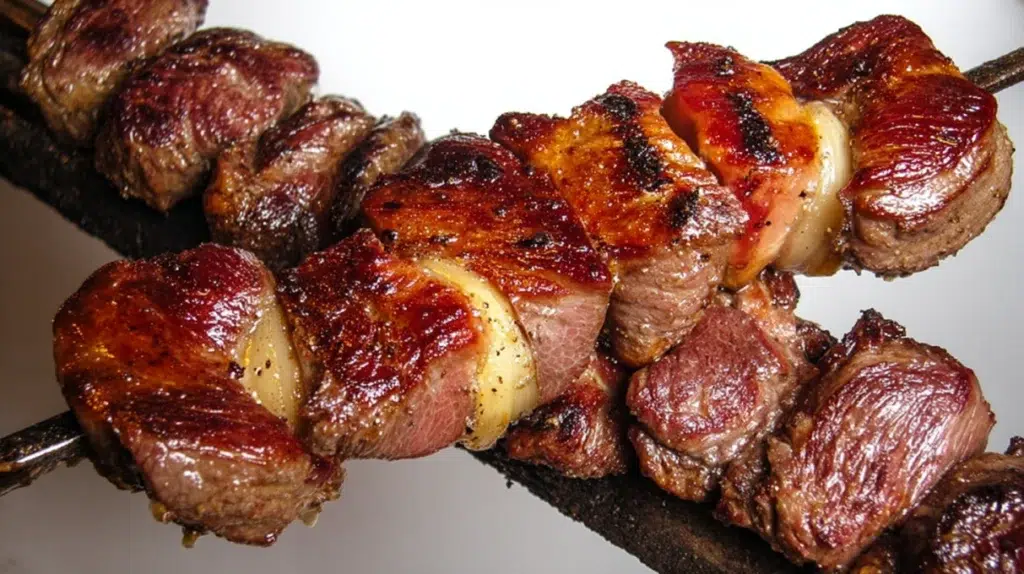
Picanha is the rump cap, a triangular cut from the top of the rump with a thick, unbroken layer of fat on one side. It is the most prized cut in Brazilian churrasco and the one most associated with the tradition worldwide. In Brazil it is eaten at virtually every churrascaria and in most home churrascos. In the US it is increasingly available at butchers and Brazilian meat markets, and sometimes at Whole Foods labeled as “rump cap” or “coulotte.”
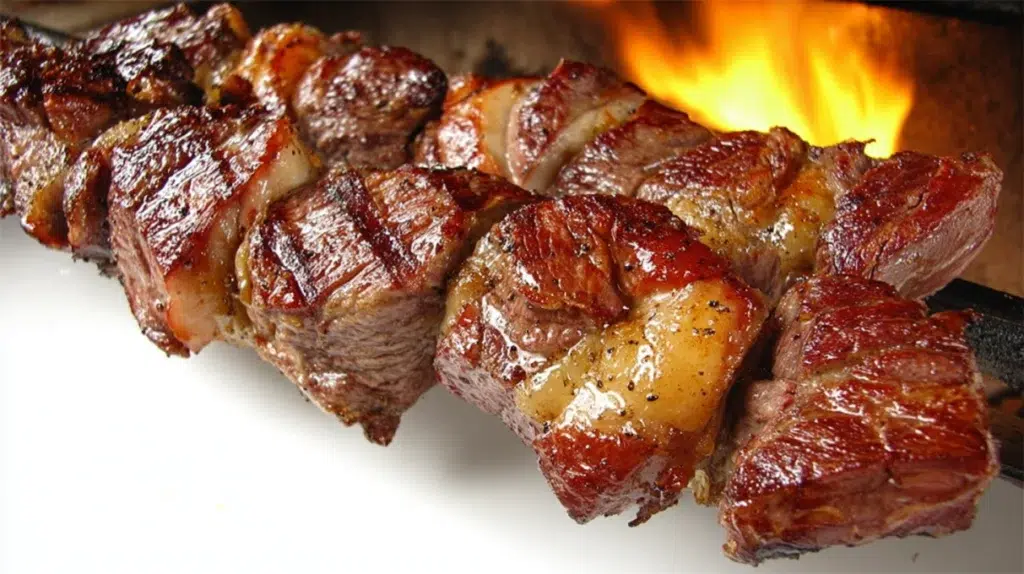
The fat cap is not optional and must not be trimmed. The fat cap is the entire point. It faces the fire first, rendering slowly and dripping down onto the meat as it cooks, basting it continuously throughout the entire cooking time. The result, crispy, caramelized fat on the outside, deeply juicy beef within is what picanha tastes like when it is done correctly. Trim the fat and you have a different, lesser dish.
How to prepare picanha for churrasco: Score the fat cap in a crosshatch pattern with a sharp knife, cuts about 2-3mm deep, not through to the meat. This helps the fat render evenly and prevents it from curling. Press coarse rock salt generously into both sides and into the scores. Rest at room temperature 30 minutes before grilling. Thread onto a curved skewer in a C-shape if using the traditional method, or grill flat.
Fraldinha: Flank Steak
Fraldinha (flank steak) is the second most popular churrasco cut, looser in grain than picanha, more intensely beefy in flavor, with a characteristic chew that rewards slow eating. Season with rock salt only. Grill quickly over high heat 3-4 minutes per side for medium-rare. Rest 5 minutes. Slice thinly against the grain before serving.
Costela: Short Ribs
Costela (beef short ribs) is the slow cook of churrasco. While picanha and fraldinha cook quickly over high heat, costela requires 4-6 hours over a much lower fire, the bones and connective tissue need time to break down into the tender, falling-off-the-bone richness that makes Brazilian costela extraordinary. Some churrasqueiros cook costela overnight at very low heat, finishing over high heat just before serving to develop the exterior crust.
At home: the easiest method is to slow-cook the costela in the oven (160°C / 320°F, 4 hours, covered in foil) and finish over the charcoal grill for the last 20-30 minutes to develop the exterior. The result is not identical to true slow churrasco but is genuinely excellent.
Linguiça: Smoked Pork Sausage
Linguiça (smoked pork sausage) is the counterpoint to the beef, always present at a proper churrasco, providing a different flavor register (smoky, garlicky, slightly sweet) alongside the clean beef cuts. Grill over medium heat, turning frequently, until the skin is deeply browned and beginning to split slightly, 8-10 minutes total. The split is a sign the interior juices are starting to flow. Do not prick before grilling.
Coração de Frango: Chicken Hearts
Chicken hearts on tiny skewers, threaded four or five at a time, seasoned with rock salt, grilled over high heat for 3-4 minutes are the snack of churrasco culture. Small, intensely flavored, slightly chewy, eaten straight off the skewer while waiting for the larger cuts to cook. They are almost always available at Brazilian grocery stores fresh or frozen.
If chicken hearts are a cultural jump too far for your table, substitute chicken thighs cut into large chunks and threaded on skewers, same technique, more familiar result.
Frango (Chicken): Marinated Exception
Chicken is the one churrasco protein that traditionally does take a marinade, typically a mixture of garlic, olive oil, lemon juice and herbs. The reason is practical: chicken lacks the fat marbling of beef that provides self-basting during grilling, so without a marinade it dries out too quickly over charcoal. Marinate chicken pieces at least 2 hours, ideally overnight. Grill over medium rather than high heat.
The Fire: Building and Managing It
Churrasco is cooked over charcoal or wood, never gas, never briquettes if it can be avoided. The flavor of churrasco comes partly from the Maillard reaction on the meat’s surface and partly from the aromatic compounds in the wood smoke. Gas produces the former but not the latter. This matters.
Building the fire: Use hardwood charcoal (not briquettes, briquettes contain binders and additives that produce an off flavor). Light with a chimney starter, no lighter fluid, which taints the flavor of the first cuts on the grill. Allow the coals to reach white-hot with visible embers, the surface of the coals should be covered in grey-white ash with a red glow underneath. This takes 20-25 minutes from lighting.
Heat zones: Spread the coals unevenly, a deeper, hotter pile on one side, a shallower, cooler spread on the other. This creates two zones: high heat for searing and developing crust on picanha and fraldinha, lower heat for cooking through thicker cuts and keeping finished pieces warm without continuing to cook them. Managing these two zones simultaneously is the skill of the churrasqueiro.
Height management: Traditional churrasco grill grates are height-adjustable, the grate can be raised away from the coals to reduce heat or lowered for more intense searing. At home with a fixed grate: manage heat by moving coals rather than the grate. Push coals together for more heat, spread them for less.
The fat flare: Picanha’s fat cap will cause flare-ups as it renders over the fire. Do not panic and do not douse with water (this creates ash that lands on the meat and produces bitterness). Move the skewer to the cool zone briefly, let the flare subside, return to the hot zone. The controlled interaction between rendered fat and flame is part of what makes picanha taste like picanha.
The Molho Campanha: The Only Sauce Churrasco Needs
Molho campanha is not applied to the meat. It sits in a bowl at the table for people to spoon onto their plates alongside the meat. It is fresh, acidic and simple, a counterpoint to the richness of the beef and fat, not a complement to it.
Ingredients:
- 3 medium tomatoes, finely diced, seeds and juice included
- 1 medium white onion, finely diced
- 1 green bell pepper, finely diced
- 3 tablespoons olive oil
- 2 tablespoons white wine vinegar
- Salt and black pepper
- Fresh parsley, finely chopped
Method: Combine all ingredients. Season generously. Rest 20 minutes before serving, the vegetables release their juices and the flavors combine. Serve at room temperature, never cold from the fridge.
The molho campanha should be loose, fresh and bright. It is the opposite of a cooked sauce, no heat ever touches it.
The Complete Home Churrasco: Order of Cooking
Churrasco is not cooked in one go, it is a progression. Different cuts have different cooking times and come off the grill at different moments across an hour or more of cooking.
The sequence:
- Costela, if doing the oven-and-finish method, this is already cooked. If doing full churrasco, it goes on first over low heat 3-4 hours before everything else.
- Linguiça, on the grill 20-25 minutes before eating. Slow-medium heat. Ready well before the beef and keeps warm easily.
- Coração de frango, 10-15 minutes before eating. These are the snack while everything else finishes.
- Frango (chicken), 20-25 minutes over medium heat.
- Fraldinha, 8-10 minutes over high heat, resting while picanha cooks.
- Picanha, fat cap down first, 5-6 minutes, then flip, 4-5 minutes for medium-rare on a 3-4cm thick piece. Rest 5 minutes. Slice at the table.
The traditional way to serve at home: bring cuts to the table on a wooden board as they finish, carving and serving continuously throughout the meal rather than waiting for everything to be ready simultaneously. This is the rodízio spirit adapted for the home table.
What to Serve Alongside
Vinagrete, identical to molho campanha, slightly more acidic. Make both from the same base.
Farofa, toasted cassava flour with butter and bacon (recipe in the feijoada guide). Spooned over the meat at the table.
Pão de alho (garlic bread), thick slices of French bread spread with garlic butter and grilled directly on the churrasco grate for 2-3 minutes per side. The most popular churrascaria side dish in Brazil.
Arroz e feijão, simple white rice and Brazilian-style black beans (not feijoada beans, everyday beans cooked with onion, garlic and bay leaf). Always on a Brazilian table.
Cold chopp (draft beer) or caipirinha, the only drinks that belong at churrasco.
Frequently Asked Questions
Where do I buy picanha in the US?
Brazilian butchers and grocery stores (Brazzil Supermarket, Brazilian Court market chains) are the most reliable source. Some Whole Foods and upscale butchers carry it as rump cap or coulotte. Ask your butcher specifically for the rump cap with the fat cap intact and untrimmed, this is the key request, as many US butchers trim the fat automatically.
Can I make churrasco on a gas grill?
Yes, the result will be good but different. You lose the wood smoke character that is part of churrasco’s flavor. Use the highest heat setting and preheat for at least 15 minutes. For the closest result on gas, add a small handful of soaked hardwood chips directly on the burner covers before the meat goes on.
What is the difference between Brazilian churrasco and Argentine asado?
Both come from the gaucho cattle tradition but differ in technique and philosophy. Brazilian churrasco favors skewers and picanha (rump cap with fat). Argentine asado uses flat iron grill grates, favors short ribs (asado de tira) and longer, slower cooking. Argentine asado uses chimichurri and olive oil marinades. Brazilian churrasco uses rock salt only. Both traditions are excellent and both prize the quality of the beef above all else.
How much meat per person?
For a home churrasco with multiple cuts: 300-400g raw meat per person is comfortable. For a single cut (picanha only): 250g per person. These amounts look large but significant weight is lost to cooking and trimming.
Planning your week? Schedule a Sunday churrasco in your weekly meal planner, light the fire at noon and the afternoon takes care of itself.