⏱ Prep: 20 min 🔥Bake: 8–10 min per batch ❄️Set: 15 min 🍪Makes: ~18 sandwich cookies
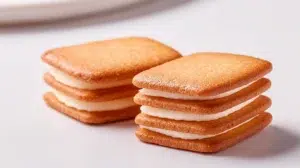
Shiroi Koibito cookies, “white lover” in Japanese are the most famous souvenir from Hokkaido, Japan. Created by Ishiya confectionery in Sapporo in 1976 and sold ever since in their distinctive blue tins, they are the cookie that travellers bring back from northern Japan and the one that everyone else wishes they could try without the plane ticket.
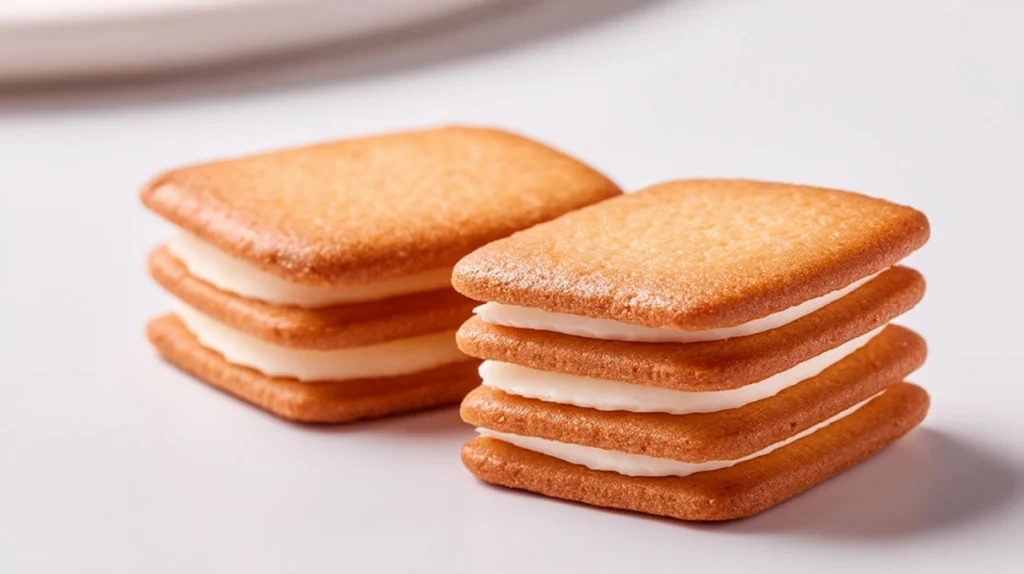
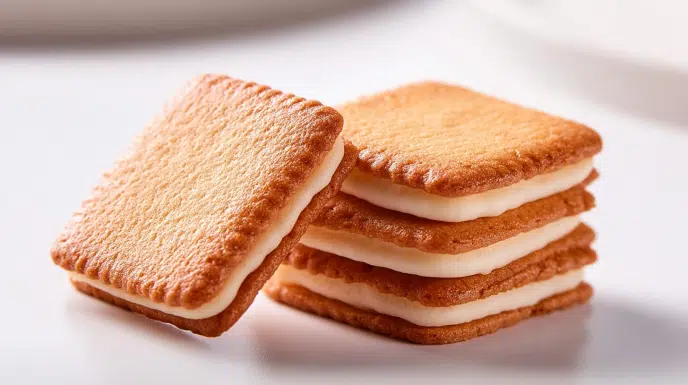
The cookie itself is a langue de chat, a thin, buttery French-style biscuit made from just four ingredients in equal measure: softened butter, icing sugar, egg whites and plain flour. Baked until golden only at the very edges. Two cookies sandwiched around a thin square of smooth white chocolate that sets firm and holds everything together. The result is simultaneously fragile and precise: crisp where the cookie is, creamy where the chocolate is, and completely gone within minutes of anyone discovering them in the kitchen.
Ingredients
The langue de chat cookies
- 50g unsalted butter, at room temperature, room temperature is essential, not softened in the microwave, not melted. The butter needs to cream properly with the sugar to create the light, airy batter that produces a crisp rather than dense cookie. Take it out of the fridge 1–2 hours before you start.
- 50g icing sugar (powdered sugar), sifted, sift to remove lumps before creaming. Icing sugar rather than caster sugar gives a finer, more delicate texture in the finished biscuit.
- 2 egg whites (from medium eggs), at room temperature. Egg whites only, no yolk. The yolk would add richness and colour but also chew; egg whites alone produce the characteristic light crispness of langue de chat.
- 50g all-purpose flour (plain flour), sifted, sift twice for the lightest batter
- ½ teaspoon vanilla extract, optional but traditional; adds warmth to the delicate buttery flavour
- Pinch of salt
The white chocolate filling
- 100g good quality white chocolate, finely chopped, quality matters significantly here; cheap white chocolate is cloying and waxy. Look for white chocolate with 30%+ cocoa butter content. Valrhona Ivoire or Lindt white chocolate both work well. Avoid white chocolate chips which contain stabilisers that prevent smooth melting.
Step by step
- Prepare everything before you start. Preheat the oven to 350°F / 175°C. Line two baking trays with baking paper. If you have a square stencil or template, place it on the paper and trace 4cm squares lightly in pencil on the underside of the paper, this guides even piping. Prepare a piping bag with a small plain round tip or simply cut a 5mm opening in the end.
- Cream butter and icing sugar. Beat the room-temperature butter with the sifted icing sugar using a hand mixer or stand mixer on medium speed for 3–4 minutes until the mixture is very pale, light and fluffy. This step is longer than it feels necessary, the air incorporated here is what gives the cookies their lightness.Do not rush the creaming. Under-creamed butter and sugar produces a flat, dense batter that spreads too much in the oven. The mixture should look almost white and hold soft peaks when you lift the beater.
- Add the egg whites. Add the egg whites one at a time, beating well after each addition until fully incorporated. Add the vanilla extract if using. The batter will look slightly split at first, keep beating and it will come together into a smooth, glossy mixture.
- Fold in the flour. Sift the flour and salt over the butter mixture. Using a spatula, fold in gently with slow, deliberate strokes until just combined and no flour streaks remain. Stop the moment the batter is uniform, overmixing develops gluten and makes the cookies tough rather than crisp.The finished batter should be smooth and thick enough to hold its shape when piped but not stiff. If it seems too loose, refrigerate for 15 minutes to firm it slightly before piping.
- Pipe the cookies. Transfer the batter to the prepared piping bag. Pipe small rectangles or squares approximately 4×4cm in size onto the lined baking trays, leaving at least 3cm between each, they spread during baking. Keep the thickness as even as possible; thicker spots bake slower than thin spots.Even thickness is the technical challenge of this recipe. A stencil or template guides consistent shapes. Without one: pipe a small amount, spread with a wet offset spatula or the back of a damp spoon to an even thin layer. Aim for roughly 2–3mm thickness. Thicker cookies don’t get properly crisp.
- Bake. Bake for 8–10 minutes until the edges are golden brown and the centres remain pale. The colour gradient, golden at the edge, cream in the middle is the signature look of langue de chat. Do not wait for the centres to colour; by then the edges will be too dark. Every oven is different. Check at 7 minutes the first batch. The cookies go from perfect to over-baked in under a minute. Once the edges are a consistent light golden brown all the way around, they are done.
- Cool completely. Leave the cookies on the tray for 2 minutes, they are extremely fragile when hot and will break if moved immediately. Transfer carefully to a wire rack and cool completely before sandwiching. This takes at least 15 minutes. Assembling with warm cookies melts the chocolate filling and produces a sticky, unset result.
- Melt the white chocolate. Place the chopped white chocolate in a heatproof bowl set over a pan of barely simmering water, the bottom of the bowl must not touch the water. Stir gently until just melted and smooth. Remove from the heat. Do not allow any water to splash into the chocolate, even a drop causes it to seize into a grainy paste.
- Assemble and set. Working quickly with cooled cookies: spread a thin, even layer of melted white chocolate across the flat side of one cookie. Press a second cookie flat-side down on top, gently, without sliding. The chocolate layer should be thin, 1–2mm, not thick. Place the assembled sandwiches on the lined tray and refrigerate for 10–15 minutes until the chocolate has fully set and the sandwich holds together firmly.
Why equal weight, the 50-50-50-50 ratio
Langue de chat dough follows a strict equal-weight ratio of butter, sugar, egg whites and flour, 50g of each in this recipe. This is not a coincidence or a stylistic preference. Each ingredient is doing a specific structural job. The butter carries flavour and creates tenderness. The icing sugar aerates during creaming and promotes browning at the edges. The egg whites provide structure and the distinctive crispness, yolk would add chewiness, which is exactly what langue de chat is not supposed to have.
The flour gives body without heaviness. Change the ratio, more flour for sturdier cookies, more butter for richer ones and you get a different cookie. The equal-weight ratio produces this specific one. Scale the recipe up or down by changing all four quantities together by the same factor.
Make it your own
Claire’s note
The milk chocolate version, using dark milk chocolate rather than white, produces something arguably even more interesting: the slightly bitter depth of the chocolate against the sweet buttery biscuit is a better contrast than the white version’s uniformly sweet pairing. Try both. The cookies themselves keep well in an airtight tin for up to a week before sandwiching, bake a full batch of biscuits, store them dry, and assemble sandwiches as needed so each one is fresh-crisp. A few drops of matcha powder sifted into the cookie batter with the flour gives them a green tinge and an earthy edge that works beautifully against the white chocolate filling. This is not traditional but it is very good, and it produces something that looks genuinely spectacular.
Serve with
Shiroi Koibito cookies are served with green tea, coffee or any light tea, the delicate sweetness and the thin chocolate filling are calibrated for a hot drink alongside. They make exceptional gifts packed in a small tin or box. For the complete Japanese baking collection the Japanese recipes guide covers the whole cuisine, and the Japanese matcha soufflé cheesecake alongside these cookies makes a full Japanese dessert spread.
Add Shiroi Koibito cookies to your weekly meal planner as a showstopping dessert for your next gathering. And for more recipes, follow us on Pinterest.
Print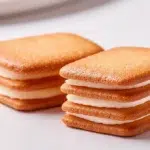
Shiroi Koibito Cookies
- Total Time: 30 minutes
- Yield: 18 cookies 1x
- Diet: Vegetarian
Description
Delicate sandwich cookies from Hokkaido, Japan, featuring thin, buttery biscuits filled with smooth white chocolate.
Ingredients
- 50g unsalted butter, at room temperature
- 50g icing sugar, sifted
- 2 egg whites (from medium eggs), at room temperature
- 50g all-purpose flour, sifted
- ½ teaspoon vanilla extract (optional)
- Pinch of salt
- 100g good quality white chocolate, finely chopped
Instructions
- Prepare everything before you start. Preheat the oven to 350°F / 175°C. Line two baking trays with baking paper.
- Cream butter and icing sugar until very pale, light, and fluffy (3–4 minutes).
- Add egg whites one at a time, beating well after each addition.
- Fold in flour and salt until just combined, being careful not to overmix.
- Pipe small rectangles or squares (4×4cm) onto the baking trays, leaving enough space between them.
- Bake for 8–10 minutes until edges are golden brown.
- Cool the cookies on the tray for 2 minutes, then transfer to a wire rack to cool completely.
- Melt the white chocolate over a double boiler until smooth.
- Assemble the cookies by spreading a thin layer of melted white chocolate on one cookie, and topping with another, then refrigerate until set.
Notes
For more flavor, consider adding matcha powder to the batter or trying dark milk chocolate filling.
- Prep Time: 20 minutes
- Cook Time: 10 minutes
- Category: Dessert
- Method: Baking
- Cuisine: Japanese
Nutrition
- Serving Size: 1 cookie
- Calories: 150
- Sugar: 10g
- Sodium: 50mg
- Fat: 7g
- Saturated Fat: 4g
- Unsaturated Fat: 2g
- Trans Fat: 0g
- Carbohydrates: 20g
- Fiber: 0g
- Protein: 1g
- Cholesterol: 10mg