⏱ Active: 20 min ❄️Set: 20 min 🍬Makes: 20–24 pieces 🌍Tanzanian / Swahili 🌿Vegan
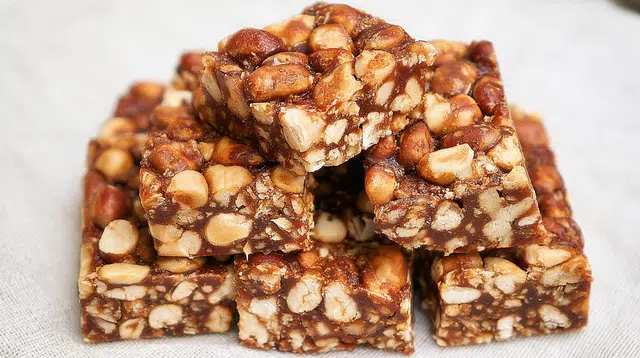
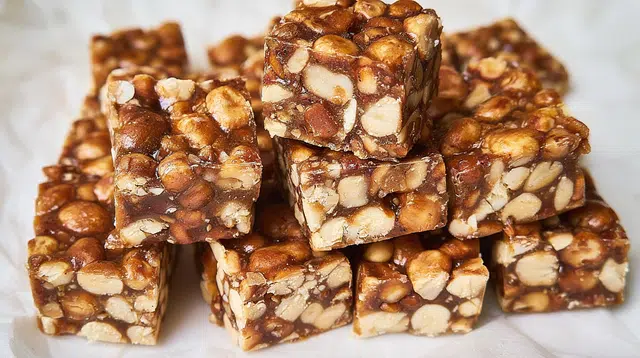
Tanzanian peanut brittle (Kashata za njugu), roasted peanuts and dried coconut set in cardamom-spiced caramel, broken into irregular pieces and sold by street vendors across Tanzania, Uganda and Kenya wrapped in paper. It is one of the great East African street food sweets: crunchy, sweet, slightly aromatic from the cardamom, with the deep nuttiness of roasted peanuts and the chew of toasted coconut all at once. Made in 20 minutes with four main ingredients.
The technique is straightforward caramel-making with two specific rules. Stir the sugar until it dissolves, then stop stirring and only swirl the pan. Stirring liquid caramel causes crystallisation, which turns the sugar grainy and white and ruins the batch. And work fast once the caramel is ready, hot caramel continues cooking off the heat and moves from perfect to burnt in under a minute.
Tanzanian peanut brittle Ingredients
- 200g (1⅓ cups) raw unsalted peanuts, dry-roasted in a pan before making the brittle. Roasting transforms raw peanuts into something nutty and deeply flavoured, the most important prep step. Raw peanuts in brittle taste flat and slightly bitter by comparison. Alternatively use pre-roasted unsalted peanuts and skip the roasting step.
- 100g (1 cup) unsweetened desiccated coconut, dried shredded coconut. Unsweetened is important, the caramel provides all the sweetness needed. If using fresh or frozen grated coconut, toast it briefly in a dry pan first until lightly golden.
- 200g (1 cup) white granulated sugar, the caramel base. Do not use brown sugar, it contains molasses which burns at a lower temperature and makes controlling the caramel much harder. Pure white sugar for the clearest, most controllable caramel.
- 3 tablespoons water, added to the sugar at the start to help it dissolve evenly before caramelising. A small amount, just enough to wet the sugar.
- ½ teaspoon ground cardamom, the defining spice of East African kashata. Warm, slightly floral, with a faint mint note. Cardamom in caramel is one of the great flavour combinations in Swahili cooking. Substitute: ground cinnamon, equally traditional and equally good.
- ¼ teaspoon fine salt, salt in sweet brittle amplifies both the caramel and the nuttiness of the peanuts
- 1 teaspoon neutral oil or butter, for greasing the tray or parchment paper
Before you start
Set everything up before the sugar goes on the heat. Once the caramel is ready you have about 60–90 seconds to add the peanuts and coconut, stir to combine and pour onto the tray. Have the roasted peanuts measured and ready beside the stove. Have the coconut, cardamom and salt measured and combined in a small bowl. Have the greased tray ready. Have a spatula within reach. Begin only when everything is prepared.
Step by step
- Dry-roast the peanuts. Place the raw peanuts in a dry pan over medium heat. Toast, stirring frequently, for 4–5 minutes until the peanuts are golden and fragrant and the skins begin to blister and loosen. Tip onto a clean tea towel and rub vigorously, the papery skins will come away. Blow off the loose skins. Set the roasted, skinned peanuts aside to cool. If using pre-roasted peanuts, skip this step. Roasting is what separates kashata that tastes deeply nutty from kashata that tastes like sweet sugar with some nuts in it. 4–5 minutes in a dry pan transforms the flavour dramatically. Do not skip unless the peanuts are already roasted.
- Prepare the tray. Line a baking tray or 20×20cm square dish with parchment paper. Brush the parchment generously with oil or rub with butter. Have it ready beside the stove before you start the caramel.
- Make the caramel, two stages. Combine the sugar and water in a medium, heavy-bottomed saucepan over medium heat. Stir constantly until the sugar has fully dissolved and the liquid is clear, about 3–4 minutes. This is the only stage where you stir. Once the sugar is dissolved and liquid, stop stirring completely. Increase to medium-high heat. The stop-stirring rule is the single most important technique in brittle-making. Once the sugar is liquid and beginning to caramelise, stirring introduces agitation that causes the sugar molecules to re-bond into crystals, the entire batch seizes into a grainy white solid that cannot be saved. From this point: swirl the pan gently if needed to even out hot spots, but no spoon or spatula touches the caramel.
- Caramelise to deep amber. Cook the dissolved sugar without stirring, swirling the pan occasionally, until the liquid deepens to a rich amber colour, like dark honey or old whisky. It will smell of caramel. This takes 4–6 minutes at medium-high heat. If using a thermometer: 150–160°C / 300–320°F (hard crack stage, the right temperature for crunchy, snapping brittle). Without a thermometer: drop a small amount into a glass of cold water, it should form a hard, brittle thread that snaps immediately. Watch the caramel constantly from the moment it begins to colour. It goes from pale gold to perfect amber to burnt and bitter in about 90 seconds. The moment it reaches a deep amber, darker than pale gold, lighter than dark brown, move immediately to the next step. Pale gold is undercooked and the brittle will be sticky; dark brown is burnt and bitter.
- Add the peanuts, coconut and spices, work fast. Remove the pan from the heat immediately. Pour in the roasted peanuts, desiccated coconut, cardamom and salt all at once. Stir quickly and firmly with a wooden spoon or heatproof spatula until every peanut and piece of coconut is evenly coated in caramel. This takes about 30–45 seconds, work fast.
- Pour and spread immediately. Pour the mixture onto the prepared tray immediately. Using the back of a spoon or a spatula, spread it into an even layer, about 1cm thick. Work quickly, the caramel sets fast.
- Score before it fully sets. After about 2–3 minutes, when the kashata is firm enough to hold its shape but not yet fully hard, score it into pieces with a sharp knife or the edge of a spatula. Press firmly straight down rather than dragging. Once fully hardened (after 15–20 minutes of cooling) it is very difficult to cut cleanly, scored lines make it easier to break along neat lines.
- Cool completely then break. Leave to cool at room temperature for 20 minutes until completely hard. Break along the scored lines into pieces. Store in an airtight container at room temperature, moisture from the fridge makes brittle sticky and soft.
Claire’s note
The caramel is the only technically demanding part of this recipe and it demands about 6 minutes of your full, undivided attention. Do not attempt to multitask during the caramelisation stage. Do not answer the phone. Do not check the next step. Stand at the stove, watch the colour, smell it, and trust your eyes over any timer.
The right moment is when the colour is a deep, warm amber, the colour of dark honey or amber jewellery. Pull it from the heat at that exact moment. If it looks like it might be getting close to right, it is probably already right. Add the peanuts, stir fast, pour fast. Brittle-making rewards preparation and quick movement over everything else.
Variations
- Coconut only (kashata za nazi): Use 200g desiccated coconut and no peanuts, the coconut-only version is equally traditional and slightly more chewy.
- With cinnamon: Replace the cardamom with ½ teaspoon ground cinnamon, the most common alternative spice in Tanzanian kashata.
- With vanilla: Add ½ teaspoon vanilla extract along with the peanuts.
- With sesame seeds: Add 2 tablespoons of toasted sesame seeds alongside the peanuts, a popular Zanzibar variation.
Serve with
Kashata za njugu is eaten as a sweet snack, exactly as it is sold on the streets of Dar es Salaam, Zanzibar and Kampala, wrapped in paper and eaten out of hand. It makes an excellent homemade gift wrapped in parchment and tied with string. For more East African cooking: Zanzibar pizza, Kenyan pilau, Tanzanian coconut fish curry, and the full African food collection.
Add Tanzanian peanut brittle to your weekly meal planner as a weekend confectionery project, 20 minutes active, feeds a crowd, keeps 2 weeks in an airtight container. Make a double batch and keep a jar on the kitchen counter.
And for more recipes, follow us on Pinterest.
Print
Tanzanian Peanut Brittle (Kashata za Njugu)
- Total Time: 40 minutes
- Yield: 20–24 pieces 1x
- Diet: Vegan
Description
A crunchy and sweet East African treat made from roasted peanuts and dried coconut set in cardamom-spiced caramel.
Ingredients
- 200g (1⅓ cups) raw unsalted peanuts, dry-roasted
- 100g (1 cup) unsweetened desiccated coconut
- 200g (1 cup) white granulated sugar
- 3 tablespoons water
- ½ teaspoon ground cardamom
- ¼ teaspoon fine salt
- 1 teaspoon neutral oil or butter (for greasing)
Instructions
- Dry-roast the peanuts in a dry pan over medium heat for 4–5 minutes until golden and fragrant.
- Prepare the tray by lining it with parchment paper and greasing it with oil or butter.
- Combine the sugar and water in a saucepan over medium heat and stir until dissolved, about 3–4 minutes.
- Caramelise the sugar without stirring, swirling occasionally, until it reaches a deep amber color, about 4–6 minutes.
- Add the peanuts, coconut, cardamom, and salt; stir quickly to coat.
- Pour the mixture onto the prepared tray and spread into an even layer.
- Score the mixture into pieces after 2–3 minutes while it is still pliable.
- Cool for 20 minutes at room temperature and then break along the scored lines.
Notes
Work quickly during the caramelisation stage for best results. Store in an airtight container to maintain crispness.
- Prep Time: 20 minutes
- Cook Time: 20 minutes
- Category: Dessert
- Method: Candy Making
- Cuisine: Tanzanian
Nutrition
- Serving Size: 1 piece
- Calories: 200
- Sugar: 12g
- Sodium: 100mg
- Fat: 10g
- Saturated Fat: 2g
- Unsaturated Fat: 6g
- Trans Fat: 0g
- Carbohydrates: 20g
- Fiber: 2g
- Protein: 5g
- Cholesterol: 0mg