⏱ Soak: 20 min 🔥Cook: 25 min 👤Serves: 2–3 🌶Heat: Medium-hot
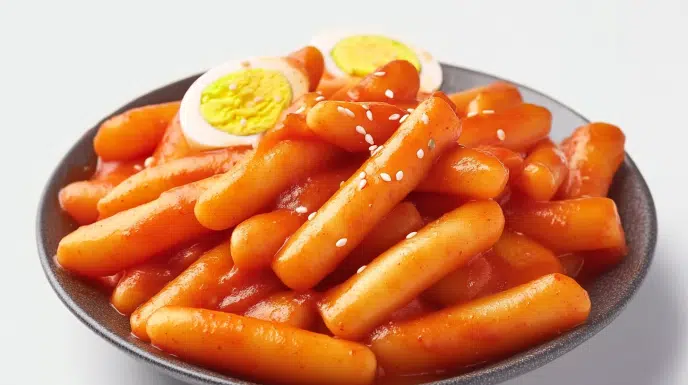
Tteokbokki recipe, pronounced “ddeok-POKE-ee” is Korea’s most beloved street food and the dish that anyone who has walked through a Korean market has smelled from thirty feet away and followed to the source. Cylindrical rice cakes with a specific chewy, slightly sticky texture that no other ingredient replicates, simmered in a sauce of gochujang, gochugaru, anchovy broth, soy sauce and brown sugar until the sauce reduces to a thick, glossy, deeply spiced coating that clings to every surface. Twenty-five minutes from start to bowl. The kind of addictive that means you eat the last one directly from the pan before you have finished serving.
Tteokbokki (떡볶이) literally means stir-fried rice cakes in Korean. It has been a street food staple since the 1950s, sold from cart vendors (pojangmacha) across Seoul and every Korean city, eaten standing at the cart, the sauce dripping onto the pavement. The cart version, the real one is what this recipe is built to replicate.
Gather these first
For the anchovy broth
- 2½ cups (600ml) water
- 7–8 large dried anchovies, heads and innards removed. Available at H Mart and Korean grocery stores. Do not skip, anchovy broth is the umami foundation that separates authentic tteokbokki from a flat gochujang-and-water version. It does not taste fishy, it tastes savory and deep.
- 1 piece dried kelp (dasima/kombu), roughly 4×4 inches. Available at H Mart and Asian grocery stores. Adds a clean oceanic umami that rounds the anchovy.
- Shortcut: 1 dashi powder packet or Korean anchovy stock coin dissolved in 2½ cups water, produces nearly identical results in zero extra time
For the tteokbokki sauce
- 3 tablespoons gochujang, the primary sauce ingredient. Haechandle or Chung Jung One brands are most reliable. Gochujang provides fermented depth, umami, body and heat simultaneously.
- 1 tablespoon gochugaru (Korean red pepper flakes), fine grind if available. Adds heat and intensifies the red color without making the sauce thicker. Do not substitute with regular chili flakes, gochugaru has a specific fruity, slightly sweet quality unique to Korean cooking.
- 1½ tablespoons soy sauce, regular or low-sodium
- 1 tablespoon brown sugar, brown rather than white, the deeper sweetness balances the fermented gochujang more effectively
- 2 cloves garlic, finely minced
- ½ teaspoon onion powder, optional but adds savory depth beyond the gochujang alone
For the tteokbokki
- 1 lb (450g) cylindrical rice cakes (garaetteok), fresh, refrigerated or frozen. Fresh is best, softest and most tender. Refrigerated needs 20 minutes soaking. Frozen needs 30 minutes soaking. Available at H Mart and Korean grocery stores. Do not substitute with any other rice cake shape, the cylinder is structural to how the sauce coats.
- 4–5 oz (120–150g) Korean fish cakes (eomuk), sold in sheets in the refrigerated section at Korean grocery stores. Slice into triangles or strips. Skip for vegetarian version, add extra rice cakes instead.
- 3 spring onions, white parts added during cooking, green parts sliced for garnish
- 1 cup (90g) green cabbage, roughly chopped, optional but adds mild sweetness and crunch
- 2 hard-boiled eggs, optional. Peeled and added in the final 5 minutes. The egg absorbs the sauce.
To finish
- 1 cup (115g) shredded mozzarella, optional for cheese tteokbokki, the version currently trending across every Korean food video on the internet
- Toasted sesame seeds
- Sliced spring onion greens
How to make it
- Soak the rice cakes. If using refrigerated or frozen rice cakes, separate any that are stuck together and soak in warm water for 20–30 minutes until pliable. Fresh rice cakes do not need soaking. Drain well before using.The soaking is not optional for refrigerated or frozen rice cakes. Cold, unsoftened rice cakes take too long to cook through in the sauce and remain hard in the center while the exterior overcooks.
- Make the anchovy broth. Add the dried anchovies, kelp and water to a wide, shallow pan or skillet. Bring to a boil over medium-high heat. Boil for 10 minutes, the water will turn a light golden color and smell deeply savory. Remove the anchovies and kelp with a slotted spoon and discard. Reserve the broth in the pan.Shortcut: skip this step entirely and use a dashi packet or Korean anchovy stock coin dissolved in 2½ cups of water. Stir until dissolved. Start from step 3.
- Make the sauce. In a small bowl combine gochujang, gochugaru, soy sauce, brown sugar, minced garlic and onion powder. Mix until completely smooth, no lumps of gochujang remaining. The sauce should look like a thick, deeply red-orange paste. Set aside.
- Build the tteokbokki. Bring the anchovy broth back to a boil. Add the sauce and stir until completely dissolved into the broth. Add the soaked, drained rice cakes and the white parts of the spring onion. If using cabbage, add it now. Stir to coat everything in the sauce.Stir frequently from this point, the rice cakes stick to the bottom of the pan as the sauce reduces. A stuck rice cake burns quickly in this sauce.
- Simmer and reduce. Cook over medium heat for 8–10 minutes, stirring frequently, until the rice cakes are fully tender and chewy throughout (press one with a spoon, it should yield easily with no hard center) and the sauce has reduced and thickened to coat every piece in a glossy, deeply red coating. Add fish cakes and hard-boiled eggs in the last 4–5 minutes. If the sauce reduces too fast before the rice cakes are tender, add a splash of water or broth and continue.The sauce should be thick enough to coat the back of a spoon but not so thick it becomes a paste. If it is too thin, cook 2–3 more minutes. If too thick, add 2–3 tablespoons of water.
- Cheese finish (optional but extraordinary). Remove from heat. Scatter mozzarella over the top of the tteokbokki. Place under the broiler for 3–4 minutes until the cheese is melted, bubbly and slightly charred at the edges. This is cheese tteokbokki, currently the most saved Korean food recipe on Pinterest and for completely justified reasons.
- Serve immediately. Scatter sesame seeds and spring onion greens over the top. Tteokbokki waits for no one, the rice cakes continue absorbing the sauce and the texture changes significantly after 5 minutes off the heat. Serve straight from the pan.
The thing that makes it
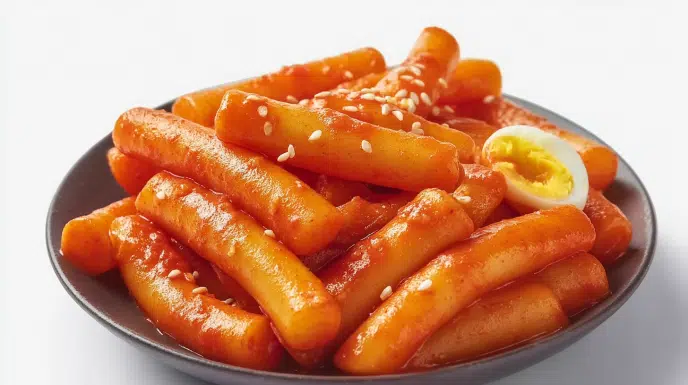
The anchovy broth is not optional and it does not taste fishy. This is the most common objection from people new to Korean cooking and the most incorrect one. Anchovy broth tastes savory and deep in the same way that parmesan makes a pasta sauce richer, you cannot identify the anchovy in the finished dish but you absolutely notice its absence. The broth is the invisible layer of umami that makes tteokbokki taste like something built over time rather than something dumped together and heated. Maangchi, the most trusted Korean home cooking voice in English has been making tteokbokki with anchovy broth since 2007 and has made the recipe 15 million times between her and her readers. It is the correct base. Use it.
The variations worth knowing
Cheese Tteokbokki: Mozzarella broiled on top, the most popular variation currently. Creamy, melted cheese against the spicy sauce is extraordinary.
Rabokki: Add instant ramen noodles in the last 3 minutes, they cook in the sauce and absorb the flavor completely. More volume, more comfort.
Rose Tteokbokki: Add ¼ cup heavy cream after the sauce is reduced, creates a creamy blush-pink sauce that is spicy, sweet and deeply rich. Milder than classic.
Gungjung Tteokbokki: The non-spicy royal court version, replace gochujang with soy sauce, sesame oil and a pinch of sugar. A completely different, subtler dish.
Seafood Tteokbokki: Add shrimp, squid rings or mussels with the fish cakes. The seafood cooks in 3 minutes and adds an oceanic sweetness to the sauce.
Vegetarian Tteokbokki: Skip fish cakes and anchovy broth. Use vegetable broth or kelp stock plus mushrooms and cabbage. Add a dash of soy sauce for extra umami.
Keep going
Tteokbokki is the Korean street food gateway dish, once you have gochujang and gochugaru in your pantry the full Korean cooking world opens up. The same gochujang base goes into gochujang chicken skewers and the kimchi that belongs alongside all of it. For the complete picture of Korean cooking at home, the pantry, the techniques and every recipe, the Korean recipes collection guide have everything.
Add tteokbokki to your weekly meal planner, make a double batch of anchovy broth Sunday and use it for tteokbokki Monday and Korean soup later in the week. And for more recipes, follow us on Pinterest.
Print
Tteokbokki
- Total Time: 45 minutes
- Yield: 2–3 servings 1x
- Diet: Vegetarian (optional)
Description
Tteokbokki is Korea’s beloved street food featuring chewy rice cakes simmered in a spicy and savory sauce.
Ingredients
- 2½ cups (600ml) water
- 7–8 large dried anchovies, heads and innards removed
- 1 piece dried kelp (dasima/kombu), roughly 4×4 inches
- 3 tablespoons gochujang
- 1 tablespoon gochugaru (Korean red pepper flakes)
- 1½ tablespoons soy sauce
- 1 tablespoon brown sugar
- 2 cloves garlic, finely minced
- ½ teaspoon onion powder (optional)
- 1 lb (450g) cylindrical rice cakes (garaetteok)
- 4–5 oz (120–150g) Korean fish cakes (eomuk) (optional)
- 3 spring onions
- 1 cup (90g) green cabbage, roughly chopped (optional)
- 2 hard-boiled eggs (optional)
- 1 cup (115g) shredded mozzarella (optional)
- Toasted sesame seeds
- Sliced spring onion greens
Instructions
- Soak the rice cakes. If using refrigerated or frozen rice cakes, separate any that are stuck together and soak in warm water for 20–30 minutes until pliable. If fresh, no soaking is needed. Drain well before using.
- Make the anchovy broth. Add dried anchovies, kelp, and water to a wide pan. Boil for 10 minutes and remove anchovies and kelp. Reserve the broth.
- Make the sauce. Combine gochujang, gochugaru, soy sauce, brown sugar, minced garlic, and onion powder in a bowl. Mix until smooth.
- Build the tteokbokki. Bring the broth back to a boil, add sauce, and stir. Add soaked rice cakes and white parts of spring onion, and cabbage if using. Stir to coat.
- Simmer and reduce. Cook for 8–10 minutes, stirring frequently, until rice cakes are tender and sauce thickens. Add fish cakes and hard-boiled eggs in the last 4–5 minutes.
- Finish with cheese (optional). Remove from heat, scatter mozzarella on top, and broil for 3–4 minutes until melted and slightly charred.
- Serve immediately. Scatter sesame seeds and spring onion greens over the top.
Notes
The anchovy broth is essential for authentic flavor. Adjust the thickness of the sauce as needed while cooking.
- Prep Time: 20 minutes
- Cook Time: 25 minutes
- Category: Main Course
- Method: Stir-frying
- Cuisine: Korean
Nutrition
- Serving Size: 1 serving
- Calories: 400
- Sugar: 6g
- Sodium: 800mg
- Fat: 15g
- Saturated Fat: 5g
- Unsaturated Fat: 8g
- Trans Fat: 0g
- Carbohydrates: 50g
- Fiber: 2g
- Protein: 10g
- Cholesterol: 70mg