Greek recipes have a problem and the problem is not the food itself, which is extraordinary. The problem is that most people think they already know Greek food and stop there.
They know hummus, which is not Greek. They know pita bread with gyro meat, which is a reasonable approximation of something Greek. They know a Greek salad from a chain restaurant, which is a reasonable approximation of something Greek. And they put all of this in a category called “Greek food” and move on, without realizing that authentic Greek cooking is one of the most sophisticated, most regionally varied, most deeply satisfying cuisines in the entire Mediterranean world and that the restaurant version barely touches it.
This guide is for the people who want to go further. Who want to understand why Greek food tastes the way it does, what the ingredients are really doing, and how to make dishes in your Nashville or Chicago or Portland kitchen that would make a Greek grandmother nod with something approaching approval.
That last standard, the Greek grandmother standard is the one I cook to. Every recipe in this collection has cleared it. Nothing less gets published here.
This is part of the Mediterranean & Middle East recipes section of RecipeWorldly. Let’s begin.
What Makes Greek Cuisine Unlike Anything Else
The traditional Greek diet, built on vegetables, olive oil, cheese, bread and seafood is one of the healthiest in the world, a fact that has been confirmed by decades of nutritional research on the Mediterranean diet. But health statistics do not explain why Greek food tastes the way it does. For that you need to understand the three pillars that structure the entire cuisine.
Olive oil: not a cooking medium, a primary ingredient
Greek cooking uses olive oil in quantities that seem extreme to American cooks and the quantities are not extreme. They are correct. Olive oil in Greek cooking is not the neutral medium used to prevent things from sticking to the pan. It is a primary flavor present in the salad, in the dip, in the bean stew, drizzled generously over finished dishes, used to braise lamb, to roast vegetables, to dress greens. Greek cooks buy olive oil in five-litre tins. This tells you everything you need to know about how central it is.
The quality of your olive oil matters enormously in Greek cooking in a way it does not in cuisines where oil is purely functional. Buy the best extra-virgin olive oil you can afford. The difference in a Greek salad dressed with excellent olive oil versus mediocre olive oil is not subtle. It is the difference between a good dish and an extraordinary one.
Lemon: the second flavoring agent after olive oil
Greek cooking uses fresh lemon in quantities that are similarly startling until you taste the result. The lemon is not for acidity alone, it is for brightness, for lift, for the way it cuts through the richness of lamb fat and the depth of olive oil and makes everything taste more alive. Avgolemono, the egg-lemon sauce used in soups and to dress stuffed vine leaves is the most sophisticated expression of this lemon philosophy: eggs whisked with lemon juice, tempered with hot broth, producing a silky sauce that is simultaneously rich and bright. It is one of the most elegant things in Greek cooking and one of the most instructive about how the cuisine thinks.
Fresh lemon only. Never bottled. Always.
The herb vocabulary: oregano above all
Greek cooking has a specific herb vocabulary that distinguishes it from other Mediterranean cuisines. Dried oregano, Greek oregano specifically, which is more intensely aromatic than the Italian variety appears in the salad dressing, on grilled meat, in marinades, in slow-braised dishes. Fresh dill appears in rice dishes and in spinach pie. Fresh mint appears in some lamb preparations and some salads. Bay leaves appear in stews. Thyme on roasted vegetables.
What Greek cooking uses sparingly: basil, parsley in large quantities, fresh thyme as a primary herb. These are the Italian and French herbs. Greek cooking has its own vocabulary and staying within it is one of the most important things you can do to make your Greek food taste genuinely Greek.
The Greek Pantry: What You Need
The absolute essentials:
Extra-virgin olive oil: buy more than you think you need. See above. California Olive Ranch makes an excellent widely available US option. For something closer to Greek character, Iliada or Gaea are reliable Greek brands at good price points.
Greek oregano: specifically Greek or Mediterranean oregano, not Italian. The flavor is more intense and more peppery. Available at Greek grocery stores, Mediterranean markets, and online. Once you have tasted Greek oregano on a proper Greek salad you cannot go back.
Feta cheese: real feta, made from sheep’s milk (or sheep and goat), produced in Greece and labeled PDO (Protected Designation of Origin). American “feta” made from cow’s milk is a different product with a milder, less tangy, less complex flavor. The difference matters enormously in dishes where feta is prominent, Greek salad, spanakopita, the feta and watermelon combination. Authentic PDO feta is available at Whole Foods, Trader Joe’s, and most well-stocked grocery stores.
Kalamata olives: dark purple, almond-shaped, brined in red wine vinegar. The olive of Greek cooking. Not green olives, not black olives from a can. Kalamata. Available everywhere.
Greek yogurt: thick, strained, full-fat. The base of tzatziki and used in many other preparations. FAGE Total (full-fat) is the most widely available authentic Greek yogurt in the US.
Phyllo pastry: for spanakopita, tiropita, and baklava. Available frozen at most major grocery stores. Thaw overnight in the fridge before using, never at room temperature which makes it too wet.
Dried chickpeas and white beans: Greek bean soups and stews (revithia, fasolada) are among the most underrated dishes in the cuisine. Dried beans cooked from scratch produce fundamentally better results than canned.
The specialty items worth finding:
Graviera cheese: a semi-hard sheep’s milk cheese from Crete with a sweet, nutty flavor. Used grated over pasta dishes and in some pies. Available at Greek grocery stores and specialty cheese shops.
Kasseri cheese: yellow, semi-hard, mild. Used in saganaki, the famous flaming cheese appetizer and in some sandwiches and pies.
Mastiha: a resin from mastic trees grown exclusively on the Greek island of Chios, with a unique piney, slightly eucalyptus flavor. Used in some breads, liqueurs, and desserts. Completely irreplaceable and worth finding at Greek grocery stores or online.
The Recipes: Where to Start
The Authentic Greek Salad: Horiatiki
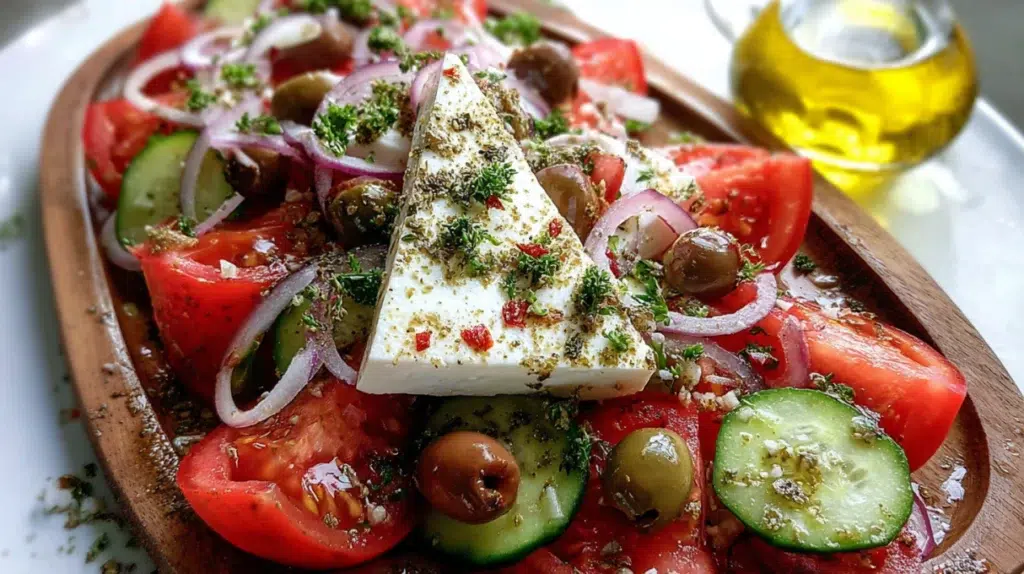
The most important thing I can tell you about Greek salad is that it does not contain lettuce.
The authentic horiatiki, the village salad is chunks of ripe tomato, thick slices of cucumber, rings of red onion, Kalamata olives, and a large slab of feta placed on top of the vegetables (not crumbled through them), dressed with excellent olive oil and dried Greek oregano, with a pinch of salt. No lettuce. No vinegar in the dressing. No croutons. No anchovies.
The American “Greek salad” with iceberg lettuce and an Italian-style dressing is a Americanized adaptation that bears the same relationship to horiatiki as a Domino’s pizza bears to a Neapolitan margherita. Both are fine. They are not the same thing.
The authentic version is simultaneously simpler and more demanding than the American version, it requires fewer ingredients but better ones. A Greek salad made in July with tomatoes from your garden and good feta and excellent olive oil is one of the greatest things you can eat. A Greek salad made in February with supermarket tomatoes and cheap feta is disappointing. This is a seasonal dish. Plan accordingly.
→ Full recipe in the authentic Greek salad recipe
Spanakopita: The Definitive Spinach Pie
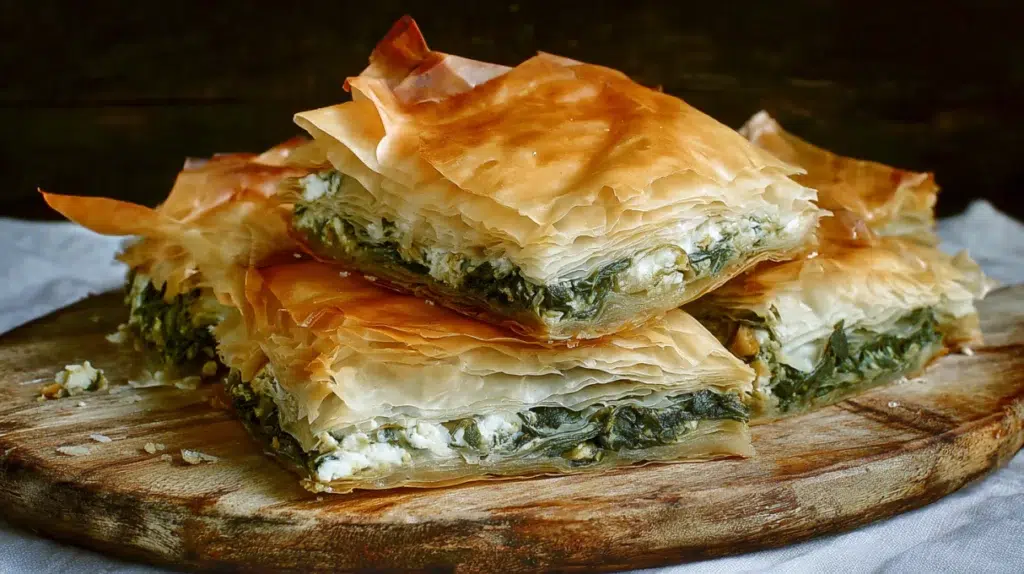
Spanakopita is the dish that makes people understand phyllo pastry, the extraordinary lightness of those tissue-thin layers when baked correctly, each sheet shattering at the touch, golden and slightly oily from the butter or olive oil brushed between them.
The filling is wilted spinach mixed with crumbled feta, eggs, onion, and dill seasoned simply, packed into a baking dish between layers of phyllo, baked until deeply golden. The result has no equivalent in American baking. The contrast between the crispy phyllo and the dense, salty, slightly creamy spinach-feta filling is one of the most satisfying textural experiences in cooking.
Working with phyllo intimidates many cooks. It should not. The sheets tear. The tears do not matter because you are layering eight to twelve sheets and the layers compensate for each other. Keep a damp cloth over the unused sheets to prevent them from drying out. Brush each sheet generously with butter or olive oil, this is not the moment for restraint. Work quickly but not frantically.
→ Full recipe in the spanakopita recipe guide
Greek Lamb: Kleftiko and Beyond
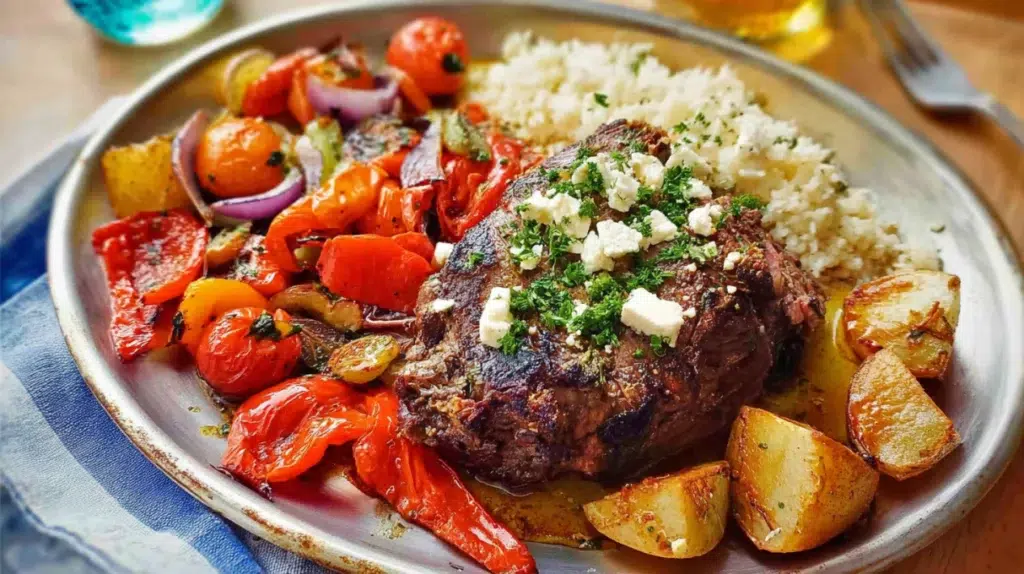
Greece is lamb country, the landscape, the grazing traditions, and the cooking all reflect a culture that has been working with lamb for thousands of years. Greek lamb cooking is some of the best lamb cooking in the world.
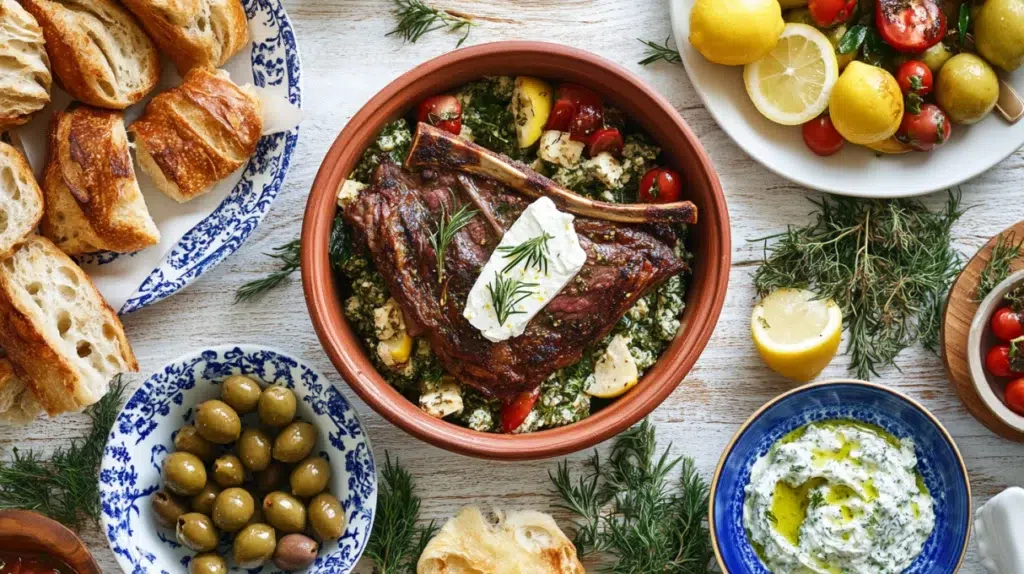
The signature preparation is kleftiko, lamb shoulder or leg slow-braised in a sealed parcel of parchment paper or foil with olive oil, lemon, garlic, oregano, and tomatoes, cooked at low temperature for three to four hours until the meat falls completely from the bone and the cooking juices have reduced to a concentrated, deeply savory sauce. The name comes from the Greek word for thief, kleftis, because the dish was supposedly cooked underground in sealed clay pots by mountain bandits hiding from the Ottomans, who needed a cooking method that produced no visible smoke.
The modern oven version produces the same extraordinary result, impossibly tender lamb with a concentrated herb-lemon-tomato sauce that demands good bread for mopping.
→ Full recipes in the Greek lamb recipes collection
Greek Dips: Tzatziki, Taramosalata and Skordalia
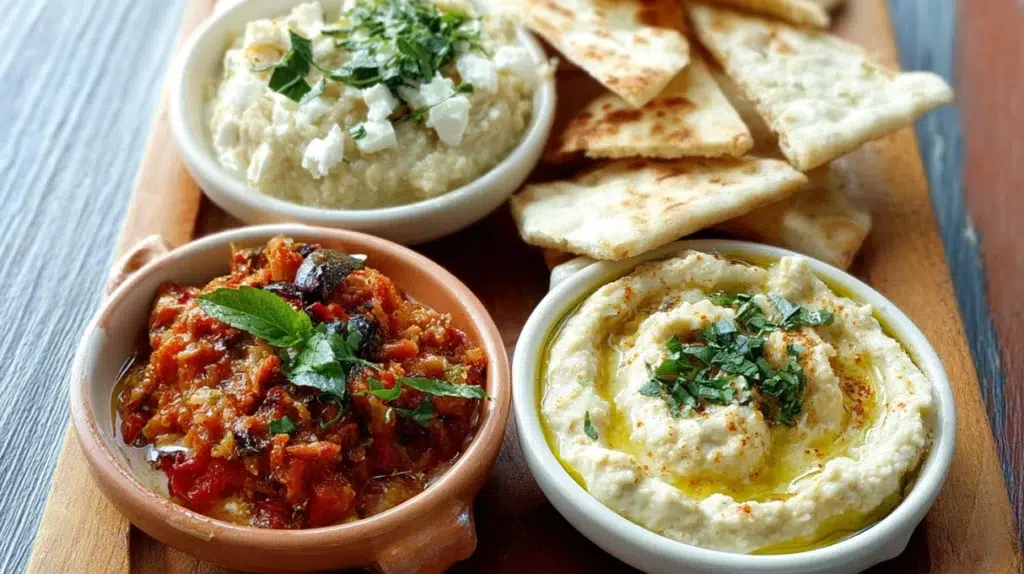
Greek dips are the entry point for most people into the cuisine and the area most frequently poorly executed. Tzatziki made with the wrong yogurt or too much garlic. Taramosalata made with the wrong roe. Skordalia that is either too sharp from raw garlic or too bland from too little.
Each dip has a specific technique and specific ingredients that produce the right result and getting those details correct transforms familiar names into genuinely extraordinary things.
Tzatziki: strained yogurt (FAGE full-fat, strained overnight through cheesecloth for an extra-thick result), cucumber grated and squeezed completely dry, garlic (less than you think), fresh dill, olive oil, a small amount of white wine vinegar. The cucumber must be squeezed, wet cucumber makes watery tzatziki.
Taramosalata: pink fish roe (tarama), white bread soaked and squeezed dry, olive oil, lemon juice, onion, blended until smooth and light pink. The bread gives it body and lightness simultaneously. The result should be pale pink, smooth, and subtly tangy.
Skordalia: a garlic and potato dip of extraordinary intensity and richness. Boiled potatoes mashed with enormous amounts of garlic, olive oil, and white wine vinegar until smooth and intensely garlicky. Not a mild dip. The garlic is the point.
→ Full recipes in the Greek dips collection
The Mezedes Table: The Heart of Greek Hospitality
Mezedes, Greek small plates shared at the center of the table is the philosophical heart of Greek food culture. Like the Lebanese mezze tradition it is built on, the idea is abundance and sharing rather than individual portions. Many small dishes covering the table, eaten slowly, accompanied by wine and conversation that extends for hours.
Dolmades, stuffed vine leaves are one of the great shared dishes of Greek and broader Middle Eastern cuisine, rice, lemon, and herbs wrapped in preserved vine leaves and cooked until tender, served at room temperature with a generous drizzle of olive oil and wedges of lemon. They appear on virtually every Greek mezedes table and at every Greek celebration.
A proper Greek mezedes spread includes tzatziki, taramosalata, skordalia, dolmades, saganaki (pan-fried kasseri cheese with lemon), grilled octopus when near the coast, spanakopita triangles, olives, fresh bread, and whatever the season offers. It is designed to be shared across two or three hours, not cleared in fifteen minutes.
Greek Food Culture: Things Worth Knowing
The kafeneio: the coffee shop as cultural institution
The Greek kafeneio, coffee shop is not the American coffeehouse. It is a specifically male-oriented social space where older men gather for hours over a small cup of thick, sweet Greek coffee, playing backgammon, arguing about politics, watching the street. The kafeneio has been the organizing social institution of Greek village life for generations. Understanding it explains something about the Greek relationship to time, the expectation that coffee, like meals, is not consumed quickly and moved past but lingered over as a social act.
Fasting and feasting: the Orthodox calendar
Greek Orthodox Christianity observes numerous fasting periods throughout the year, most significantly Lent before Easter during which meat, dairy, and sometimes fish are avoided. This has produced an extraordinary tradition of vegetarian and vegan Greek cooking that most non-Greeks are entirely unaware of. Lenten dishes, bean soups, vegetable stews, taramosalata made without eggs, simple greens dressed with olive oil and lemon are some of the most delicious and most underappreciated parts of the cuisine.
Easter is the feast that follows forty days of fasting and the Easter Sunday meal, with whole lamb roasting on a spit over an open fire, is one of the great celebrations in Greek food culture. The contrast between the austerity of Lent and the abundance of Easter Sunday is built into the cuisine at a fundamental level.
Philoxenia: hospitality as a sacred duty
Philoxenia, love of the stranger, or hospitality is one of the oldest Greek cultural values, encoded in the laws of Zeus and practiced in Greek homes for three thousand years. A guest in a Greek home is never allowed to leave without being fed. Refusing food that is offered is considered rude. Accepting it and eating generously is the correct response.
This hospitality shapes how Greek food is cooked generously, with care, with the goal of the guest feeling genuinely welcomed rather than merely fed. It is the same philosophy you find in Lebanese karam and Moroccan table generosity, the conviction that feeding someone is one of the most meaningful things you can do for them.
Regional variation: not one cuisine but many
Greek food varies significantly by region in ways that most non-Greeks never encounter. Cretan cooking, based on the Mediterranean diet model with extraordinary olive oil, wild greens, and local cheeses is different from Macedonian cooking in northern Greece, which shows more Ottoman influence. Island cooking reflects the sea, more seafood, different cheeses, different herbs. Epirus in the northwest has a rich tradition of meat pies. The Ionian islands show Italian influence from centuries of Venetian rule.
This regional variety is one of the things that make Greek cooking rewarding to explore beyond the obvious dishes.
How I Test Every Greek Recipe
The same three-cook process as every other cuisine, but Greek cooking presents a specific challenge worth naming honestly. Many Greek dishes depend on ingredient quality in a way that technique cannot compensate for. A Greek salad made with excellent summer tomatoes and PDO feta needs no technique at all. The same salad made with winter supermarket tomatoes and mediocre feta cannot be rescued by technique.
Where this applies I am transparent in every recipe, which dishes require seasonal ingredients to shine, which work year-round, and which ingredient upgrades make the biggest difference.
Frequently Asked Questions
Is Greek food very different from Turkish food?
More similar than either Greeks or Turks tend to admit, centuries of shared Ottoman history produced shared dishes, shared ingredients, and shared cooking techniques across both cuisines. The differences are real and meaningful in spice use, in specific preparations, in dairy traditions. But the similarities run deeper than either national cuisine publicly acknowledges. See the full Greek vs Turkish food comparison for the honest answer.
What is the difference between Greek and Lebanese food?
Both are Mediterranean cuisines built on olive oil, lemon, and fresh ingredients, but they diverge significantly in spice palette (Lebanese seven spice and sumac versus Greek oregano and mint), in meat traditions (lamb is central to both but prepared very differently), and in the grain tradition (Greek cooking is more pasta and bread-forward, Lebanese more bulgur and rice). Both are magnificent and genuinely distinct.
Do I need specialist equipment?
A baking dish for spanakopita. A heavy casserole for kleftiko and bean soups. A good wooden spoon. A sharp knife. Nothing expensive or specialist, Greek peasant cooking was designed for simple equipment and real ingredients.
Where do I start?
Make the Greek salad first. If you can source good summer tomatoes and PDO feta, make it immediately. It will recalibrate what you think Greek food is and everything else will follow from there.
All Greek Recipes on This Site
The Essential Dishes
Meat
Dips and Spreads
Comparisons