⏱ Rise: 1 hour 🔥Fry: 20 min 👤Makes: 30–35 balls 🌿Diet: Vegan
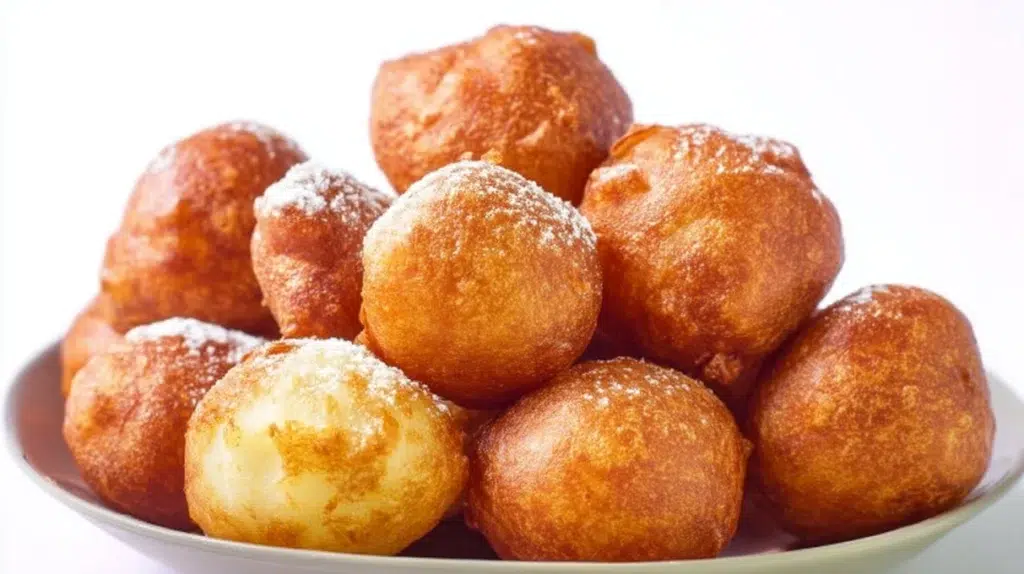
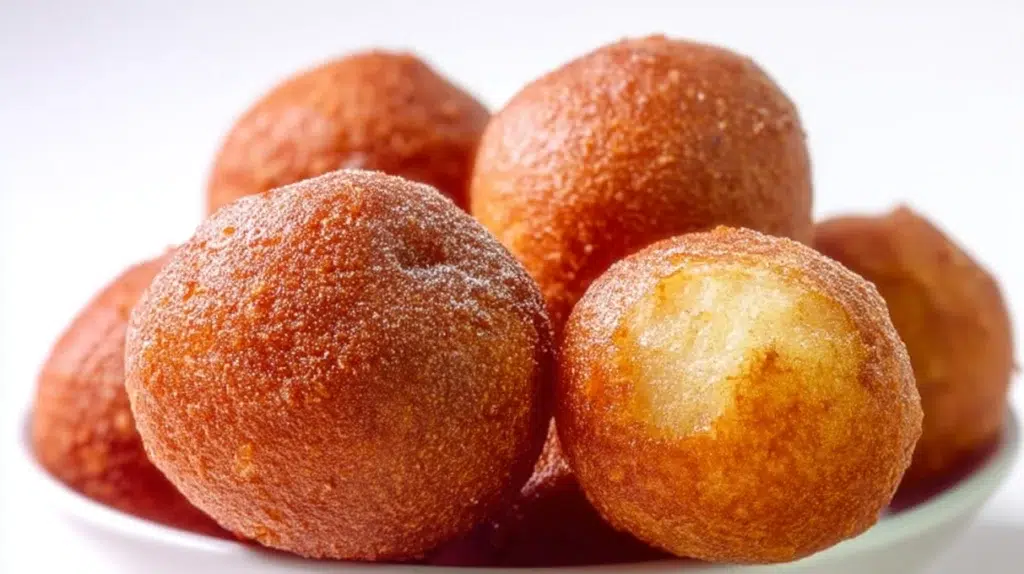
Puff puff recipe is the Nigerian street snack that anyone who has tasted it once understands immediately, golden, perfectly round fried dough balls with a slightly crispy exterior and a soft, pillowy, lightly sweet interior flavored with nutmeg that makes them impossible to eat just one of. Six ingredients. One hour of rising. Three minutes of frying per batch. They disappear faster than you can make them and are the first thing finished at every Nigerian party table.
Puff puff is Nigeria’s answer to the doughnut, but lighter, simpler and more addictive than any doughnut you have bought from a shop. Ghanaians call the same thing bofrot, Cameroonians also call it puff puff, and the French equivalent is the beignet. The Nigerian version is particular in one way: the nutmeg. That specific warm, slightly sweet spice note is what makes puff puff taste like puff puff rather than generic fried dough.
What you need
- 2 cups (250g) all-purpose flour, sifted. Sifting removes lumps and ensures a smooth, uniform batter. Do not use self-rising flour, the yeast provides all the lift needed.
- 2¼ teaspoons (1 packet) instant yeast, or active dry yeast. If using active dry yeast, proof it first, dissolve in warm water with 1 teaspoon sugar and wait 5–10 minutes until foamy before adding to the flour. If using instant yeast, mix directly into the dry ingredients.
- ½ cup (100g) granulated sugar, adjust to preference. ½ cup is medium sweet, the classic puff puff sweetness. Reduce to ⅓ cup for a less sweet version, increase to ¾ cup for extra sweet.
- ½ teaspoon freshly grated nutmeg, the defining spice of Nigerian puff puff. Freshly grated from a whole nutmeg is significantly more fragrant than pre-ground. Do not skip or reduce, it is the spice that makes puff puff taste like puff puff.
- ½ teaspoon salt
- 1¼ cups (300ml) warm water, 105°F–115°F (40°C–46°C). Too hot kills the yeast. Too cold will not activate it. The correct temperature feels pleasantly warm on your inner wrist, not hot, not cool.
- Vegetable oil for deep frying, enough for 3–4 inches depth. Sunflower, vegetable or canola oil all work. The oil must be at the correct temperature, 350°F–360°F (175°C–182°C).
Optional additions: ½ teaspoon ground cinnamon alongside the nutmeg, adds warmth. 1 teaspoon vanilla extract stirred into the warm water, adds fragrance. Both are non-traditional but good.
To serve: powdered sugar for dusting, traditional. Nigerian pepper sauce on the side, the savory version equally beloved.
Step by step
- Activate the yeast. If using instant yeast: combine flour, sugar, salt, nutmeg and instant yeast in a large bowl. Stir to distribute evenly. Add the warm water gradually while stirring, the batter will come together quickly. If using active dry yeast: dissolve 1 teaspoon of the sugar and the yeast in ¼ cup of the warm water. Stir once and leave for 5–10 minutes until the surface is foamy and fragrant. If no foam appears after 10 minutes the yeast is dead, start with fresh yeast. Combine flour, remaining sugar, salt and nutmeg in a bowl. Add the activated yeast mixture and the remaining warm water gradually.The water temperature is the most critical variable in puff puff. Too hot (above 120°F/49°C) kills the yeast entirely, the batter will not rise at all. Too cold (below 95°F/35°C) produces a very slow or failed rise. Use a thermometer if you have one. If not: the water should feel warm and comfortable on your inner wrist.
- Mix the batter. Stir everything together by hand or with a wooden spoon for 2–3 minutes until completely smooth with no dry flour pockets and no lumps. The batter should be thick, significantly thicker than pancake batter, but still loose enough to drop from a spoon in a slow, heavy fall. It should not be stiff enough to knead like bread dough. If it is too thick, add warm water 1 tablespoon at a time. If it is too thin, add flour 1 tablespoon at a time.The correct batter consistency is the most important factor in achieving perfectly round puff puff. Too thin and the batter spreads flat in the oil rather than forming a ball. Too thick and the puff puff does not rise properly and has a dense, doughy interior.
- Rise. Cover the bowl tightly with plastic wrap or a clean kitchen towel. Place in a warm spot, a slightly warm oven (turned on for 90 seconds then switched off), on top of the refrigerator or in a warm corner of the kitchen. Leave for 45–60 minutes until the batter has doubled in size and the surface shows bubbles and a slightly domed appearance. It will also smell distinctly yeasty and slightly sweet, this smell tells you it is ready.A cold kitchen dramatically slows the rise what takes 45 minutes in a warm kitchen can take 90 minutes at a cold room temperature. If your kitchen is cold, use the warm oven method. Do not fry until the batter has genuinely doubled. Under-risen batter produces puff puff that does not puff in the oil.
- Heat the oil. Pour vegetable oil into a heavy pot or deep skillet to a depth of 3–4 inches. Heat over medium to medium-high heat to 350°F–360°F (175°C–182°C). Test without a thermometer: drop a small amount of batter into the oil. It should rise to the surface within 2–3 seconds and begin sizzling actively. If it sinks and stays: oil too cold. If it browns within 30 seconds: oil too hot.Oil temperature is the second most critical variable after batter consistency. Too cold and the puff puff absorbs oil and comes out greasy. Too hot and the outside browns before the inside cooks through, you get golden puff puff that is raw dough in the center.
- Drop and fry. The batter is sticky and cannot be rolled, do not try. Dip a tablespoon or soup spoon into the hot oil first, the oil coating prevents the batter from sticking. Scoop a generous tablespoon of batter. Use your other hand or a second oiled spoon to push the batter off into the oil with a gentle twisting motion, this twisting action is what helps the batter form a round ball rather than an irregular blob. Fry 5–7 at a time without crowding. The puff puff will float immediately and begin rotating by themselves as the bottom side gets lighter.The self-rotating is not magic, it happens because the bottom cooks faster than the top, changing the density distribution and flipping the ball. Once the rotating slows, turn with a slotted spoon to ensure even golden color all over.
- Fry until golden and drain. Fry each batch for 4–6 minutes total, turning once or twice, until deep golden brown all over. Remove with a slotted spoon. Drain on a wire rack or paper towels. Check the oil temperature between batches, it drops with each batch. Allow it to return to 350°F before adding the next batch. Dust with powdered sugar while still warm. Serve immediately.
The honest note
The rise is the recipe. Puff puff that has not risen properly, batter that is flat, dense, has no surface bubbles will not puff in the oil. It will fry into dense, greasy dough balls that are still food but are not puff puff. The doubled volume and the surface bubbles and the sweet yeasty smell are not optional signs, they are the mandatory confirmation that the yeast has done its work and the batter is ready. If your puff puff has not risen after 60 minutes: check whether the water was too hot (killed the yeast), too cold (yeast never activated), or whether the yeast itself was expired. Old yeast is the most common cause of failed puff puff. Check the expiry date before you start and if you are unsure, proof the yeast first regardless of type.
Variations worth trying
Claire’s note
Spicy puff puff, the savory street vendor version: reduce the sugar to 2 tablespoons, omit the nutmeg, add 1 finely chopped scotch bonnet pepper or habanero and 2 tablespoons very finely diced onion to the batter after the rise. Fry exactly the same way. Serve with Nigerian pepper sauce rather than powdered sugar. This version is the one sold from roadside carts at dawn alongside akara and is equally beloved. Pepper-cheese puff puff: add 2 tablespoons finely chopped jalapeño and ¼ cup very finely grated parmesan to the batter. The cheese melts into pockets inside during frying. Completely non-traditional and completely worth making.
What to eat alongside
Puff puff is served as a standalone snack, hot from the oil, dusted with powdered sugar, eaten immediately with nothing else needed. At Nigerian parties it appears on the small chops platter alongside bobotie, akara, samosas and spring rolls as the first thing guests eat before the main meal. With Nigerian pepper sauce on the side the savory version works as a complete street breakfast alongside Nigerian pepper soup. For everything else on a Nigerian table, the jollof, the soups, the stews, the complete Nigerian recipes collection have it all.
Add puff puff to your weekly meal planner as a weekend baking project, make a double batch and freeze half. Reheat at 350°F for 8 minutes and they come back almost exactly to where they were. And for more recipes, follow us on Pinterest.
Print
Puff Puff
- Total Time: 75 minutes
- Yield: 30–35 balls 1x
- Diet: Vegan
Description
Puff puff is a beloved Nigerian street snack, featuring golden, round fried dough balls with a crispy exterior and a soft, sweet interior flavored with nutmeg.
Ingredients
- 2 cups (250g) all-purpose flour, sifted
- 2¼ teaspoons (1 packet) instant yeast, or active dry yeast
- ½ cup (100g) granulated sugar
- ½ teaspoon freshly grated nutmeg
- ½ teaspoon salt
- 1¼ cups (300ml) warm water (105°F–115°F)
- Vegetable oil for deep frying (enough for 3–4 inches depth)
- Optional: ½ teaspoon ground cinnamon, 1 teaspoon vanilla extract for flavor
- To serve: powdered sugar for dusting
Instructions
- Activate the yeast. Combine flour, sugar, salt, nutmeg, and instant yeast in a large bowl. Gradually add warm water while stirring until the batter forms. For active dry yeast, dissolve sugar and yeast in warm water and let it foam before adding.
- Mix the batter. Stir everything together until smooth, ensuring no dry flour remains. Adjust the thickness with warm water or flour as needed.
- Rise. Cover the bowl and let it sit in a warm place for 45–60 minutes until it’s doubled in size.
- Heat the oil in a deep pot to 350°F–360°F (175°C–182°C) and test if ready.
- Drop spoonfuls of batter into hot oil without crowding, then fry.
- Fry until golden brown, about 4–6 minutes, turning as needed. Drain on paper towels and dust with powdered sugar.
Notes
Ensure the yeast is fresh and the water temperature is correct for best results. Dust with powdered sugar while warm for a classic touch.
- Prep Time: 15 minutes
- Cook Time: 20 minutes
- Category: Snack
- Method: Frying
- Cuisine: Nigerian
Nutrition
- Serving Size: 1 ball
- Calories: 150
- Sugar: 6g
- Sodium: 220mg
- Fat: 8g
- Saturated Fat: 1g
- Unsaturated Fat: 6g
- Trans Fat: 0g
- Carbohydrates: 20g
- Fiber: 1g
- Protein: 3g
- Cholesterol: 0mg