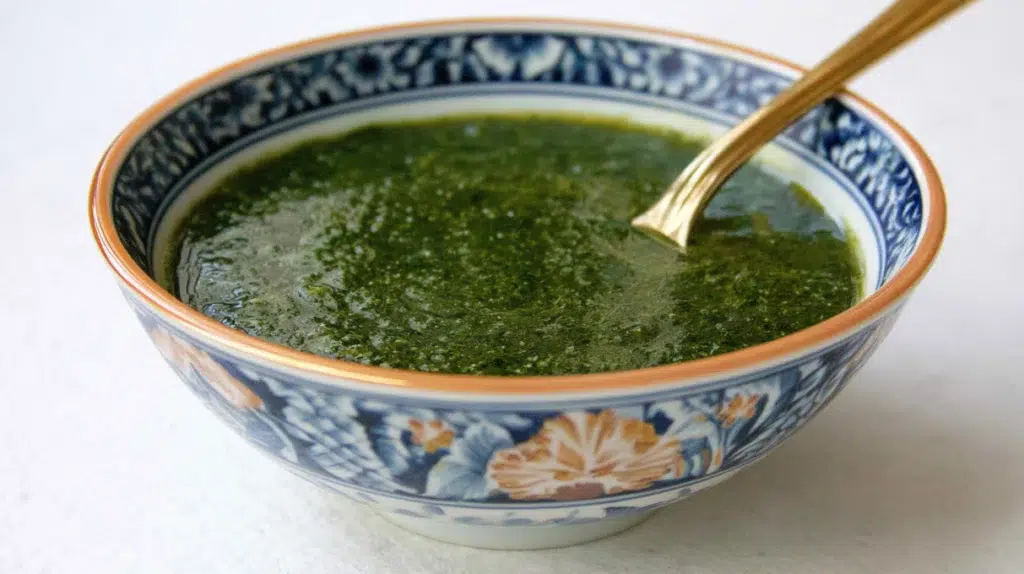
⏱ Broth: 1 hr 🔥Stew: 35 min 👤Serves: 6 🌍Origin: Lebanon / Egypt
Molokhia is a dish that requires a small act of faith from anyone making it for the first time, because the ingredient looks unlike anything in most Western kitchens, the texture is genuinely unlike anything else, and the flavour, once you taste it properly, becomes one of those things you find yourself craving specifically rather than just generically wanting “something good.”
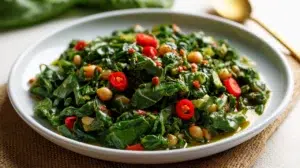
The word molokhia translates roughly as “of the kings”, a reference to the dish’s ancient origins in Pharaonic Egypt, where jute mallow leaves were said to be eaten by royalty. What it actually is: jute leaf stew, simmered in a garlicky, lemon-bright chicken broth with a generous ta’leya, a fried garlic and coriander paste stirred through twice during cooking, served over vermicelli rice with raw onion and wedges of lemon on the side. It is deeply savoury, deeply aromatic, slightly gelatinous in the way that only this leaf produces, and completely addictive once you understand what it is.
This recipe makes the Lebanese version, whole leaves in a thick broth with full notes on where it differs from the Egyptian version.
Ingredients
For the chicken and broth
- 1 whole chicken (about 1.5 kg), or 1 kg bone-in chicken thighs; bone-in pieces give a richer, more gelatinous broth than boneless. The whole chicken also provides the shredded meat that goes back into the stew.
- 1 large onion, quartered
- 2 cinnamon sticks
- 4 cardamom pods, lightly crushed
- 2 bay leaves
- Salt and black pepper
- 2 litres water
For the molokhia stew
- 200g dried molokhia leaves, the Lebanese version uses whole leaves, not minced. Dried is the easiest form to find in the US, available at Middle Eastern grocery stores. Alternatively: 500g frozen whole-leaf molokhia (added directly from frozen, no thawing needed), or 600g fresh leaves stripped from stems. Do not use the minced/powdered frozen form for this recipe, that is the Egyptian preparation.
- 3 tablespoons ghee or butter, ghee gives more depth; butter works well; olive oil if needed
- 10 cloves garlic, finely minced, a large quantity is correct; garlic is foundational, not a background note in this dish
- 1 large bunch fresh cilantro (coriander), finely chopped, about 60g leaves and fine stems. Fresh is essential; dried changes the character of the dish significantly.
- 1 teaspoon ground coriander in addition to the fresh; adds an earthier layer
- ½ teaspoon seven spice (baharat), optional but traditional in the Lebanese version
- 3 tablespoons fresh lemon juice, plus more at the table. Always fresh.
- Salt to taste
To serve
- Lebanese vermicelli rice, the traditional base; plain rice works but vermicelli rice is what this dish was built to sit on top of
- Raw white or red onion, thinly sliced, scattered alongside or over the stew at the table. Traditional and important, the sharpness cuts through the broth.
- Pita bread, for tearing and dipping
- Lemon wedges, extra lemon at the table is non-negotiable
Step by step
- Make the chicken broth. Place the whole chicken in a large pot with the quartered onion, cinnamon sticks, cardamom pods, bay leaves, salt and pepper. Cover with 2 litres of cold water. Bring to a boil, skimming off any foam that rises. Reduce to a gentle simmer, cover, and cook for 1 to 1.5 hours until the chicken is completely tender and falling off the bone. Remove the chicken and set aside to cool. Strain the broth through a fine sieve and set aside, you need at least 1.2 litres of clear, well-seasoned broth. The broth is the backbone of the entire dish. A rushed broth produces a flat molokhia regardless of how well you execute every other step. Season it generously, it should taste just slightly saltier than you want the finished stew, as the leaves will absorb some seasoning.
- Prepare the dried molokhia leaves. If using dried: place the leaves in a large bowl and cover with very hot water. Soak for 20–25 minutes until softened. Drain, then squeeze out as much liquid as possible with your hands. Repeat this soak-and-squeeze process 2–3 times until the water runs clear and no longer brown. The leaves should be damp but not wet. If using frozen whole leaves: skip this step entirely, add from frozen directly in step 4. If using fresh: strip leaves from thick stems, wash thoroughly in cold water, and dry. The repeated squeezing is not just cleaning, it controls the final texture of the stew. Thoroughly squeezed leaves release their natural mucilage more gradually into the broth during cooking, giving a silky body rather than an overly slimy result.
- Shred the chicken. Once cooled, remove the skin and bones from the chicken and shred the meat into rough pieces. Set aside.
- Make the ta’leya, the garlic-coriander base. In a large heavy pot, melt the ghee over medium heat. Reserve about 2 tablespoons of the minced garlic and a handful of the chopped cilantro to add again at the end. Add the remaining garlic to the pot and cook, stirring constantly, for 1–2 minutes until deeply fragrant and just turning golden at the edges, do not let it brown fully. Add most of the fresh cilantro and the ground coriander. Stir for 1 minute until fragrant. The ta’leya is the soul of molokhia. Don’t rush the garlic or let it burn, bitter garlic ruins the dish. The moment it smells fragrant and looks golden at the very edges, the next ingredient goes in immediately.
- Add the molokhia and broth. Add the prepared molokhia leaves to the ta’leya and stir to coat thoroughly in the garlic-coriander paste, cooking for 2–3 minutes. Pour in the hot strained chicken broth, start with 1.2 litres and add more depending on how thick or brothy you prefer the final stew. Add the seven spice if using. Bring to a gentle simmer.
- Simmer gently, do not boil hard. Cover and cook over low heat for 25–30 minutes, stirring occasionally. The leaves will soften and the broth will thicken slightly to a silky, lightly gelatinous consistency. Do not let it boil aggressively, a rolling boil breaks down the leaves too much and makes the texture muddy rather than silky.
- Finish with chicken, lemon and reserved ta’leya. Stir in the shredded chicken and the lemon juice. Add the reserved garlic and fresh cilantro, this second addition of the raw aromatics lifts and brightens the flavour at the end in a way the cooked portion alone doesn’t achieve. Simmer for 5 more minutes. Taste and adjust salt and lemon. The stew should be deeply savoury, garlicky, bright with lemon, and smell unmistakably of that specific jute-leaf character, earthy, green, slightly floral.
- Serve immediately. Spoon generously over vermicelli rice. Scatter thinly sliced raw onion over or alongside. Add lemon wedges and pita bread. Extra lemon at the table is traditional and expected, this is a dish where people season their own bowl.
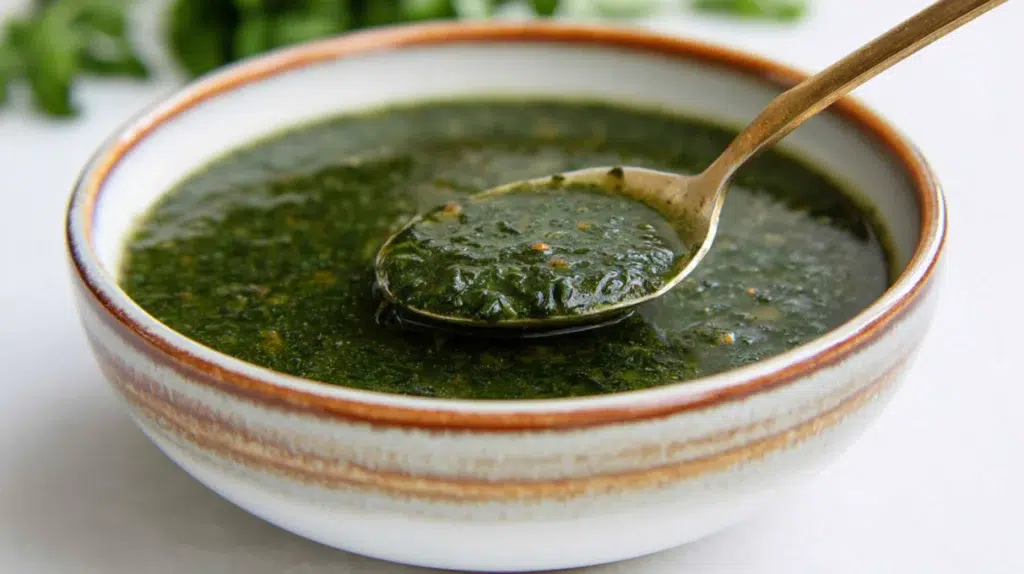
Lebanese vs Egyptian molokhia, the same dish, differently
These are genuinely different dishes that share an ingredient and a name. Understanding the distinction prevents confusion if you’ve eaten one version and are making the other.
The Lebanese version, mloukhieh, uses whole leaves that stay intact through cooking. The result is a thick, leaf-forward stew with visible whole leaves in a silky garlic broth. The leaves have presence and texture in every spoonful. Served over vermicelli rice with the shredded chicken stirred in.
The Egyptian version uses minced or finely chopped leaves, often frozen minced molokhia which dissolve almost entirely into the broth during the short cooking time, producing something closer to a dark green soup with a more uniform, liquid consistency. Egyptian molokhia is cooked much faster (minutes rather than thirty minutes) and the ta’leya is typically poured over the top of the simmering pot in a dramatic sizzle rather than cooked into the leaves from the beginning.
Both are correct. Both are delicious. They are not interchangeable if you are trying to make one specifically.
On the texture, what to expect and what it means
Molokhia has a natural mucilaginous quality, a slight gelatinous slip similar to okra that some people find unexpected and others immediately love. This is inherent to the jute leaf and is part of what gives the stew its characteristic silky body. It is not a sign that something went wrong. It is the dish. Anyone who has eaten molokhia at a Lebanese or Egyptian family table has eaten it with this texture and considered it the thing they came for. The correct approach is not to resist it but to understand it as the reason the stew coats the rice the way it does, richly, completely, in a way that a non-gelatinous broth never achieves.
Make it your own
Claire’s note
Molokhia is one of the best dishes to make in a large quantity on a Sunday and eat across the week, it reheats beautifully, the flavour deepens by day two, and it freezes well for up to three months. The version that comes out of the freezer after a month is, controversially, sometimes better than the fresh version because the leaves have had time to fully absorb the broth.
A whole habanero pepper added to the stew during simmering (left whole, removed before serving) adds warmth and flavour without making the dish spicy, this is a Lebanese technique worth borrowing. And if you find yourself with the leftovers getting thicker in the fridge overnight, that is normal, add a splash of water or broth when reheating and stir gently to bring it back.
Serve with
Molokhia sits over vermicelli rice or plain rice, always with raw onion and lemon alongside. For the complete Lebanese spread it pairs naturally with toum on the side and the complete Lebanese recipes collection has everything else from this tradition. The broader Middle Eastern recipes guide covers the Egyptian and regional context.
Add molokhia to your weekly meal planner, make a full batch on the weekend and it feeds the family generously across three days without any extra effort.
And for more recipes, follow us on Pinterest.
Print
Molokhia Stew
- Total Time: 115 minutes
- Yield: 6 servings 1x
- Diet: Paleo
Description
A savory jute leaf stew simmered in a garlicky chicken broth, served over vermicelli rice, perfect for a comforting meal.
Ingredients
- 1 whole chicken (about 1.5 kg) or 1 kg bone-in chicken thighs
- 1 large onion, quartered
- 2 cinnamon sticks
- 4 cardamom pods, lightly crushed
- 2 bay leaves
- Salt and black pepper, to taste
- 2 litres water
- 200g dried molokhia leaves (or 500g frozen whole-leaf molokhia)
- 3 tablespoons ghee or butter
- 10 cloves garlic, finely minced
- 1 large bunch fresh cilantro (coriander), finely chopped
- 1 teaspoon ground coriander
- ½ teaspoon seven spice (baharat), optional
- 3 tablespoons fresh lemon juice
- Lebanese vermicelli rice, for serving
- Raw white or red onion, thinly sliced, for serving
- Pita bread, for serving
- Lemon wedges, for serving
Instructions
- Make the chicken broth: Place the chicken in a large pot with the onion, cinnamon, cardamom, bay leaves, salt, and pepper. Cover with water and bring to a boil. Reduce to a gentle simmer and cook for 60–90 minutes. Remove chicken, strain broth and set aside.
- Prepare the molokhia: Soak dried leaves in hot water for 20–25 minutes until softened. Drain and squeeze out excess liquid.
- Shred the chicken: Once cooled, remove skin and bones, and shred meat into pieces.
- Make the ta’leya: In a pot, melt ghee over medium heat. Reserve some garlic and cilantro, then cook remaining garlic until fragrant. Add most cilantro and ground coriander, stirring for 1 minute.
- Add the molokhia and broth: Stir molokhia leaves into ta’leya. Pour in hot strained broth, simmer gently.
- Simmer: Cook over low heat for 25–30 minutes, stirring occasionally.
- Finish the stew: Stir in shredded chicken, lemon juice, reserved garlic, and cilantro. Simmer for 5 more minutes. Adjust taste.
- Serve immediately over vermicelli rice with raw onion, lemon wedges, and pita bread.
Notes
Molokhia can be made in large quantities and reheats beautifully. Add a whole habanero pepper during simmering for warmth without the spice.
- Prep Time: 20 minutes
- Cook Time: 95 minutes
- Category: Main Course
- Method: Simmering
- Cuisine: Middle Eastern
Nutrition
- Serving Size: 1 serving
- Calories: 400
- Sugar: 3g
- Sodium: 500mg
- Fat: 15g
- Saturated Fat: 6g
- Unsaturated Fat: 8g
- Trans Fat: 0g
- Carbohydrates: 40g
- Fiber: 5g
- Protein: 25g
- Cholesterol: 70mg