
⏱ Active: 15 min 🌡️Marinate: 4 hrs 🥚Makes: 6 eggs
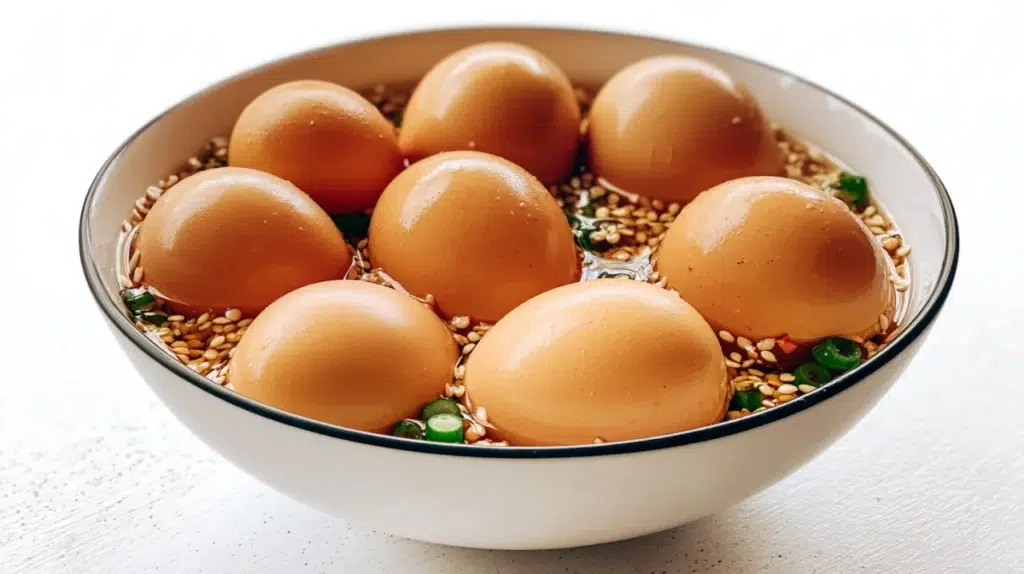
Mayak eggs, mayak gyeran in Korean, literally “drug eggs”, are soft-boiled eggs with jammy yolks marinated in a soy sauce brine loaded with garlic, green onion, gochugaru, honey and sesame. The name refers to their addictive quality rather than any ingredient. Four hours in the marinade and the whites are stained a deep mahogany, the yolk is custardy and orange, and the flavour has penetrated every millimetre of the egg. Overnight is better. They keep for three days. You will make a second batch before the first is finished.
The technique has two parts: a precise soft boil (6 minutes 30 seconds, ice bath immediately after), and a marinade that covers the eggs completely. Both are simple. The marinade does all the work while you sleep. The hardest part is waiting.
Ingredients
- 6 large eggs, at room temperature, pull from the fridge 30 minutes before boiling. Cold eggs crack more easily when they hit boiling water, the rapid temperature change stresses the shell. Room temperature eggs also cook more evenly, producing a more consistent jammy yolk rather than a cooked ring around the outside with a runny centre.
- 1 tablespoon white vinegar, added to the boiling water. Helps with easier peeling and prevents cracking if a shell does chip.
For the marinade
- 80ml (⅓ cup) soy sauce, the primary seasoning. Japanese soy sauce (Kikkoman, Yamasa) gives a cleaner, lighter result. Korean soy sauce (Jin, Sempio) gives a slightly stronger, more savoury flavour. Both are correct.
- 80ml (⅓ cup) water
- 2 tablespoons honey, or rice syrup (mulyeot), which is the more traditional Korean sweetener. Honey produces a slightly more complex sweetness. Sugar also works, use 1½ tablespoons.
- 1 tablespoon rice vinegar, adds a mild acidity that brightens the marinade and prevents it from tasting flat
- 1 tablespoon toasted sesame oil, added to the marinade, not as a garnish only. Adds richness and the characteristic Korean sesame aroma that penetrates the egg white during marinating.
- 1 teaspoon gochugaru (Korean red pepper flakes), coarser and less sharp than regular chili flakes, with a slight smokiness and fruity heat. Available at Korean grocery stores. Substitute: ½ teaspoon regular chili flakes + ½ teaspoon sweet paprika.
- 4 cloves garlic, finely minced, do not reduce the garlic. It is a dominant flavour and what distinguishes mayak eggs from a simple soy-marinated egg.
- 4 green onions (scallions), thinly sliced, whites and greens both go into the marinade
- 1 red chili, thinly sliced, optional, for extra heat. Jalapeño or Fresno chili both work.
- 1 tablespoon toasted sesame seeds
Step by step
- Bring eggs to room temperature. Remove eggs from the fridge 30 minutes before cooking. While they come up to temperature, prepare the marinade.
- Make the marinade. Combine the soy sauce, water, honey, rice vinegar and sesame oil in a bowl. Stir until the honey is fully dissolved. Add the gochugaru, garlic, green onion, chili and sesame seeds. Mix well. Taste, it should be salty, sweet, slightly spicy and deeply savoury. Adjust the honey (more sweetness) or soy sauce (more salt) to your preference. Pour into a container deep enough to fully submerge 6 eggs. Taste and adjust the marinade before the eggs go in, this is the only opportunity. Once the eggs are marinating the balance cannot be changed without starting a new batch.
- Soft boil the eggs, 6 minutes 30 seconds exactly. Bring a pot of water to a rolling boil. Add the white vinegar. Using a spoon or tongs, gently lower the room-temperature eggs into the boiling water one at a time. Set a timer immediately for 6 minutes 30 seconds. Maintain a gentle, rolling boil, not a vigorous full boil which bounces the eggs around. 6 minutes 30 seconds produces a fully set white and a jammy, slightly runny orange yolk. 6 minutes produces a more runny yolk. 7 minutes produces a yolk that is almost fully set with a slightly creamy centre. Choose based on preference, 6 minutes 30 seconds is the standard for mayak eggs.
- Ice bath immediately. When the timer goes off, transfer eggs immediately to a bowl of ice water. Leave for at least 5 minutes until completely cool. The ice bath stops the cooking instantly, eggs left in warm water continue cooking for several minutes from residual heat, turning the jammy yolk into a fully set one.
- Peel carefully. Peel the cooled eggs gently, soft-boiled eggs are more fragile than hard-boiled. Tap the shell all over against the side of the bowl to create fine cracks, then peel under a thin stream of cold running water, which gets under the membrane and makes peeling easier. The white is fully set and should hold its shape cleanly.
- Marinate. Lower the peeled eggs gently into the marinade, soft-boiled eggs can split if dropped. The eggs must be completely submerged. If the marinade doesn’t fully cover them, lay a piece of paper towel or plastic wrap directly on the surface and press it down over the eggs, the marinade wicks up through the paper and keeps the tops evenly coated. Cover the container and refrigerate for a minimum of 4 hours, overnight is significantly better. After 4 hours the whites will be lightly stained and the flavour is present but mild. After 12 hours (overnight) the whites are deeply stained mahogany, the flavour has fully penetrated and the garlic and sesame are pronounced throughout. The difference between 4 hours and overnight is noticeable, make these the night before whenever possible.
- Remove from marinade after 24–48 hours. If you are not eating all the eggs within 24 hours, remove them from the marinade and store separately, continued soaking makes the whites rubbery and oversalted. The eggs keep for 3–4 days refrigerated out of the marinade. The marinade itself keeps for up to 1 week and can be reused 2–3 times with fresh batches of soft-boiled eggs.
Claire’s note
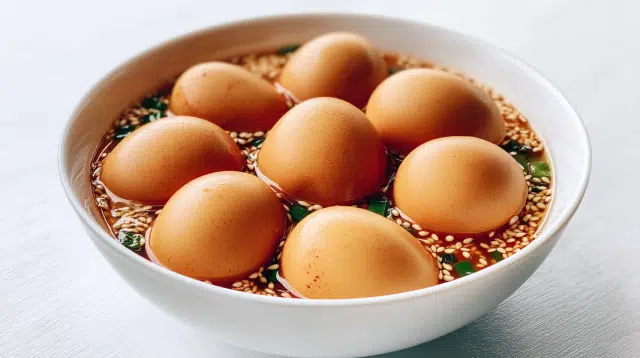
The eggs must be completely submerged in the marinade or you get uneven colouring, one half dark mahogany, one half pale yellow, which looks wrong and means the flavour hasn’t penetrated the top half. If your container isn’t deep enough to fully cover the eggs, use a smaller, deeper container, or press a piece of cling film directly onto the surface of the marinade, pushing it against the eggs so the liquid contacts every surface.
The paper towel trick works equally well, lay it over the eggs and press it into the marinade and it wicks the liquid up to coat the tops evenly. Either method, check after an hour and turn the eggs gently if any pale patches are visible.
How to serve mayak eggs
The classic way: halve the eggs lengthwise over a bowl of steamed white rice. Spoon 2–3 tablespoons of the marinade directly over the rice and egg. Add a drizzle of sesame oil, a few extra sesame seeds and a little more sliced green onion. The marinade doubles as the rice seasoning, it is as good as any sauce. Mayak eggs also work as a Korean banchan (side dish) alongside other dishes, tucked into grain bowls, sliced over ramen or eaten cold from the fridge as a protein-rich snack.
Serve with
Mayak eggs over rice is the core serving. For a full Korean meal: alongside Korean beef bowl, kimchi and steamed rice. They also work as a topping for chicken yakitori, slice in half and add to the bowl in the last step. The complete Korean recipes collection has everything alongside.
Add mayak eggs to your weekly meal planner as a Sunday prep stapl, 15 minutes of active work Sunday evening, ready for every meal Monday through Wednesday. Make a double batch, the marinade is reusable.
And for more recipes, follow us on Pinterest.
Print
Mayak Eggs (Korean Drug Eggs)
- Total Time: 4 hours 15 minutes
- Yield: 6 servings 1x
- Diet: Vegetarian
Description
Addictive soft-boiled eggs marinated in a flavorful soy sauce brine, perfect as a side dish or protein-rich snack.
Ingredients
- 6 large eggs, at room temperature
- 1 tablespoon white vinegar
- 80ml (⅓ cup) soy sauce
- 80ml (⅓ cup) water
- 2 tablespoons honey
- 1 tablespoon rice vinegar
- 1 tablespoon toasted sesame oil
- 1 teaspoon gochugaru
- 4 cloves garlic, finely minced
- 4 green onions, thinly sliced
- 1 red chili, thinly sliced (optional)
- 1 tablespoon toasted sesame seeds
Instructions
- Bring eggs to room temperature. Remove eggs from the fridge 30 minutes before cooking.
- Make the marinade. Combine soy sauce, water, honey, rice vinegar, and sesame oil in a bowl. Stir until honey is dissolved and add gochugaru, garlic, green onion, chili, and sesame seeds. Mix well.
- Soft boil the eggs for 6 minutes 30 seconds. Bring a pot of water to a rolling boil, add white vinegar, and lower the eggs into the boiling water.
- Ice bath immediately. Transfer eggs to a bowl of ice water for at least 5 minutes.
- Peel the cooled eggs carefully under cold running water.
- Marinate the peeled eggs in the marinade, ensuring they are completely submerged. Cover and refrigerate for a minimum of 4 hours or overnight for best results.
- Remove from marinade after 24–48 hours if not consuming all at once.
Notes
Use room temperature eggs to avoid cracking. Ensure eggs are fully submerged in the marinade for even flavoring.
- Prep Time: 15 minutes
- Cook Time: 6 minutes 30 seconds
- Category: Side Dish
- Method: Boiling
- Cuisine: Korean
Nutrition
- Serving Size: 1 egg
- Calories: 130
- Sugar: 5g
- Sodium: 600mg
- Fat: 5g
- Saturated Fat: 1g
- Unsaturated Fat: 3g
- Trans Fat: 0g
- Carbohydrates: 12g
- Fiber: 0g
- Protein: 8g
- Cholesterol: 210mg