⏱ Prep: 30 min 🔥Simmer: 2–2.5 hrs 👤Serves: 4–6 🌍Origin: Iran
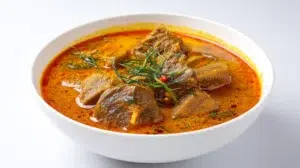
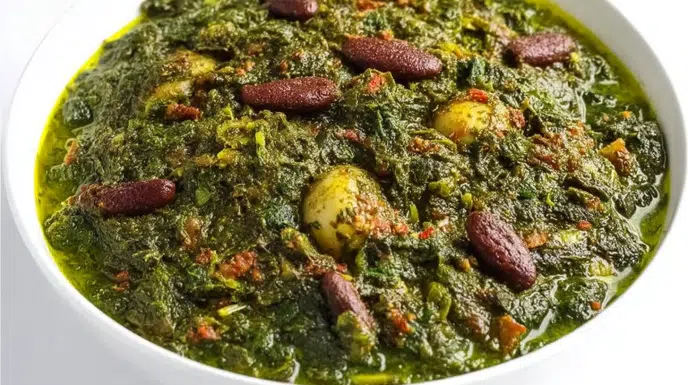
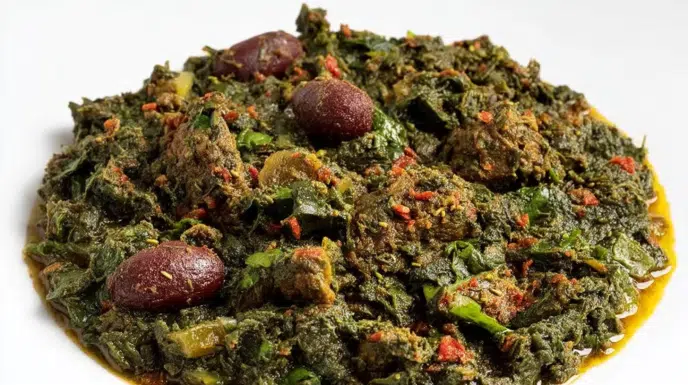
Ghormeh Sabzi Herb Stew is the national dish of Iran, a stew so deeply embedded in Persian culture that the smell of it cooking in a home is universally understood as a signal that something important is being celebrated. Fresh parsley, cilantro, spinach and scallions fried low and slow in oil until almost black and intensely concentrated, combined with lamb or beef, kidney beans and dried Persian limes that release a haunting, uniquely tart and earthy citrus note into the broth over two hours of simmering. It takes time. It is worth every hour.
Ingredients
For the meat base
- 1½ lbs (680g) bone-in lamb shoulder or beef chuck, cut into 2-inch chunks. Bone-in lamb is the most traditional and produces the richest broth. Boneless beef chuck is widely available and produces an excellent result. Do not use lean cuts, the collagen and fat in shoulder and chuck break down over the long simmer and produce the thick, glossy broth that defines ghormeh sabzi.
- 1 large yellow onion, finely diced
- 3 tablespoons neutral oil or vegetable oil
- 1 teaspoon ground turmeric, the base spice of Persian cooking, gives the meat and broth their characteristic warm golden colour
- ½ teaspoon black pepper
- 1 teaspoon salt
- 3 cups (720ml) hot water or beef broth
For the herb mixture (sabzi)
- 3 cups fresh flat-leaf parsley, packed, stems removed, finely chopped. Parsley is the primary herb and makes up the largest portion of the sabzi. The sabzi means herbs or greens in Farsi and is literally in the name of the dish.
- 1 cup fresh cilantro, packed, finely chopped. Some cooks omit cilantro, both with and without are traditional depending on region.
- 1 cup fresh spinach, finely chopped or baby spinach. Adds body and a slightly milder herbal note alongside the parsley.
- ½ cup scallions, finely sliced or chives or leek. Adds a mild onion note to the herb base.
- 3 tablespoons dried fenugreek leaves (shanbalileh), the defining flavour of ghormeh sabzi alongside the dried lime. Adds a distinctive slightly bitter, almost maple-like depth that no other herb replicates. Available at Persian grocery stores, Indian grocery stores (sold as kasuri methi) and online. Do not fry the dried fenugreek, add it off the heat after the fresh herbs are cooked, confirmed by multiple Persian sources as essential to prevent bitterness.
- 3–4 tablespoons neutral oil, for frying the herbs down to a dark, concentrated paste
For the stew
- 1 can (15 oz/425g) red kidney beans, drained and rinsed. Or dried kidney beans soaked overnight and boiled until just tender before adding. The beans are added in the final 30 minutes, added too early they turn mushy.
- 4–5 dried Persian limes (limoo amani), the most important single ingredient in ghormeh sabzi and the one with no true substitute. They give the stew its characteristic haunting, slightly bitter, deeply tart citrus flavour that fresh lime cannot replicate. Pierce each lime 4–5 times with a fork or crack them lightly with a rolling pin before adding, this releases the juice and aromatic oils during simmering. Available at Persian grocery stores, Middle Eastern grocery stores and Amazon. Substitute if absolutely unavailable: juice of 2 limes plus 1 teaspoon dried lime powder.
- 1 teaspoon ground turmeric, added to the herbs
- Salt to taste
- 1–2 tablespoons fresh lemon juice, added at the very end to brighten and balance the tartness of the dried limes
Step by step
- Soak the beans if using dried. If using dried kidney beans: soak overnight in cold water. Drain, cover with fresh water and boil for 45 minutes until just tender. Drain and set aside. If using canned: drain, rinse and set aside for later.
- Prepare and crack the dried limes. Pierce each dried lime 4–5 times all over with a fork. Alternatively press down on each lime with a rolling pin to crack the skin slightly, this allows the stew to extract maximum flavour from the lime during simmering. Set aside.The dried limes must be pierced or cracked, whole intact dried limes release very little flavour. The holes allow the broth to enter the lime and the lime’s juice and aromatic oils to seep out slowly over the long simmer. The resulting flavour is smoky, tart and deeply complex, entirely different from fresh lime juice.
- Brown the meat. Heat 3 tablespoons of oil in a large heavy pot over medium-high heat. Season the meat with turmeric, salt and pepper. Brown the chunks all over in batches, 4–5 minutes per batch. Do not crowd. Remove and set aside. In the same pot, add the diced onion. Cook over medium heat for 8–10 minutes until deeply golden, not just soft. Add the browned meat back to the pot. Add the hot water or broth. Bring to a boil, skim any foam, reduce to a steady simmer. Cover and cook for 45 minutes.While the meat simmers, prepare the herbs. Use this 45 minutes to fry the herb mixture, it needs time and attention.
- Fry the herbs, the defining step. Heat 3–4 tablespoons of oil in a wide skillet over medium heat. Add the chopped parsley, cilantro, spinach and scallions. Cook for 15–20 minutes, stirring frequently, until the herbs have completely wilted, lost most of their moisture and turned a very deep, almost dark green. The volume reduces dramatically, from a large pile to a small, dense, concentrated mass. The colour should look almost too dark. This is correct. Remove from heat. Sprinkle the dried fenugreek over the cooked herbs and stir through. Do not cook the fenugreek in the oil, add it off the heat.The deep frying of the herbs until almost black is the single most important technique in ghormeh sabzi. It concentrates the herb flavours dramatically and creates the deep, complex, earthy base that makes this stew taste unlike any other. Under-fried bright green herbs produce a flat, one-dimensional result. Deeply fried dark herbs produce the authentic depth that defines the dish. This step takes a full 15–20 minutes and requires patience.
- Combine and simmer. After the meat has cooked for 45 minutes, add the fried herb mixture and the pierced dried limes to the pot. Stir well to combine. Add a little more water or broth if needed, the stew should be thick but pourable. Cover and simmer over low heat for 1 hour, stirring occasionally.
- Add the beans. Add the drained kidney beans to the stew. Stir gently. Taste the broth and adjust salt. Continue simmering uncovered for 20–30 minutes until the beans are heated through and the stew has reached a thick, rich consistency. Add the fresh lemon juice. Taste one final time.The finished ghormeh sabzi should taste deeply herby, pleasantly tart from the dried limes, savory from the meat and beans, with a slightly bitter, earthy background note from the fenugreek. If the tartness feels too sharp, add a pinch of sugar. If the stew tastes flat, add more salt and a squeeze of lemon.
- Remove the dried limes and serve. Remove and discard the dried limes before serving, they become very soft and bitter by the end of the simmer and are not pleasant to eat. Serve over steamed basmati rice or alongside tahdig.
The two non-negotiables
The two special ingredients that give Ghormeh Sabzi Herb Stew its distinct flavour are the limoo amani, dried limes, along with a herb named shambalileh, known as fenugreek. Remove either one and the dish is no longer ghormeh sabzi.
The dried lime is a dried, blackened lime that tastes like a turbo-blasted lemon peel, smoky, tart, slightly bitter, with an aromatic complexity that fresh lime cannot approach. It is the single most irreplaceable ingredient. Order it online if you cannot find it locally.
The fenugreek must be added off the heat, not fried in oil. It is important not to fry the fenugreek as it can give the dish a bitter taste. Crumbled over the fried herbs after they have been removed from the heat, it releases its characteristic slightly bitter, maple-like depth without turning acrid.
Make it ahead
Claire’s note
Ghormeh Sabzi Herb Stew is one of the great make-ahead stews, it improves significantly the next day as the dried lime flavour deepens and the herbs and meat fully integrate. Refrigerate for up to 5 days. Freeze for up to 3 months, the herbs hold their flavour beautifully after freezing and thawing. Reheat gently over low heat with a splash of water. The fried herb mixture can be made up to 2 days ahead and refrigerated, it is the most labour-intensive step and doing it in advance reduces the day-of cooking to an almost hands-off process. Many Persian families make the fried herbs in large batches and freeze them, a well-established practice that saves significant time on the day.
Serve with
Ghormeh Sabzi Herb Stew is perfect served with fluffy basmati rice or tahdig. The combination of the intensely herby, tart stew over fragrant basmati with a crispy tahdig crust is one of the definitive experiences of Persian cuisine. For everything else on the Persian and broader Middle Eastern table the complete Middle Eastern recipes collection has it all.
Add Ghormeh Sabzi Herb Stew to your weekly meal planner, make the fried herbs Saturday, assemble and simmer Sunday, better Monday through Thursday. And for more recipes, follow us on Pinterest.
Print
Ghormeh Sabzi Herb Stew
- Total Time: 180 minutes
- Yield: 4–6 servings 1x
- Diet: Contains Meat
Description
A classic Persian stew made with a blend of herbs, meat, and dried limes, perfect for a celebratory meal.
Ingredients
- 1½ lbs (680g) bone-in lamb shoulder or beef chuck, cut into 2-inch chunks
- 1 large yellow onion, finely diced
- 3 tablespoons neutral oil or vegetable oil
- 1 teaspoon ground turmeric
- ½ teaspoon black pepper
- 1 teaspoon salt
- 3 cups (720ml) hot water or beef broth
- 3 cups fresh flat-leaf parsley, packed, stems removed, finely chopped
- 1 cup fresh cilantro, packed, finely chopped
- 1 cup fresh spinach, finely chopped
- ½ cup scallions, finely sliced
- 3 tablespoons dried fenugreek leaves
- 3–4 tablespoons neutral oil, for frying
- 1 can (15 oz/425g) red kidney beans, drained and rinsed
- 4–5 dried Persian limes, pierced
- 1 teaspoon ground turmeric, added to the herbs
- Salt to taste
- 1–2 tablespoons fresh lemon juice
Instructions
- Soak the beans if using dried: soak overnight in cold water, then boil for 45 minutes until just tender.
- Prepare and crack the dried limes by piercing them 4–5 times with a fork.
- Brown the meat in a large pot with oil, seasoned with turmeric, salt, and pepper.
- Cook the diced onion in the same pot until deeply golden, then add the meat back.
- Add hot water or broth, bring to a boil, reduce heat, and simmer for 45 minutes.
- Fry the herb mixture in a skillet until dark and concentrated, about 15–20 minutes.
- Combine the fried herbs and pierced dried limes with the meat in the pot. Simmer for 1 hour.
- Add the kidney beans to the stew during the last 20–30 minutes of simmering.
- Remove and discard the dried limes before serving the stew.
Notes
Refrigerate for up to 5 days or freeze for up to 3 months. The flavor improves after a day.
- Prep Time: 30 minutes
- Cook Time: 150 minutes
- Category: Main Course
- Method: Simmering
- Cuisine: Persian
Nutrition
- Serving Size: 1 serving
- Calories: 450
- Sugar: 4g
- Sodium: 700mg
- Fat: 20g
- Saturated Fat: 6g
- Unsaturated Fat: 10g
- Trans Fat: 0g
- Carbohydrates: 40g
- Fiber: 9g
- Protein: 30g
- Cholesterol: 70mg