⏱ Prep: 15 min 👤Serves: 4 🌿Vegan 🫒Palestinian
Jerusalem salad is a Palestinian chopped salad, one of the oldest and most widely eaten salads in the Levant, made from what grows on the land: cucumber, tomato, onion, parsley, lemon and olive oil. It appears on every table across Palestine, Lebanon, Jordan and the broader region under different names but the same essential idea. In its simplest form it has five ingredients.
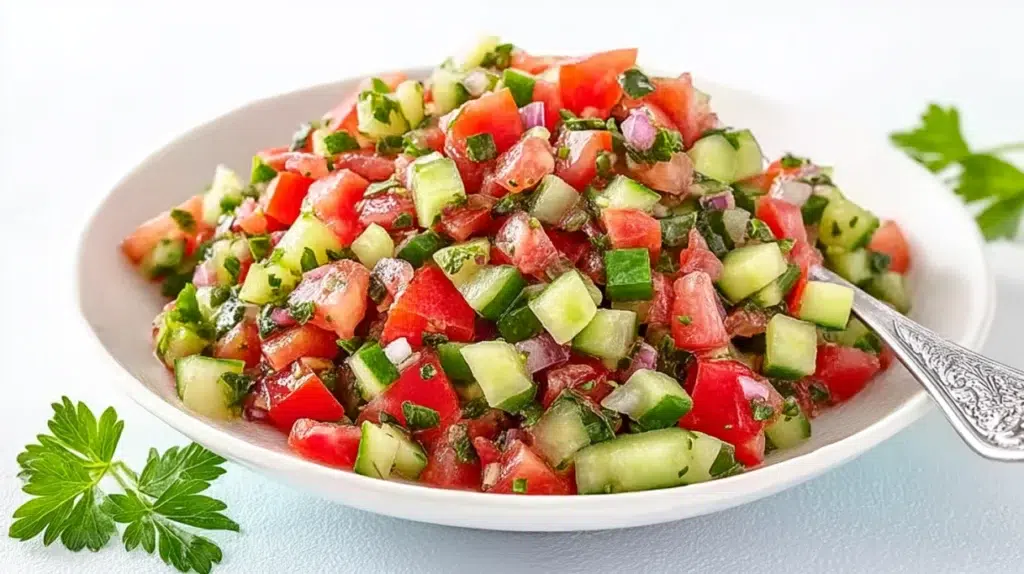
In its fuller form it has sumac, fresh mint, a pinch of salt that draws out the vegetable juices, and the finest dice you can manage. That last detail, the fine dice is not aesthetic. It changes how the salad eats: the smaller the pieces, the more evenly the dressing coats everything, the more the flavours combine in each mouthful rather than arriving separately.
It is a 15-minute salad. It is also one of the most versatile things in Middle Eastern cooking, served alongside grilled meat, hummus, falafel, fish, rice dishes, and anything else that benefits from something bright and acidic alongside it.
Ingredients
- 3 medium ripe tomatoes, Roma or vine tomatoes work best, they have less excess moisture than beefsteak. Deseed before dicing: halve each tomato, squeeze or scoop out the watery seed pulp, then dice the flesh. This prevents the salad from becoming a watery pool within minutes of dressing.
- 2 medium cucumbers, Persian cucumbers are ideal, thin-skinned, crisp, minimal seeds, no peeling needed. English cucumber works well, peel and deseed. Regular cucumbers should be peeled and deseeded. The skin of Persian cucumbers is tender enough to leave on.
- ½ small red onion, very finely diced, or 3 green onions (scallions), thinly sliced, for a milder flavour. Raw red onion is sharp, if you want to mellow it, soak the diced onion in cold water for 10 minutes, then drain and pat dry before adding.
- Large handful flat-leaf parsley, finely chopped, the essential herb. Chop finely, no large leafy pieces. Remove the thick stems and use leaves and thin stems only.
- Small handful fresh mint, finely chopped, optional but traditional across much of the Levant. Adds a clean freshness that makes the salad feel lighter. Do not skip if available.
- Juice of 1½ lemons, fresh only. Bottled lemon juice produces a flat, slightly bitter result. The lemon is the primary acid, taste and adjust after dressing.
- 3 tablespoons good extra-virgin olive oil, this is one of the few ingredients in the dressing, use the best olive oil you have. It affects the flavour directly.
- 1 teaspoon sumac, optional but strongly recommended. A lemony, slightly astringent spice that adds a tartness different from the lemon juice, more complex and less sharp. Available at Middle Eastern grocery stores and many supermarkets. If unavailable, add an extra squeeze of lemon.
- ½ teaspoon fine salt, plus more to taste. Salt draws moisture from the tomatoes and cucumber, which concentrates the flavour slightly.
- Black pepper to taste
Step by step
- Prep the vegetables, the fine dice. Deseed the tomatoes: halve crosswise, squeeze out the seed pulp, dice the flesh into pieces no larger than 1cm, smaller is better. Dice the cucumber to the same size. Finely dice the red onion. Finely chop the parsley and mint. Keep each component separate for now. Uniformity of dice matters more than speed. When all the pieces are the same size they combine naturally in the spoon and the dressing coats everything evenly. Unevenly chopped salad has bites that are all tomato, then all cucumber, then all onion. Aim for 5–8mm dice consistently, use a sharp knife and take your time.
- Optional: salt and drain for a less watery result. Combine the diced tomato and cucumber in a bowl. Add ½ teaspoon of salt and toss. Leave for 15–20 minutes, the salt draws out excess moisture from both vegetables. Drain through a fine sieve, discarding the liquid. This step is optional but produces a noticeably more concentrated, less watery salad that holds its texture for longer after dressing. The difference between a salted-and-drained salad and an undrained one is most noticeable if the salad will sit for more than 10–15 minutes before serving. If you are dressing and eating immediately, skip this step. If you are making ahead or serving at a table where it will sit for a while, the draining step is worth it.
- Combine and dress. Place the diced tomato, cucumber, red onion, parsley and mint in a large bowl. Add the lemon juice, olive oil, sumac, salt and pepper. Toss gently until everything is evenly coated. Taste immediately, adjust lemon for acidity, salt for seasoning, olive oil for richness. The salad should taste bright and clean, well-seasoned but not salty, with the lemon forward and the olive oil giving body.
- Serve at room temperature immediately. Jerusalem salad is best within 15–20 minutes of dressing, after that the vegetables continue releasing moisture and the texture softens. Serve at room temperature, not cold from the fridge, cold vegetables mute the flavour of the olive oil and lemon. A final drizzle of olive oil and a pinch of sumac over the top before bringing to the table.
Claire’s note
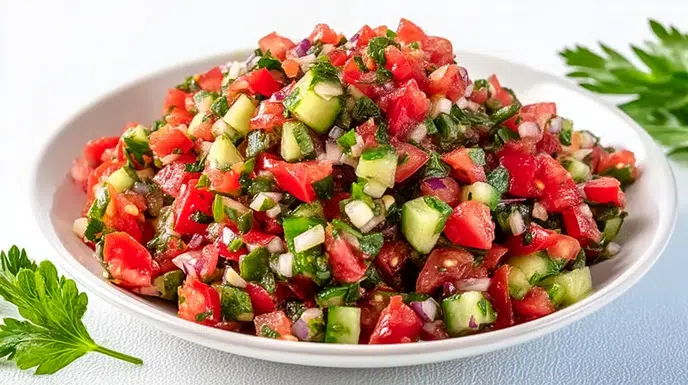
The fine dice is everything in this salad. I have made it with roughly chopped vegetables and with the finest dice I could manage, and they are genuinely different experiences. The fine dice, 5–8mm pieces, all the same size produces a salad where every spoonful has every element in it, the dressing reaches every surface, and the herbs distribute evenly throughout rather than appearing in random clumps. It takes an extra five minutes. Use a sharp knife (a dull knife crushes tomatoes rather than cutting them cleanly) and work methodically.
The other thing: taste after dressing and adjust immediately, before you serve. The lemon-to-olive oil balance is everything in a salad this simple. Too little lemon and it tastes flat and oily. Too much and it is sharp and one-dimensional. The right balance, bright and acidic with the olive oil rounding it out, is what makes this salad something people reach for repeatedly.
Variations
- With tahini: Replace the olive oil with 2 tablespoons of tahini thinned with 2 tablespoons of water, a popular version served alongside fried or grilled fish across the Levant.
- Fattoush: Chop the vegetables slightly larger, add sliced radish, shredded lettuce and toasted or fried pita bread pieces.
- With chickpeas: Add a drained tin of chickpeas for a more substantial salad that works as a light main.
- With feta: Crumble 80g of feta over the top, pushes it toward a Greek salad character but very good.
Serve with
Jerusalem salad belongs alongside almost everything in Middle Eastern cooking. It is the default accompaniment to hummus, baba ganoush, kafta kebab, shakshuka and falafel. It sits on every table that has Lebanese mezze. The full Mediterranean & Middle East collection has everything it pairs with.
Add Jerusalem salad to your weekly meal planner as the side dish that goes with everything, 15 minutes, no cooking, endlessly versatile. Make the vegetables ahead and dress at serving. And for more recipes, follow us on Pinterest.
Print
Jerusalem Salad
- Total Time: 15 minutes
- Yield: 4 servings 1x
- Diet: Vegan
Description
A classic Palestinian chopped salad full of fresh ingredients, perfect as a side dish or light meal.
Ingredients
- 3 medium ripe tomatoes, deseeded and diced
- 2 medium cucumbers, diced
- ½ small red onion, very finely diced
- Large handful flat-leaf parsley, finely chopped
- Small handful fresh mint, finely chopped (optional)
- Juice of 1½ lemons (fresh)
- 3 tablespoons extra-virgin olive oil
- 1 teaspoon sumac (optional)
- ½ teaspoon fine salt
- Black pepper to taste
Instructions
- Prep the vegetables — the fine dice. Deseed the tomatoes, halve crosswise, squeeze out the seed pulp, and dice the flesh into pieces no larger than 1cm.
- Combine the diced tomato and cucumber in a bowl. Add ½ teaspoon of salt and toss. Leave for 15–20 minutes, then drain through a fine sieve.
- Combine the diced tomato, cucumber, red onion, parsley, and mint in a large bowl. Add lemon juice, olive oil, sumac, salt, and pepper. Toss gently until everything is evenly coated.
- Serve at room temperature immediately. Drizzle with extra olive oil and a pinch of sumac before serving.
Notes
The fine dice is essential in this salad to ensure every spoonful contains all elements and dressing.
- Prep Time: 15 minutes
- Cook Time: 0 minutes
- Category: Salad
- Method: No cooking
- Cuisine: Middle Eastern
Nutrition
- Serving Size: 1 serving
- Calories: 180
- Sugar: 5g
- Sodium: 350mg
- Fat: 14g
- Saturated Fat: 2g
- Unsaturated Fat: 12g
- Trans Fat: 0g
- Carbohydrates: 16g
- Fiber: 4g
- Protein: 3g
- Cholesterol: 0mg