
⏱ Prep: 20 min ❄️Cool: 20 min🔥Fry: 20–25 min 🍽 Makes: 14–16 fritters 🌿Vegetarian
Moroccan Potato Maakouda is one of Morocco’s most enduring street foods. In the medinas of Marrakech, Fes and Tangier, vendors fry these spiced mashed potato fritters to order in wide pans of shimmering oil, the smell of cumin and garlic rising into the evening air, and hand them over in paper for a few dirhams. They are eaten plain on the spot, dipped into harissa at a café table, or in the version that is arguably even better, stuffed into a split baguette or wedge of Moroccan khobz with sliced tomato, lettuce and a generous smear of harissa. A four-ingredient sandwich that costs almost nothing and is nearly impossible to improve upon.
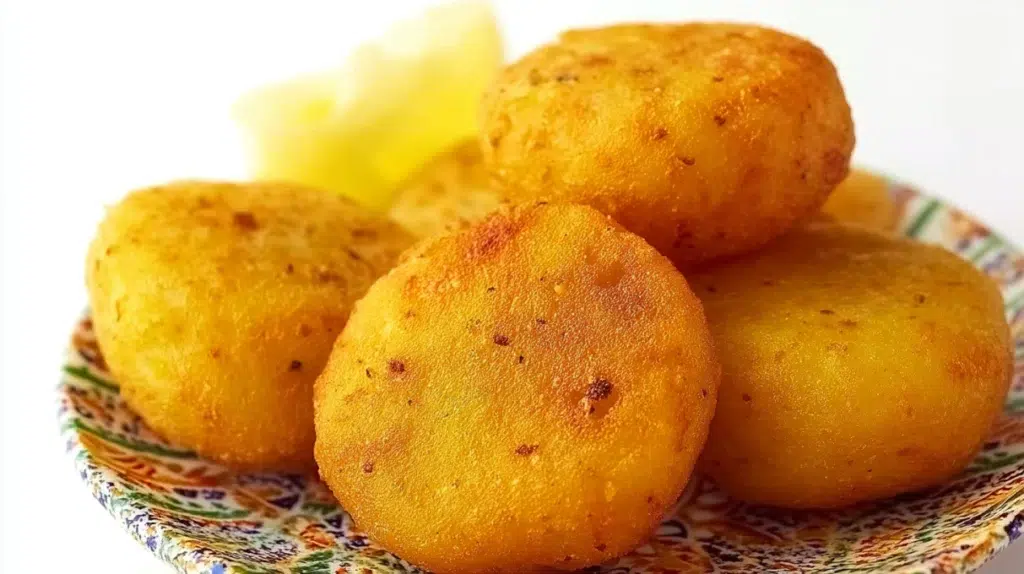
The fritters themselves are simple. Boiled potatoes mashed smooth, seasoned with cumin, turmeric, garlic, parsley and cilantro, bound with a beaten egg, shaped into small patties and fried in olive oil until the coating is crunchy and golden and the interior is hot, fluffy and deeply aromatic. The things that actually matter are drying the potatoes properly before mashing, wet potatoes produce fritters that fall apart in the oil, cooling the mixture before shaping, and frying at the right temperature so the outside crisps before the inside overcooks. Everything else is flexible.
Ingredients
For the maakouda
- 1kg (about 5 medium) floury potatoes, Russet, Maris Piper, King Edward, or any variety sold as “baking potato.” Floury potatoes mash smoothly and produce a fluffier, lighter interior than waxy varieties, which stay dense even when mashed. Peel before boiling.
- 1 teaspoon fine salt, for the boiling water
- 4 cloves garlic, finely minced or grated, raw garlic goes directly into the mashed potato mixture. It softens and mellows during frying.
- 2 tablespoons fresh flat-leaf parsley, finely chopped
- 2 tablespoons fresh cilantro (coriander), finely chopped, parsley only is traditional in some regions; the parsley-cilantro combination is common across Morocco and is the more flavourful version. Use all parsley if cilantro is unavailable or disliked.
- 2 teaspoons ground cumin, the dominant spice and the one that makes maakouda unmistakably Moroccan. Do not reduce, the cumin should be present and obvious, not background. Freshly ground cumin from whole seeds is noticeably better.
- ½ teaspoon ground turmeric, gives the fritters their characteristic golden colour inside and adds a faint earthiness. Does not contribute a strong flavour at this quantity but produces the appealing yellow tint throughout.
- ½ teaspoon sweet paprika
- ½ teaspoon freshly ground black pepper
- ¼ teaspoon cayenne pepper, optional, for a little background heat. Or substitute 1 teaspoon harissa stirred into the mixture.
- 1 large egg, lightly beaten, goes into the potato mixture as the binder that holds everything together during frying
- Salt to taste
For the coating
- 2 large eggs, lightly beaten, for dipping each shaped patty before the second flour dredge
- 100g (¾ cup) plain flour, for the two-stage flour dredge. The flour-egg-flour sequence builds a thin, crispy shell around each fritter that protects the interior and crisps properly in the oil. A simple one-stage flour dredge works but gives a thinner crust.
For frying and serving
- Olive oil for frying, enough to fill a wide pan to about 1.5cm depth. Olive oil is the traditional Moroccan choice and gives the fritters a flavour that neutral oil cannot replicate. Light olive oil (not extra virgin) has a higher smoke point and is better suited to frying than extra virgin. Sunflower or vegetable oil can substitute.
- Harissa, for serving, the natural accompaniment. Store-bought harissa works well; the Moroccan spice guide covers making your own.
- Lemon wedges, a squeeze over the hot fritters immediately before eating brightens everything
Step by step
- Boil and dry the potatoes. Peel the potatoes and cut into even chunks, roughly the same size so they cook at the same rate. Place in a large pot, cover with cold salted water and bring to a boil. Cook at a steady boil for 15–20 minutes until completely tender throughout, a skewer should slide through with no resistance. Drain thoroughly in a colander. Return the empty pot to the stove over low heat for 1 minute until completely dry. Tip the drained potatoes back into the hot dry pot and shake gently over the heat for 1–2 minutes until the surface moisture has fully evaporated and the potato surfaces look dry and slightly floury rather than wet and glossy.This drying step is the single most important thing in this recipe. Excess moisture in mashed potatoes produces a mixture that is too wet to hold its shape during frying, causing the fritters to spread, crack and fall apart in the oil. A properly dried potato produces a mash firm enough to shape cleanly. Do not skip or abbreviate this step.
- Mash smooth. Mash the dried potatoes while they are still hot, hot potatoes mash more smoothly than cold ones. Use a potato masher or a ricer for the smoothest result. The mash should be completely lump-free, lumps create weak points in the fritter that crack open during frying. Do not use a food processor or hand blender, which overwork the starch and produce a gluey, gummy texture.
- Season the mixture. Spread the mash in the bowl and allow it to cool until just warm, not hot, not cold. Hot mixture is too soft to hold shape; cold mixture is dense and harder to work with. Just warm is right. Add the garlic, parsley, cilantro, cumin, turmeric, paprika, black pepper and cayenne (if using). Mix thoroughly, the spices should be distributed evenly throughout so every fritter tastes the same. Taste the mixture and adjust salt. It should be well-seasoned and aromatic, the flavour will mellow slightly once the egg is added and the fritters are fried. Add the beaten egg and mix until fully incorporated and the mixture holds together when pressed. Season generously at this stage. The coating and the frying dilute the seasoning slightly, so the raw mixture should taste slightly more intense than you want the finished fritter to taste. If the mixture feels too soft to shape after the egg is added, refrigerate for 15 minutes, chilling firms it up without affecting the flavour.
- Shape the fritters. Lightly oil your hands, the potato mixture is sticky and oiled hands prevent it from clinging. Scoop a heaped tablespoon of the mixture (about 50g) and roll it gently into a ball, then flatten into a round patty approximately 5–6cm in diameter and 1.5cm thick. Uniform size and thickness means uniform cooking, thick fritters take longer to heat through and the outside can overbrown before the centre is hot. Lay the shaped patties on a plate or tray as you go.
- Coat the fritters, flour, egg, flour. Set up two shallow bowls: one with the beaten eggs, one with the flour. Working one fritter at a time, dredge it in flour on both sides and the edges, shaking off the excess. Dip it in the beaten egg, turning to coat all surfaces. Dredge in flour a second time, pressing gently so the flour adheres. The two flour layers with egg between them build a shell that stays crispy in the oil and protects the soft interior. Place each coated fritter back on the plate and repeat. Handle the coated fritters gently, the crust is fragile until it hits the hot oil and sets. Don’t stack them, which compresses the coating and causes it to peel off during frying.
- Fry in batches. Pour olive oil into a wide, heavy pan to about 1.5cm depth. Heat over medium heat until the oil reaches 180°C / 350°F, a small piece of bread dropped in should turn golden in about 60 seconds. Too cool and the fritters absorb oil and go greasy; too hot and the coating burns before the inside heats through. Fry in batches of 3–4, never crowding the pan, crowded fritters lower the oil temperature and steam each other. Cook 2–3 minutes per side, turning once, until deep golden on both sides and the edges look set and firm. Adjust the heat as you go, it tends to climb after the first batch.Resist turning the fritters before 2 minutes. A crust that has not set will tear when flipped. When the fritter releases easily from the pan without sticking, it is ready to turn. If it sticks, give it another 30 seconds.
- Drain and serve immediately. Transfer the fried maakouda to a plate lined with paper towels. Blot gently. Serve hot, maakouda are at their best within 5–10 minutes of frying, while the crust is still crackling. With harissa and lemon wedges on the side, or assembled into sandwiches as below.
The maakouda sandwich
This is the version you find at Moroccan street food stalls and, honestly, it is the best way to eat them. Split a baguette or a wedge of Moroccan khobz lengthways without cutting all the way through. Spread the interior generously with harissa. Lay two or three hot maakouda patties inside. Add sliced tomato, a little shredded lettuce or fresh parsley leaves, and a squeeze of lemon. Close and press gently.
Eat immediately while the fritters are still hot and the bread is still soft. This sandwich, cheap, spiced, messy in the best way is one of the great everyday street food combinations that Morocco produces almost effortlessly.
Claire’s note
The cumin quantity here, 2 full teaspoons for 1kg of potato is not a typo and should not be reduced. Every maakouda recipe I encountered in Morocco used what would seem, by Western baking standards, like a generous amount of cumin. It is the spice that makes the fritter taste like what it is rather than a vaguely seasoned potato cake. If you are used to cumin as a background note, this is the dish that teaches you what it tastes like when it is the point.
The other thing worth saying: the potato mixture must be genuinely cool before you try to shape it. Hot mixture collapses into a flat disc the moment it touches the pan. I have learned this exact lesson multiple times and I am passing it on.
Serve with
Maakouda are most naturally served as a snack or starter with harissa for dipping and lemon on the side. As a side dish they pair well with Moroccan chicken tagine, alongside Moroccan vegetarian dishes, or next to a bowl of harira soup as a complete Moroccan meal. For the spice context, what cumin and turmeric do in Moroccan cooking and how they work with other spices, the Moroccan spice guide covers the full picture.
The complete Moroccan recipes collection has everything this cuisine does well.
Add Moroccan potato maakouda to your weekly meal planner as an easy Friday night starter or weekend snack, the potato mixture can be made a day ahead and refrigerated, making the frying stage quick and stress-free. And for more recipes, follow us on Pinterest.
Print
Moroccan Potato Maakouda
- Total Time: 40 minutes
- Yield: 14–16 fritters 1x
- Diet: Vegetarian
Description
Moroccan Potato Maakouda are spiced mashed potato fritters, a popular and delicious street food from Morocco.
Ingredients
- 1kg (about 5 medium) floury potatoes, peeled and cut into chunks
- 1 teaspoon fine salt (for boiling)
- 4 cloves garlic, finely minced or grated
- 2 tablespoons fresh flat-leaf parsley, finely chopped
- 2 tablespoons fresh cilantro, finely chopped
- 2 teaspoons ground cumin
- ½ teaspoon ground turmeric
- ½ teaspoon sweet paprika
- ½ teaspoon freshly ground black pepper
- ¼ teaspoon cayenne pepper (optional)
- 1 large egg, lightly beaten
- Salt to taste
- 2 large eggs, lightly beaten (for coating)
- 100g (¾ cup) plain flour (for coating)
- Olive oil (for frying)
- Harissa (for serving)
- Lemon wedges (for serving)
Instructions
- Boil and dry the potatoes: Place the peeled potato chunks in a pot, cover with cold salted water, and bring to a boil. Cook for 15-20 minutes until tender, then drain and dry in the pot over low heat.
- Mash smooth: Mash the dried potatoes while they are hot until completely lump-free.
- Season the mixture: Allow mash to cool until just warm, then mix in garlic, parsley, cilantro, spices, and the beaten egg. Adjust salt.
- Shape the fritters: Lightly oil your hands and shape the mixture into patties.
- Coat the fritters: Dredge each patty in flour, dip in beaten egg, and coat again in flour.
- Fry in batches: Heat oil in a pan and fry patties until golden brown on both sides.
- Drain and serve: Transfer fried maakouda to paper towels to drain and serve immediately with harissa and lemon wedges.
Notes
Ensure that the potato mixture is cool before shaping. Excess moisture leads to fritters that fall apart in the oil. The cumin quantity should not be reduced for authentic flavor.
- Prep Time: 20 minutes
- Cook Time: 20 minutes
- Category: Snack
- Method: Frying
- Cuisine: Moroccan
Nutrition
- Serving Size: 1 fritter
- Calories: 200
- Sugar: 1g
- Sodium: 500mg
- Fat: 6g
- Saturated Fat: 1g
- Unsaturated Fat: 3g
- Trans Fat: 0g
- Carbohydrates: 30g
- Fiber: 4g
- Protein: 5g
- Cholesterol: 20mg