⏱ Prep: 30 min ❄️Chill: 1 hr 🔥Fry: 25 min 🍯Soak: 2–3 hrs 🍪Makes: 20–24 cookies
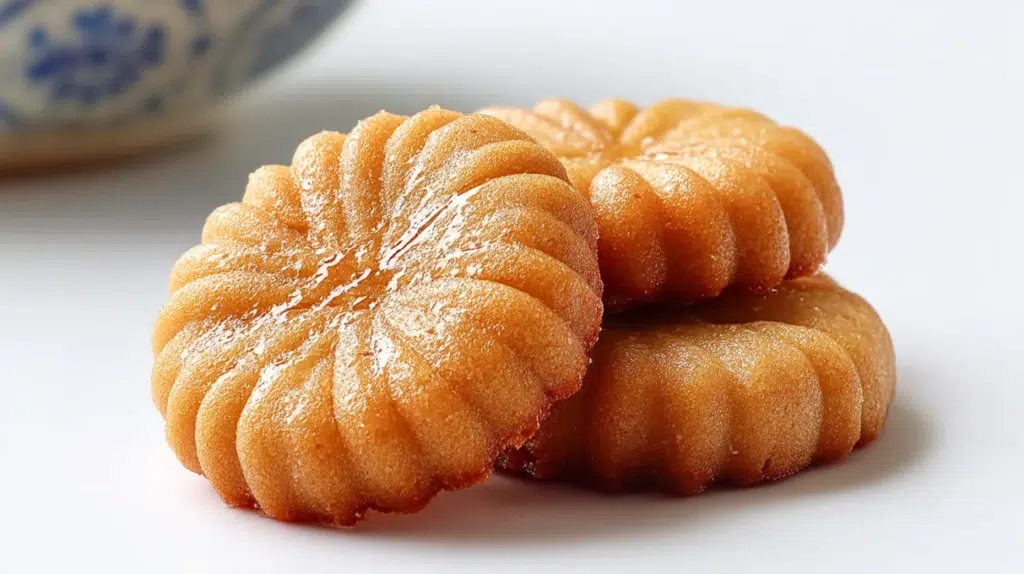
Korean Honey Cookies, Yakgwa, the name means “medicinal confection,” from yak (medicine) and gwa (confection) and for over a thousand years that name was entirely literal. In the Goryeo dynasty, honey was a rare and precious ingredient, considered to have restorative and healing properties, and the confections made from it were the exclusive province of royalty, aristocrats and Buddhist temples.
Yakgwa appeared at royal banquets, wedding ceremonies, ancestral rites, and offerings to the Buddha. Ordinary people might encounter them once or twice in a lifetime. The scarcity was the point. Honey was medicine first and sweetener second, and anything made from it carried that weight.
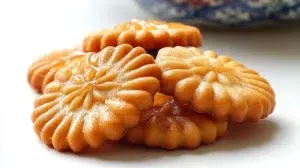
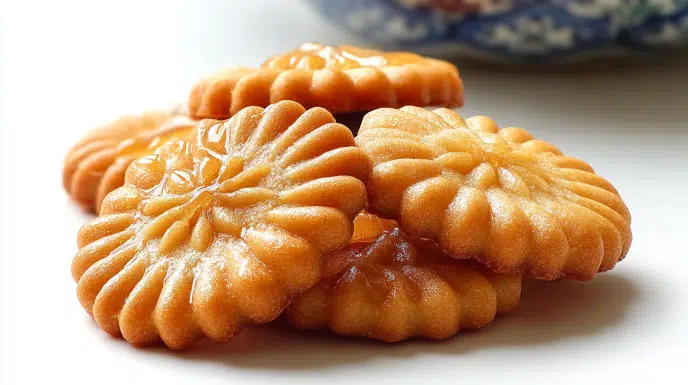
Today yakgwa is everywhere in Korea, sold at bakeries and convenience stores, experiencing a major revival driven partly by younger Korean consumers rediscovering traditional hangwa (Korean confections), and partly by the phenomenon Koreans call “yakgeting”: competitively pre-ordering handmade yakgwa from artisan bakers online before they sell out. The recipe hasn’t changed in a thousand years. Wheat flour, toasted sesame oil, honey, rice wine, ginger, cinnamon, everything mixed with a light hand to avoid gluten development, shaped, fried in two temperature stages, and soaked in a ginger-honey syrup until the cookies are glossy, sticky, malt-sweet and deeply aromatic.
Ingredients
For the dough
- 250g (2 cups) plain (all-purpose) flour, sifted, sifted to aerate. The sesame oil will be rubbed through it; a light, airy flour takes to this process better than a dense, compacted one.
- ½ teaspoon ground cinnamon
- ¼ teaspoon salt
- 3 tablespoons toasted sesame oil, Korean toasted sesame oil specifically, dark, intensely fragrant, the kind sold in small bottles at Korean grocery stores. Not light sesame oil and not a generic blend. The toasted sesame oil is the flavour that makes yakgwa unmistakably itself. Rub it into the flour before the liquid ingredients go in, this is the technique that produces the characteristic tender, crumbly, delicate texture.
- 2 tablespoons honey
- 2 tablespoons cheongju (Korean rice wine), or sake, or soju. The alcohol adds flavour and helps the dough come together without overworking. It evaporates during frying, creating steam pockets that contribute to the light, slightly layered interior texture. Substitute: 2 tablespoons water if alcohol is unavailable, though the flavour will be slightly less complex.
- 2 tablespoons warm water
- 1 teaspoon fresh ginger juice, grate fresh ginger and squeeze through a cloth or fine sieve to extract the juice. Adds a clean, warm spiciness to the dough that complements the cinnamon.
For the ginger-honey soaking syrup
- 150g (½ cup) jocheong (rice malt syrup), a thick, amber, malty syrup made from rice and barley malt. Available at Korean grocery stores. It gives yakgwa the characteristic subtle malty depth and glossy finish that honey alone cannot replicate. Substitute: replace with an equal amount of honey, though the flavour will be sweeter and less complex.
- 3 tablespoons honey
- 5 thin slices of fresh ginger
- 1 cinnamon stick
- 4 tablespoons water
For finishing
- Oil for deep frying, neutral oil with a high smoke point: vegetable or sunflower oil. Enough to fill a medium saucepan to at least 5cm depth. Maintain the correct temperature carefully, yakgwa burns easily at high heat due to the honey in the dough.
- 20–24 pine nuts (잣, jat), one pressed into the centre of each cookie before frying. Pine nuts are the traditional and most beautiful garnish for yakgwa, and their gentle nuttiness complements the ginger-honey flavour. Blanched whole almonds can substitute. The pine nut goes in before frying, not after, it adheres to the surface during the fry and clings through the syrup soak.
Step by step
- Make the syrup first. Combine the jocheong, honey, ginger slices, cinnamon stick and water in a small saucepan. Bring to a boil over medium heat, stirring once or twice to combine. Reduce to a low simmer and cook for 8–10 minutes until the syrup has thickened slightly and drips slowly from a spoon rather than running off freely. Remove from the heat and set aside to cool and deepen in flavour while you make the dough. The syrup can be made up to 3 days ahead and refrigerated. Reheat gently before using.
- Rub sesame oil into the flour, the critical technique step. In a large bowl, whisk together the sifted flour, ground cinnamon and salt. Drizzle the sesame oil over the flour mixture a tablespoon at a time. Using your fingertips, rub the oil into the flour with a light, quick motion, the same technique used for rubbing butter into flour for shortcrust pastry. Continue until the entire mixture looks and feels like damp sand: every grain of flour should be lightly coated in oil, and when you press a handful together it should clump briefly then fall apart again. This step is what makes yakgwa yakgwa. Coating the flour grains in sesame oil before any liquid is added prevents gluten strands from forming freely, the oil acts as a barrier between the flour and the water in the wet ingredients. Less gluten means less chew, less elasticity, and more of the tender, crumbly, melt-in-mouth quality that defines the cookie. This is exactly how shortcrust pastry works, and exactly why yakgwa has its texture. If the flour and oil are not rubbed together properly, if the oil is added directly to the wet ingredients instead, for example, the gluten develops normally and the cookie is tough and dense.
- Make the wet mixture and combine. In a small bowl, whisk together the honey, cheongju, warm water and ginger juice until the honey has dissolved. Pour this over the flour mixture. Using a spatula or your hands, mix and fold until the dough just comes together, it should be a smooth, pliable dough that holds its shape when pressed. Do not knead. The moment the dough coheres is the moment to stop. Over-mixing from this point develops gluten despite the sesame oil barrier and produces a tougher cookie. The dough should feel slightly softer than traditional shortcrust pastry and hold its shape cleanly when pressed or rolled. If it feels dry and crumbly and refuses to hold together, add warm water a teaspoon at a time and press again. If it feels sticky, dust lightly with flour and press together once more. The right consistency is soft, smooth and cooperative without being at all sticky to the touch.
- Chill for 1 hour minimum. Shape the dough into a flat disc, wrap tightly in plastic wrap and refrigerate for at least 1 hour, or up to overnight. This resting time relaxes whatever small amount of gluten has formed and allows the sesame oil, honey and spices to distribute fully through the dough. Cold dough also holds its stamped or cut shape much better during frying than room-temperature dough.
- Shape the cookies. Remove the chilled dough from the refrigerator. On a lightly floured surface, roll to a thickness of about 8–10mm, slightly thicker than a standard cookie dough. If you have a yakgwa mold (a carved wooden mold that stamps a traditional flower or grid pattern into the surface), dust the mold lightly with flour, press the rolled dough firmly into it, then tap out onto the work surface. More practically: cut the dough into squares or rectangles approximately 4–5cm each using a sharp knife, or cut rounds with a cookie cutter. Press one pine nut firmly into the centre of each piece. The pine nut is pressed in before frying, not added after. Pressed firmly before the dough goes into the oil, it adheres during the fry and stays anchored through the syrup soak. Added after, it slides off. The traditional pressing also creates a slight indentation in the cookie surface that catches and holds syrup during soaking.
- First fry, very low temperature, patience required. Pour oil to a depth of at least 5cm in a medium-sized heavy saucepan. Heat to 130–140°C / 265–285°F, this is significantly lower than standard frying temperatures. A cube of bread dropped in should take at least 60–90 seconds to turn golden. Gently lower 4–5 cookie pieces into the oil. They should sizzle gently, not aggressively. Fry for 8–12 minutes, turning every few minutes, until the cookies have puffed slightly, feel firm to the touch, and are a pale golden colour throughout. This low-temperature first fry is what makes yakgwa’s interior texture, cooking slowly through the centre while developing the structure that will hold the syrup. The honey in the dough burns easily at higher temperatures, which is why yakgwa is fried cooler and slower than almost any other fried dough. Oil that is too hot produces a dark exterior with a raw, dense interior. The first fry is about cooking through; the second fry is about colour.
- Second fry, increase temperature for colour. After the first fry batch is pale and firm, increase the oil temperature to 160–170°C / 320–340°F. Return the same batch to the oil and fry for a further 2–3 minutes until they are a deep, even golden brown. Remove with a slotted spoon.
- Transfer directly to syrup while hot. Using the slotted spoon, move the hot fried cookies immediately from the oil into the warm ginger-honey syrup, do not let them cool first. Hot cookies are porous and absorb the syrup most deeply; cold cookies absorb less effectively. Turn each cookie over once in the syrup to ensure even coating. Repeat the two-stage frying process with the remaining batches, adding each batch directly to the syrup while hot. When all cookies are in the syrup, allow them to soak.
- Soak for 2–3 hours minimum. Leave the cookies in the syrup at room temperature for at least 2–3 hours, turning them over gently once or twice. The syrup will penetrate the cookies slowly, making them glossy, sticky and deeply sweet throughout. Overnight soaking produces an even better result, the cookies become more evenly saturated and the ginger and cinnamon in the syrup integrate fully with the honey-sesame flavour of the dough. Do not rush this stage. Yakgwa eaten immediately after frying, before the syrup has penetrated, tastes good but one-dimensional, the exterior is sweet and sticky but the interior is dry and dense. After a full 2–3 hour soak, the cookie is uniformly flavoured and moist throughout, and the distinctive kkudeokhada texture, that pleasantly chewy, brownie-like quality has fully developed. They also improve over the next 2–3 days as the syrup continues to settle into the dough.
- Remove and rest. Using a slotted spoon, transfer the soaked yakgwa to a wire rack set over a tray, or a parchment-lined plate, to allow excess syrup to drip off. They will remain sticky and glossy. Leave at room temperature uncovered for 30 minutes before serving. Store in a single layer or with parchment between layers in an airtight container at room temperature, they keep exceptionally well for up to 2 weeks, improving in flavour over the first few days.
Claire’s note
Three things that most home attempts at yakgwa get wrong. First: the oil temperature in the first fry. 130–140°C feels absurdly low if you are used to frying at 180°C. It is correct. The honey in the dough burns at standard frying temperatures, and yakgwa needs the slow, gentle heat of the first fry to cook through without colouring too fast. Use a thermometer. Do not trust guesses.
The second: soaking time. Two hours is the minimum; overnight is the target. Yakgwa eaten at the one-hour mark tastes like fried dough with a sticky exterior. Yakgwa eaten the next morning tastes like the thing it is supposed to be deep, complex, malty, with that specific chewy-dense quality that makes it genuinely unlike anything else.
The third: over-kneading. The moment the dough holds together, stop. Walk away. The sesame oil is doing its job only as long as you don’t undo it by developing gluten through extra kneading. Soft touch, short mix, patience on the rest.
Serve with
Yakgwa is eaten at room temperature as a tea-time sweet or dessert, the traditional pairing is a cup of barley tea (boricha) or citron tea (yuja-cha), whose clean bitterness and acidity cut through the rich sweetness. Strong black coffee is an excellent modern pairing for the same reason. As part of a Korean dessert spread it sits naturally alongside the Tteokbokki (Korean rice cakes) that appear at the same celebrations, or with other Korean snacks from the Korean recipes collection. The broader Asian recipes collection covers the full picture of East Asian baking and sweets.
Add Korean honey cookies to your weekly meal planner as a weekend project, the active time is about an hour, but the cookies need 2–3 hours of soaking and improve over several days, making them ideal to make on Saturday for a Sunday gathering.
And for more recipes, follow us on Pinterest.
Print
Korean Honey Cookies (Yakgwa)
- Total Time: 120 minutes
- Yield: 20–24 cookies 1x
- Diet: Vegetarian
Description
Traditional Korean honey cookies, deeply aromatic and sweet, soaked in ginger-honey syrup, perfect for tea time or dessert.
Ingredients
- 250g (2 cups) plain (all-purpose) flour, sifted
- ½ teaspoon ground cinnamon
- ¼ teaspoon salt
- 3 tablespoons toasted sesame oil
- 2 tablespoons honey
- 2 tablespoons cheongju (Korean rice wine) or sake
- 2 tablespoons warm water
- 1 teaspoon fresh ginger juice
- 150g (½ cup) jocheong (rice malt syrup)
- 3 tablespoons honey
- 5 thin slices of fresh ginger
- 1 cinnamon stick
- 4 tablespoons water
- Oil for deep frying
- 20–24 pine nuts
Instructions
- Make the syrup first. Combine the jocheong, honey, ginger slices, cinnamon stick and water in a small saucepan. Bring to a boil over medium heat, stirring occasionally. Reduce to a low simmer and cook for 8–10 minutes until thickened. Remove from heat and cool.
- Rub sesame oil into the flour. In a bowl, whisk together the flour, cinnamon and salt. Drizzle the sesame oil and rub it into the flour until it resembles damp sand.
- Make the wet mixture. In a small bowl, whisk together honey, cheongju, warm water and ginger juice until smooth. Pour over the flour mixture and mix until a smooth dough forms. Do not knead.
- Chill the dough for 1 hour. Shape the dough into a flat disc, wrap in plastic wrap and refrigerate.
- Shape the cookies. Roll out dough to 8–10mm thickness and cut into pieces. Press a pine nut into the center of each cookie.
- Fry cookies at a low temperature (130–140°C or 265–285°F) for 8–12 minutes until pale golden.
- Second fry at a higher temperature (160–170°C or 320–340°F) for 2–3 minutes until golden brown.
- Transfer hot cookies to the syrup immediately and soak for 2–3 hours, turning gently.
- Remove from syrup and rest on a wire rack for 30 minutes before serving.
Notes
Yakgwa improves in flavor over the first few days after making. Serve with barley tea or strong black coffee.
- Prep Time: 30 minutes
- Cook Time: 25 minutes
- Category: Dessert
- Method: Frying
- Cuisine: Korean
Nutrition
- Serving Size: 1 cookie
- Calories: 150
- Sugar: 10g
- Sodium: 50mg
- Fat: 7g
- Saturated Fat: 1g
- Unsaturated Fat: 6g
- Trans Fat: 0g
- Carbohydrates: 22g
- Fiber: 1g
- Protein: 2g
- Cholesterol: 0mg