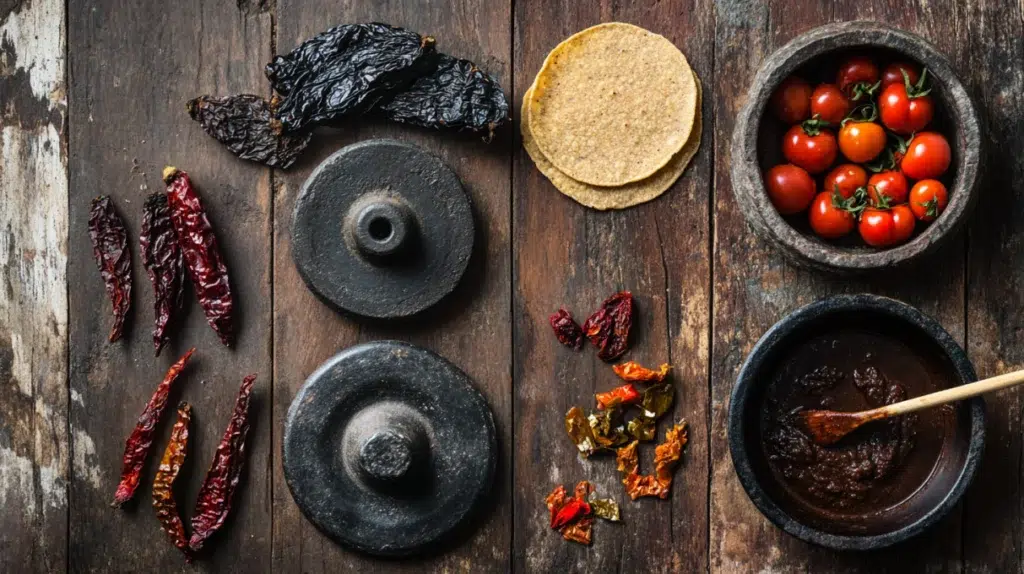
Mexican cooking techniques are the reason Mexican food tastes the way it does, and the reason most home attempts at Mexican cooking, even using the right ingredients, produce something that is good but not quite right.
The ingredients matter. The chiles, the masa, the tomatillos, the epazote, all of it matters. But the technique is what transforms those ingredients into the specific flavors that make Mexican cooking one of the most celebrated food cultures in the world. In 2010, UNESCO recognized Mexican cuisine as an Intangible Cultural Heritage of Humanity, not for its ingredients list, but for the depth and continuity of its cooking traditions. Those traditions are the techniques in this article.
Maize has been domesticated in Mexico for at least 9,000 years and one of the first uses of ground maize was very likely the tortilla, making corn-based cooking techniques the oldest and most fundamental in Mexican cuisine. That 9,000-year history is not a footnote. It is the reason Mexican cooking techniques have the depth and complexity they do, they have been refined across thousands of years of continuous practice by cooks who understood their ingredients at a level most food cultures never reach.
This is part of the Mexican recipes collection, the foundation that makes every other recipe make sense.
Table of Contents
Technique 1: Nixtamalization: The Most Important Process in Mexican Cooking
Nixtamalization is the process of treating dried corn kernels with an alkaline solution, traditionally wood ash lye, today calcium hydroxide (slaked lime), before grinding them into masa. It is the foundational technique of Mexican cooking and one of the most significant food processing discoveries in human history.
The corn for tortillas was traditionally boiled with unslaked lime, softening the kernels and loosening the hulls, then ground on a stone metate and baked on a comal, a process that has defined Mexican cooking for thousands of years. What sounds like a simple preparatory step is actually a profound chemical transformation. The alkaline treatment does three things: it loosens and removes the corn’s outer hull, it increases the bioavailability of niacin (vitamin B3) in the corn dramatically, preventing pellagra, a deficiency disease that plagued populations eating untreated corn, and it fundamentally changes the flavor, aroma and texture of the corn itself. Nixtamalized corn tastes like a tortilla. Untreated ground corn tastes like cornbread. They are completely different things.
What this means for your cooking: When a recipe calls for masa harina, the dried, powdered form of nixtamalized corn, it cannot be substituted with regular cornmeal or corn flour. They are not the same ingredient. Masa harina is nixtamalized; cornmeal is not. Maseca brand masa harina is available at virtually every US grocery store. The corn tortillas guide covers the full process of making tortillas from masa harina, including the right water ratio, the pressing technique and the comal temperature.
At home: You can nixtamalize your own corn from dried kernels using food-grade cal (calcium hydroxide, sold at Mexican grocery stores). Soak in limewater overnight, rinse thoroughly and grind in a food processor or blender with water. The result, fresh masa, has a flavor and texture that packaged masa harina cannot fully replicate. It is a weekend project worth attempting at least once.
Technique 2: Dry-Toasting Chiles: Where the Flavor Actually Comes From
Dried chiles are not used raw in Mexican cooking. They are toasted, pressed flat onto a dry hot comal or skillet, held for 10-15 seconds per side until they blister, soften and begin to release their oils, before being soaked in hot water and blended into sauces, stews and moles. This single step is the most important technique in Mexican cooking for people cooking at home, and the most consistently skipped.
Why it matters: the heat of the comal drives off volatile compounds in the dried chile that produce bitterness, and simultaneously releases the aromatic oils that produce depth and complexity. A toasted and soaked guajillo produces a sauce with a rich, fruity, slightly smoky depth. An untoasted guajillo produces a flat, slightly raw, one-dimensional sauce. The difference is not subtle, it is the difference between Mexican food that tastes right and Mexican food that doesn’t quite get there.
How to do it correctly: Remove the stem and seeds from the dried chile (seeds carry most of the heat, keep some if you want more). Open the chile flat. Heat a dry comal or heavy skillet over medium heat until very hot. Press the chile flat against the surface with a spatula. Hold 10-15 seconds, the chile should blister and begin to change color slightly. Flip. Another 10-15 seconds. You should smell something toasty, slightly smoky and deeply fragrant. Not burnt, if it smells acrid or the chile turns black, it went too far and will be bitter. Start over.
Transfer the toasted chile immediately to a bowl of very hot (not boiling) water. Weight it down with a plate if needed to keep it submerged. Soak 20-30 minutes until completely pliable and soft. Drain. Now blend.
The chiles this applies to: guajillo, ancho, pasilla, mulato, chile negro, cascabel, chipotle (dried, not canned). Every dried chile in Mexican cooking benefits from this treatment. The Mexican pantry guide covers each chile variety, its flavor profile and how to use it.
Technique 3: The Comal: Mexico’s Most Essential Cooking Surface
The comal is a flat, round griddle, traditionally made from clay, now more commonly from cast iron or carbon steel, that is Mexico’s most fundamental piece of cooking equipment. Everything passes through the comal: tortillas, quesadillas, the skins of tomatoes and tomatillos for charring, dried chiles for toasting, fresh chiles for roasting, and spices for dry-toasting.
Understanding the comal means understanding heat differentiation. A comal is used at two distinct temperatures simultaneously: the center runs very hot (for immediate charring and toasting), while the edges run cooler (for warming tortillas slowly without drying them, for keeping things warm without further cooking them). An experienced Mexican cook manages the entire meal across one comal by moving things between hot center and cool edges constantly.
At home: A large cast iron skillet or carbon steel pan is the best comal substitute. Pre-season it well and heat it fully before use, it should be hot enough that a drop of water evaporates immediately. This is the surface for:
Charring tomatoes and tomatillos, cut side down on a very hot dry comal until blackened in patches. This char is not a mistake or a sign of burning, it is the flavor. Charred tomato skins give Mexican red salsas their specific smoky depth. Charred tomatillo skins give salsa verde its specific bitterness that balances the acidity.
Toasting whole spices, cumin seeds, coriander seeds, whole black peppercorns, Mexican cinnamon (canela), on the dry comal for 60-90 seconds before grinding. The same principle as dry-toasting chiles: heat releases aromatic oils that remain locked otherwise.
Making tortillas, the full technique in the corn tortillas guide, but briefly: 30 seconds first side, flip, 30 seconds second side, flip again, 15-20 seconds on the first side until the tortilla puffs slightly. This second flip-and-puff is the sign that the masa has fully cooked through.
Technique 4: Making Sofrito: The Flavor Base
The Mexican sofrito, called the recado, the base, or simply “the sauce” depending on region, is the foundation of most Mexican braised dishes, salsas and stews. Unlike Italian sofrito (slowly sweated onion, celery and carrot) or Spanish sofrito (tomato and onion cooked down in olive oil), the Mexican version involves roasting or charring the aromatics on a dry comal before blending them.
The standard Mexican sofrito base: dry-charred tomatoes, dry-charred tomatillos, dry-charred white onion, dry-charred garlic (still in its skin), dry-toasted dried chiles, all blended together with the soaking liquid from the chiles. The charring of each element is not uniform: some pieces should be almost blackened, some only lightly blistered. This variation in char level produces the complexity and depth that a single uniform cook cannot.
The technique step most people miss: frying the blended salsa in hot lard or oil before adding liquid. The blended sauce goes into hot fat in a heavy pot and is cooked, stirring constantly, for 5-8 minutes until it darkens, thickens and “fries” rather than steams. This step, called sazonar, concentrates the flavor, drives off excess water and develops a depth that skipping it entirely prevents. Every professional Mexican cook does this. Most home recipes omit it.
This sofrito frying technique is what makes mole negro so extraordinarily complex, 30+ ingredients, each individually toasted or charred or fried, then blended and fried again in lard until the sauce is almost black and deeply concentrated.
Technique 5: Adobo: Marinating in Chile Paste
Adobo is the Mexican technique of coating meat in a thick paste of dried and rehydrated chiles, vinegar, garlic, spices and sometimes chipotle, then cooking it slowly until the paste forms a dark, intensely flavored crust on the exterior of the meat while keeping the interior moist and tender.
Not to be confused with Filipino adobo (a braising technique using soy sauce and vinegar) or Spanish adobo (a vinegar-based marinade). Mexican adobo is specifically a dried chile paste that works through the combination of the chile’s natural pigments, the acid from the vinegar and the Maillard reaction of the chile sugars caramelizing against the heat.
What it’s used on: Adobo is most associated with pork, specifically adobo de puerco, pork ribs or shoulder coated in ancho and guajillo chile paste and slow-cooked until completely tender. It is also used on chicken (pollo adobado), on fish in coastal Veracruz and Oaxacan cooking, and as the base for enchilada sauce.
The home technique: Toast and soak the dried chiles (2-3 anchos, 3-4 guajillos). Blend with 4 cloves garlic, 1 teaspoon cumin, ½ teaspoon Mexican cinnamon, 2 tablespoons apple cider vinegar, ½ teaspoon black pepper and ½ teaspoon oregano until completely smooth. Rub thoroughly over the meat. Marinate at least 4 hours, overnight is better. Cook low and slow (160°C / 320°F oven, 2-3 hours for pork shoulder, covered for the first 2 hours, uncovered for the last 30 minutes to develop the crust).
Technique 6: Slow Braising in Earthenware (Cazuela Cooking)
The cazuela, a deep, round, unglazed clay pot is the slow-cooker of Mexican cooking and has been for centuries. Clay conducts heat differently from metal: it heats slowly, retains heat exceptionally well and distributes it very evenly without hot spots. The result is a specific style of slow cooking, very low heat, very long time, the clay pot sweating slightly, the contents barely simmering that produces a tenderness and flavor concentration that faster methods cannot replicate.
This is the technique behind birria (slow-braised goat or beef in dried chile broth), barbacoa (meat wrapped in maguey leaves and slow-cooked in a pit or sealed pot for hours), and the great braised bean dishes of Mexican cooking. The principle, very low heat, very long time, sealed vessel is what produces collagen-rich, gelatinous, deeply flavored braises rather than the drier, less complex results of higher-temperature cooking.
At home without a cazuela: A Dutch oven is the closest equivalent for this style of cooking. The key is temperature, 140-160°C / 285-320°F, significantly lower than most braising recipes suggest. At this temperature, collagen converts to gelatin slowly and completely, the fat renders gently and the braising liquid never aggressively boils (which toughens protein fibers). Cook 3-4 hours minimum for beef, 2-3 hours for pork, checking periodically but not stirring unnecessarily.
Technique 7: Making Salsa: The Art of Raw and Cooked Together
Mexican salsa is not one thing, it is a technique continuum from completely raw (pico de gallo) to partially cooked (salsa taquera) to fully cooked (salsa roja for enchiladas) to roasted (salsa asada). Understanding which salsa serves which purpose is the technique knowledge that separates Mexican cooking that tastes layered and intentional from cooking that tastes one-dimensional.
Salsa cruda (raw): Tomatoes, white onion, jalapeño, cilantro, lime, salt, all finely chopped by hand or briefly pulsed in a blender. The texture should be rough, not smooth. Served immediately, raw salsa deteriorates fast. Used on tacos, over grilled meats, as a table salsa. This is pico de gallo. Bright, fresh, acidic, no depth from cooking.
Salsa taquera (partially cooked): The tomatillos or tomatoes are boiled briefly before blending. The onion and garlic are charred on the comal. The chiles are toasted. The result is blended partially smooth and fried briefly in hot oil. Used on tacos al pastor, on street food, as a medium-depth table salsa.
Salsa asada (roasted): Every element, tomatoes, tomatillos, chiles, onion, garlic is charred directly on the comal or under a broiler until blackened in patches. Blended rough. Not fried further. Deep, smoky, charred flavor that raw salsa cannot approach. The correct salsa for Mexican street food like tacos de canasta and carnitas.
Salsa roja for enchiladas: Rehydrated dried chiles blended with charred tomato, fried in oil and then simmered with chicken stock until thick. This is the fully cooked version, maximum depth and body, used as a sauce rather than a condiment.
The Mexican vs Tex-Mex guide covers how this salsa technique spectrum is one of the clearest differences between authentic Mexican cooking and its American adaptations, Tex-Mex salsa is almost universally the raw version, while authentic Mexican cooking uses all four types depending on context.
Traditional Mexican Cooking Methods: How the 7 Techniques Work Together
These techniques are not independent. They work in sequence, building on each other in almost every dish:
A mole starts with dry-toasting (technique 2) the dried chiles, then dry-toasting the spices and seeds, then charring the tomato and onion on the comal (technique 3), then making a sofrito by frying the blended ingredients (technique 4). The meat that will go into the mole is coated in adobo (technique 5) before cooking. It is then slow-braised (technique 6) until completely tender.
Understanding the techniques individually means understanding how to make any Mexican dish, not just the ones with recipes written out. This is what “learning to cook Mexican food” actually means: not memorizing recipes but internalizing these seven methods until they become instinct.
FAQ About Mexican Cooking Techniques
What is the difference between a comal and a griddle?
A comal is flat and thin with no raised edges, traditionally made from clay. A cast iron griddle has low raised edges and is generally thicker. Both work for tortillas and charring vegetables, but the comal’s lack of sides allows for easier flipping and repositioning. A large cast iron skillet used upside down (flat base as the cooking surface) mimics a comal closely.
Can I use regular cornmeal instead of masa harina?
No, these are completely different products. Masa harina is made from nixtamalized corn that has been dried and ground. Regular cornmeal is made from non-nixtamalized corn. They cannot substitute for each other in any Mexican recipe. Masa harina (Maseca brand) is available at every major US grocery store, usually in the Latin foods aisle.
Why does my homemade salsa taste flat compared to restaurant salsa?
Almost certainly because you are not charring the tomatoes and tomatillos first. Raw tomato blended with raw onion and jalapeño produces a bright but flat salsa. Charring even 30% of the tomatoes before blending adds the roasted depth that makes the difference. Char half the tomatoes on a dry screaming-hot skillet until blackened in patches, leave the other half raw, blend together. The result will be immediately recognizable as restaurant-quality.
What is canela and why does Mexican cinnamon taste different?
Canela is Mexican cinnamon, true cinnamon (Cinnamomum verum), also called Ceylon cinnamon, as opposed to the cassia cinnamon sold in most US grocery stores. Canela is softer, slightly dusty, with a more delicate, less aggressive flavor and lower coumarin content. It can be ground in a spice grinder, which cassia sticks cannot. Available at Mexican grocery stores. Details in the Mexican pantry guide.
Planning your week? Start with the charred tomato salsa technique on Sunday, it takes 15 minutes and immediately elevates every taco and grilled dish for the rest of the week. Add it to your weekly meal planner as a Sunday prep staple.