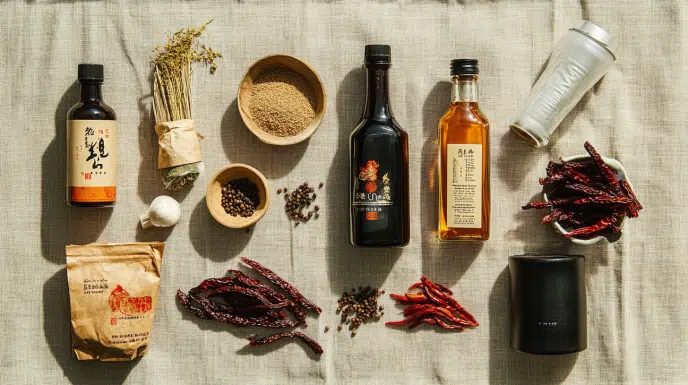
Chinese pantry essentials are the barrier between wanting to cook Chinese food at home and actually doing it, and they are a significantly smaller barrier than most people think.
Chinese cooking requires a specific set of condiments, sauces and aromatics that are not available at most Western grocery stores. But the claim that Chinese ingredients are hard to find in the US is increasingly outdated. Chinese grocery stores exist in every American city with an Asian population. H Mart carries most essentials. Whole Foods now stocks soy sauce, sesame oil, oyster sauce, five spice and several other core ingredients. Amazon carries everything else.
The initial investment to stock a proper Chinese pantry runs to $60-80 for the full kit. Once stocked, Chinese weeknight cooking becomes fast and effortless, most dishes use combinations of the same dozen ingredients, and having them ready means a genuinely good Chinese fried rice or kung pao chicken is 20 minutes from an empty pan.
This guide covers every essential ingredient, what it is, what it does, which brand to buy, whether there is an acceptable substitute, and exactly where to find it. This is part of the Chinese recipes collection, the foundation that makes every other recipe possible.
Table of Contents
The Liquid Foundation: Soy Sauces and Cooking Wines
Light Soy Sauce (生抽, Sheng Chou): The Most Used Ingredient in Chinese Cooking
Soy sauce has a long history, first made in China as a thick paste called jiang over 2,000 years ago, it is now the foundational liquid seasoning of Chinese cuisine and essential across East and Southeast Asian cooking. Light soy sauce (sheng chou) is the everyday cooking soy sauce of Chinese kitchens, thinner, saltier and more delicate than dark soy, used for seasoning, marinating, dipping and finishing throughout Chinese cooking.
What it tastes like: Salty, deeply savory with a mild fermented complexity. Much lighter in color and flavor than dark soy. Not to be confused with “low sodium” or “reduced salt” soy sauce, which is a different product entirely.
Which to buy: Pearl River Bridge Superior Light Soy Sauce is the gold standard widely available at Chinese grocery stores. Lee Kum Kee Premium Soy Sauce is excellent and more widely available at mainstream stores. Kikkoman (Japanese-style) is acceptable as a substitute but is milder and more delicate, use slightly more than the recipe calls for.
Where to find it: Every grocery store. Chinese grocery stores carry the best Chinese-style brands.
Dark Soy Sauce (老抽, Lao Chou): Color and Depth
Dark soy sauce is thick, less salty, and deep mahogany in color. It is used specifically to add rich color to braised dishes, fried rice and stir-fries, not as the primary flavoring, but as the color agent that gives Chinese cooking its characteristic golden-brown to deep red appearance. A teaspoon of dark soy transforms the color of a dish without significantly increasing its saltiness.
The critical mistake: Using dark soy sauce as the only soy sauce in a recipe makes a dish very dark and slightly bitter. Use both, light for flavor and saltiness, dark for color and a subtle caramel sweetness.
Which to buy: Pearl River Bridge Superior Dark Soy Sauce. Lee Kum Kee Premium Dark Soy Sauce. Both are reliable and available at Chinese grocery stores.
Substitute: If you cannot find dark soy: use light soy sauce plus half a teaspoon of brown sugar and a few drops of kitchen molasses per tablespoon. Not identical, but achieves a similar color effect.
Shaoxing Rice Wine (绍兴酒): The Cooking Wine That Changes Everything
Shaoxing rice wine, named for the city of Shaoxing in Zhejiang province where it has been produced for centuries, is the most important cooking wine in Chinese cuisine. Added to marinades, stir-fries and braises, it deepens flavor, removes the raw smell from meat and seafood, and adds a mild, slightly sweet complexity that no other liquid replicates.
What it tastes like: Amber, slightly nutty, mildly alcoholic, with a distinct character that is nothing like white wine, nothing like sake, and entirely specific to Chinese cooking.
Cooking vs drinking Shaoxing: Cooking Shaoxing (labeled “Shaoxing cooking wine”) has salt added, which makes it unsuitable for drinking. It is cheaper and perfectly adequate for cooking. Drinking-grade Shaoxing (clear label, higher price) is better but not necessary.
Where to find it: Chinese grocery stores always. Some Whole Foods and Walmart locations now carry it. Amazon ships it reliably.
Substitute: Dry sherry is the closest widely available substitute, same amber color, similar nuttiness. Use in equal amounts. Dry sake works in a pinch. White wine is too acidic and misses the nuttiness entirely. Water is not a substitute, omit the Shaoxing rather than replacing with water.
The Fermented Pastes: Depth and Heat
Doubanjiang (豆瓣酱): The Soul of Sichuan Cooking
Doubanjiang, fermented broad bean and chili paste from Pixian in Sichuan province is the single most important ingredient in Sichuan cooking and one of the most transformative in the entire Chinese pantry. A tablespoon of doubanjiang added to hot oil produces an intensely savory, deeply complex, spicy base that underpins mapo tofu, dan dan noodles, Sichuan dry-pot and dozens of other dishes.
What it tastes like: Spicy, deeply savory, fermented, with a specific red chili and broad bean complexity that builds in the mouth rather than arriving all at once. The heat is real and significant start with less than the recipe calls for until you know your tolerance.
Which to buy: Pixian doubanjiang (郫县豆瓣) is the authentic Sichuan variety and produces the best results. Look for the label “Pixian” on the jar. Lee Kum Kee makes a widely available version that is acceptable but milder. The Mala Market (online) sells high-quality artisan Pixian doubanjiang.
Storage: Refrigerate after opening. Keeps for months. The surface may darken, this is normal.
Where to find it: Chinese grocery stores, H Mart, some Whole Foods, Amazon.
Fermented Black Beans (豆豉, Douchi): Umami Depth
Fermented and dried black soybeans with an intensely savory, slightly funky, deeply umami character. Used whole or roughly chopped in stir-fries, sauces and steamed dishes. Classic in black bean sauce, black bean garlic sauce and steamed fish. A tablespoon in a stir-fry adds a depth that is immediately noticeable.
Which to buy: Yang Jiang Preserved Beans is the standard reliable brand. Available at Chinese grocery stores.
Substitute: A small amount of black bean sauce (made from fermented black beans) works in most applications.
Oyster Sauce: The Cantonese Finishing Sauce
Thick, dark, intensely savory-sweet sauce made from oyster extracts reduced with soy and sugar. The defining sauce of Cantonese cooking, used in stir-fries to add gloss and depth, in dipping sauces, in marinades and as a finishing drizzle over steamed vegetables. Bok choy with oyster sauce is one of the simplest and most satisfying Cantonese side dishes: blanch the bok choy, drizzle oyster sauce, pour a small amount of hot sesame-scented oil over the top to bloom the sauce. Done.
Which to buy: Lee Kum Kee Premium Oyster Sauce. Their logo features a woman and boy in a boat, the original packaging since the company’s founding. The premium version (blue label) is noticeably better than the standard version.
Vegetarian version: Lee Kum Kee makes a mushroom-based vegetarian “oyster sauce” that is an excellent substitute.
Hoisin Sauce: Sweet-Savory Glaze and Dipping
Hoisin sauce, made from soybeans, flour, sugar, spices, garlic and chili, is a sweet and spicy Chinese condiment used in cooking and as a table sauce, invariably served with Peking duck. Beyond Peking duck, hoisin appears in mu shu pork, as a glaze for char siu barbecue pork, in marinades and as a base component of several dipping sauces.
What it tastes like: Sweet, slightly spicy, deeply savory with a specific five-spice adjacent complexity. Thick and glossy.
Which to buy: Lee Kum Kee Hoisin Sauce. Koon Chun Hoisin Sauce is excellent and popular at Chinese grocery stores.
The Aromatics: Fresh and Dried
Sichuan Peppercorns (花椒, Huajiao)
The defining spice of Sichuan cooking, produces a tingling, numbing sensation (ma) rather than heat. Used toasted and ground in Sichuan spice blends, added whole to hot oil to infuse the fat, and scattered over finished dishes. See the kung pao chicken article for the full explanation of why they matter.
Where to find: Chinese grocery stores, H Mart, Whole Foods (increasingly), Amazon. Buy whole peppercorns, pre-ground loses its numbing compound quickly.
Chinese Five Spice (五香粉, Wuxiangfen)
The defining spice blend of Chinese cooking, star anise, Chinese cinnamon (cassia), cloves, Sichuan peppercorns and fennel seeds, ground together. Used in braised meats, BBQ marinades, roasted meats and some stir-fry sauces. The aroma is immediately recognizable as Chinese cooking.
Which to buy: Any supermarket brand works for this blend. The key is freshness, buy in small quantities and replace every 6-12 months.
Dried Shiitake Mushrooms
More intensely flavored than fresh, with a deep umami quality that builds character in any dish they enter. Soaked in warm water (minimum 30 minutes, overnight is better for maximum flavor), the mushrooms are then sliced and used, but crucially, the soaking liquid is saved and used as a cooking liquid, adding extraordinary depth to braises, soups and stir-fries.
Where to find: Chinese grocery stores (best selection and price), Asian grocery stores, some Whole Foods.
Dried Chilis (朝天椒, Facing Heaven Chilis)
Small, intensely hot dried red chilis used whole in Sichuan stir-fries. Charred briefly in hot oil before other ingredients are added, they release their oils and add a specific smoky heat. Not the same as dried chili flakes or chili powder, the whole dried chili in hot oil is a specific technique with a specific result.
Where to find: Chinese grocery stores. Dried chili de árbol is an acceptable substitute.
The Thickeners and Finishers
Cornstarch (玉米淀粉): The Multi-Use Essential
Used constantly in Chinese cooking: for velveting (coating protein before high-heat cooking), thickening sauces (mixed with cold water before adding to the pan), coating proteins before frying, and binding dumpling fillings. Standard supermarket cornstarch works perfectly.
Toasted Sesame Oil (芝麻油)
Used exclusively as a finishing oil, added off heat to soups, noodles, stir-fries and marinades for fragrance and a background nutty depth. Never used for cooking (it burns and loses its flavor). A few drops go a long way. Buy Kadoya brand (Japanese-made but excellent) or any toasted sesame oil from an Asian grocery store.
Chinese Black Vinegar (镇江醋, Chinkiang Vinegar)
Dark, slightly smoky, malty rice vinegar from Zhenjiang in Jiangsu province. Used in kung pao sauce, dan dan noodle dressing, dumpling dipping sauces and cold noodle dishes. Its specific character, less sharp than white vinegar, deeper than rice wine vinegar, is worth seeking out.
Where to find: Chinese grocery stores. Amazon if unavailable locally.
Substitute: Apple cider vinegar is the best widely available alternative, use slightly less as it is more acidic.
Where to Buy Everything in the US
Chinese grocery stores, the best single source for the full Chinese pantry. Search “Chinese grocery store” or “Asian grocery store” near you. Selection, authenticity and price are all superior to mainstream stores.
H Mart, pan-Asian supermarket chain with excellent Chinese ingredient selection. Carries doubanjiang, Shaoxing wine, both soy sauces, oyster sauce, hoisin, sesame oil, dried mushrooms, five spice and most other essentials.
Whole Foods, reliable for: Kikkoman soy sauce, sesame oil, five spice, oyster sauce, hoisin. Less reliable for: doubanjiang, Shaoxing wine, black vinegar, Sichuan peppercorns.
Amazon, excellent for: Shaoxing wine, Pixian doubanjiang, black vinegar, Sichuan peppercorns, specific brand soy sauces. Ships reliably and often cheaper than specialty stores.
The Mala Market (online), specialist Chinese ingredient retailer with exceptionally high quality Sichuan pantry items. Worth bookmarking for doubanjiang, Sichuan peppercorns and chili oils.
How the Chinese Pantry Differs from Japanese and Korean
The three East Asian pantries share some ingredients (soy sauce, sesame oil, rice wine) but differ significantly in their core condiments. The Japanese pantry centers on dashi, mirin, miso and short-grain rice, producing a lighter, more delicate flavor profile. The Korean pantry centers on gochujang, doenjang, sesame oil and gochugaru, producing a bolder, more fermented, chili-forward profile. The Chinese pantry, with its doubanjiang, oyster sauce, dark and light soy, Shaoxing wine and five spice produces the most regionally varied results of the three, from the delicate Cantonese to the fiercely bold Sichuan.
Frequently Asked Questions
Can I use Japanese soy sauce for Chinese recipes?
Yes, Kikkoman works acceptably in most Chinese recipes. Japanese shoyu is slightly lighter and more delicate than Chinese soy sauce (which uses wheat flour rather than roasted crushed wheat). Use slightly more than called for to compensate for the milder flavor. For the best results in Sichuan or braised dishes, find a Chinese-style soy sauce.
How long do these pantry items last?
Light soy sauce, 1-2 years refrigerated after opening. Dark soy sauce, 2 years refrigerated. Shaoxing wine, 1 year. Oyster sauce, 6 months refrigerated. Doubanjiang, months to a year refrigerated. Five spice, 6-12 months. Dried mushrooms, 1-2 years sealed. Cornstarch, years. Sesame oil, 1 year refrigerated.
Is there a substitute for doubanjiang?
For mild heat and savory depth: Korean gochujang mixed with a small amount of Chinese dark bean paste comes closest. For Sichuan-specific dishes it genuinely cannot be substituted, the fermented broad bean character is specific and irreplaceable. If unavailable, omit and add extra chili oil and a small amount of fermented black beans instead.
What is the difference between rice vinegar and Chinese black vinegar?
Rice vinegar (clear or pale golden) is mild, clean and slightly sweet. Chinese black vinegar (Chinkiang) is darker, more complex, slightly smoky and less sharp. They are not interchangeable for dishes where the black vinegar’s specific character matters, kung pao sauce and dan dan noodles in particular.
Planning your week? Stock the Chinese pantry once and add Chinese recipes to your weekly meal planner without a second thought, most dishes draw from the same dozen ingredients.
More From the Chinese Recipes Collection:
- Chinese Recipes: The Complete Guide
- Chinese Fried Rice: The Technique That Works
- Kung Pao Chicken: The Sichuan Original
- Dim Sum at Home: Dumplings, Buns and More
- Sichuan Recipes, Mapo Tofu, Dan Dan Noodles and More