⏱ Prep: 20 min 🕐Rest: 30 min minimum 👤Serves: 4–6 🌿Diet: Vegan, Gluten-free option
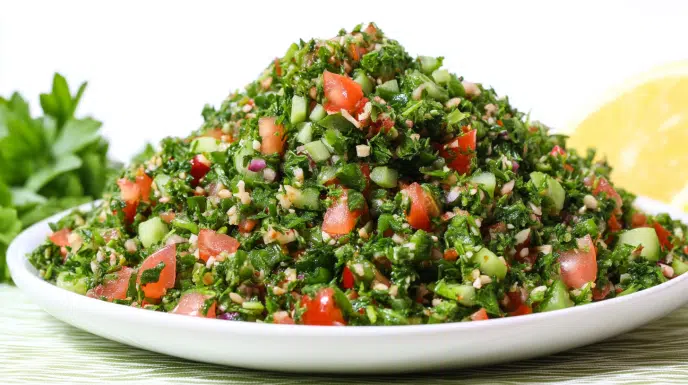
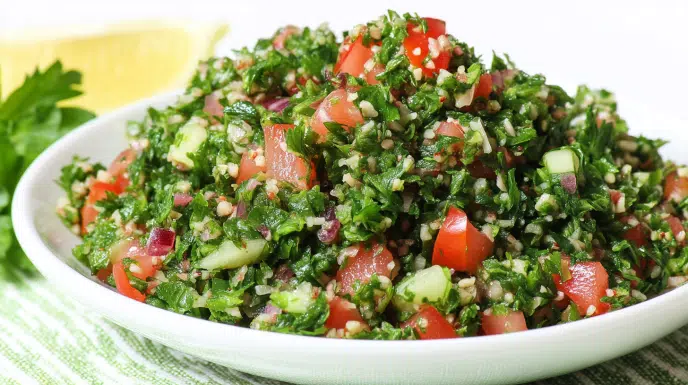
Tabbouleh recipe is the salad that corrects every misconception you have about Middle Eastern food being heavy. A mountain of finely chopped flat-leaf parsley and fresh mint with barely a quarter cup of fine bulgur, diced ripe tomato, thinly sliced scallion, fresh lemon juice and your best olive oil. Bright, intensely herby, tangy and impossibly fresh. It is not a grain salad with herbs scattered through it. It is an herb salad with a small amount of grain to give it body.
What you need
- 3 large bunches fresh flat-leaf parsley, about 2 cups firmly packed after washing and drying, stems removed and finely chopped. This is the star. Buy more than you think you need, you will always need more. Deep green with no yellowing leaves. Curly parsley works but flat-leaf has more flavor.
- ¼ cup fresh mint leaves, finely chopped, fresh only. Dried mint produces a completely flat, dusty result. Fresh mint is non-negotiable.
- ¼ cup (40g) fine bulgur wheat, fine bulgur only, not medium, not coarse. Fine bulgur softens from soaking in lemon juice alone, it does not need cooking. This small amount is correct. Authentic Lebanese tabbouleh uses bulgur as a binder and texture element, not as the main ingredient.
- 3 ripe Roma tomatoes, seeded and very finely diced, seed the tomatoes before dicing, the seeds and juice make the tabbouleh watery. Firm, ripe tomatoes only. Soft or overripe tomatoes collapse and make the salad soggy.
- 5–6 scallions (green onions), very thinly sliced, white and green parts both. Traditional Lebanese tabbouleh uses scallions, not white onion, milder and fresher tasting.
- ¼ cup (60ml) fresh lemon juice, from 2 large lemons. Fresh only, never bottled. The lemon juice does two things: it is the primary dressing acid and it softens the bulgur. Both functions require fresh juice.
- 3 tablespoons extra virgin olive oil, your best olive oil. With only five ingredients in the dressing, the quality of the olive oil is completely visible in the finished dish. Do not use light or mild olive oil.
- ¾ teaspoon fine sea salt, plus more to taste. Add salt last, it draws moisture from the vegetables and will make the salad watery if added too early.
- ¼ teaspoon black pepper
Gluten-free version: replace the bulgur with an equal amount of cooked quinoa or omit entirely. The salad is still authentic in character, just lighter in body.
The method
- Soak the bulgur in lemon juice. Place the fine bulgur in a small bowl. Pour the fresh lemon juice over it. Stir once. Leave to soak for 20–30 minutes while you prepare everything else. The bulgur will absorb the lemon juice, swell slightly and soften completely, no cooking, no boiling water needed. Fine bulgur is the only type that works this way.Never boil bulgur for tabbouleh. Boiling makes it too soft, too wet and too starchy. Lemon juice soaking produces the specific slightly chewy, lemon-infused texture that authentic tabbouleh requires.
- Wash and completely dry the herbs. This is the step most people skip and the step that determines whether the tabbouleh is vibrant or wilted. Wash the parsley and mint thoroughly. Spin in a salad spinner, then lay on clean kitchen towels and pat completely dry. Any surface moisture on the parsley dilutes the dressing and makes the salad watery within 30 minutes.The herbs must be completely dry before chopping. Wet herbs stick together during chopping and produce a crushed paste rather than fine individual pieces. Dry them thoroughly, more thoroughly than you think necessary.
- Chop the parsley by hand. Remove all thick stems, only leaves and the thinnest tender stems. Gather into a tight pile on a dry cutting board. Rock a sharp knife through the pile repeatedly until the pieces are very fine, smaller than you think necessary but not a paste. Authentic tabbouleh has fine but still visible parsley pieces that hold their structure in the salad. A food processor produces a wet, crushed herb that cannot hold structure, do not use one.The chopping takes 5–7 minutes by hand and is the most important technique in this recipe. A sharp knife makes it significantly easier, a dull knife crushes rather than cuts and releases too much moisture from the leaves.
- Prepare the tomatoes. Halve the Roma tomatoes. Squeeze gently over the sink to remove the seeds and watery interior. Dice as finely as possible, similar in size to the chopped parsley. This uniform size means every forkful has all components in balance.
- Combine everything except the salt. In a large bowl add the finely chopped parsley and mint, diced seeded tomatoes, sliced scallions and the lemon-soaked bulgur with all its lemon juice. Drizzle the olive oil over everything. Toss gently, the goal is to distribute everything without crushing the herbs. Use your hands or two large spoons. Add the black pepper.Do not mix vigorously, tabbouleh should look like a pile of fine herbs with the other components distributed through it, not a uniformly blended mass.
- Add salt and rest. Add the salt now, not earlier. Toss once more. Taste and adjust, more lemon if it needs brightness, more salt, more olive oil if it tastes flat. Cover and refrigerate for at least 30 minutes, 1–2 hours produces a noticeably better result as the flavors meld and the bulgur continues absorbing the tomato and lemon juices. Taste again just before serving and add a final squeeze of lemon.
The honest note
Most tabbouleh served in Western restaurants and made from Western recipes has the ratio exactly backwards. It is a grain dish, heavy with bulgur, pale with insufficient parsley, served as a side and eaten politely. Authentic Lebanese tabbouleh has a ratio of roughly 8 parts parsley to 1 part bulgur. The bulgur is almost invisible in the finished salad. When you look at it, you should see green. When you eat it, you should taste parsley and lemon and good olive oil simultaneously, with a faint chew from the bulgur beneath. The 3 large bunches of parsley in this recipe will feel like an enormous amount when you buy them. They are the correct amount. Do not reduce the parsley. Do not increase the bulgur.
Before you serve
Claire’s note
Tabbouleh is one of those rare salads that is genuinely better after several hours in the fridge. The parsley softens very slightly and loses any bitterness, the bulgur absorbs the tomato and lemon juice and swells further, and the olive oil integrates with the lemon into a cohesive dressing rather than sitting separately on top. Make it the morning of a dinner party and refrigerate, taste and add a final squeeze of fresh lemon and a drizzle of olive oil just before serving. Tabbouleh keeps for up to 3 days refrigerated in a sealed container, though it will release liquid as it sits. Drain the excess liquid before serving and add a small drizzle of fresh olive oil and lemon to refresh.
Serve with
Tabbouleh is the essential green element of any Lebanese mezze spread, it belongs alongside hummus, labneh and muhammara as the bright, acidic counterpoint to the richer creamy dips. It is also the natural partner for grilled meats, alongside beef kafta kebabs and chicken shawarma the tabbouleh cuts through the richness of the spiced meat in exactly the right way. In Lebanon it is traditionally served with crisp romaine lettuce leaves for scooping, use a leaf as a spoon and eat the tabbouleh directly from it. For everything else on a Lebanese table the complete Lebanese recipes collection has it all.
Add tabbouleh to your weekly meal planner, make a large batch Sunday and it serves as a side with every dinner through Wednesday. And for more recipes, follow us on Pinterest.
Print
Authentic Lebanese Tabbouleh
- Total Time: 50 minutes
- Yield: 4–6 servings 1x
- Diet: Vegan, Gluten-free option
Description
A vibrant and fresh herb salad loaded with parsley, mint, and a hint of bulgur, dressed with lemon and olive oil.
Ingredients
- 3 large bunches fresh flat-leaf parsley, finely chopped
- ¼ cup fresh mint leaves, finely chopped
- ¼ cup (40g) fine bulgur wheat
- 3 ripe Roma tomatoes, seeded and finely diced
- 5–6 scallions, thinly sliced
- ¼ cup (60ml) fresh lemon juice
- 3 tablespoons extra virgin olive oil
- ¾ teaspoon fine sea salt
- ¼ teaspoon black pepper
Instructions
- Soak the bulgur in lemon juice. Place the fine bulgur in a small bowl and pour lemon juice over it. Stir once and leave to soak for 20–30 minutes.
- Wash and completely dry the herbs. Wash parsley and mint, then dry thoroughly.
- Chop the parsley by hand, ensuring to remove all thick stems and chopping into fine pieces.
- Prepare the tomatoes by seeding and finely dicing them.
- Combine everything except the salt in a large bowl. Add parsley, mint, tomatoes, scallions, and bulgur, drizzled with olive oil. Toss gently.
- Add salt and mix once more. Taste and adjust as needed.
- Cover and refrigerate for at least 30 minutes before serving.
Notes
Better if made several hours in advance. Tabbouleh will keep for up to 3 days in the fridge. Drain excess liquid before serving.
- Prep Time: 20 minutes
- Cook Time: 0 minutes
- Category: Salad
- Method: No Cooking
- Cuisine: Lebanese
Nutrition
- Serving Size: 1 serving
- Calories: 180
- Sugar: 3g
- Sodium: 350mg
- Fat: 10g
- Saturated Fat: 1g
- Unsaturated Fat: 9g
- Trans Fat: 0g
- Carbohydrates: 20g
- Fiber: 5g
- Protein: 4g
- Cholesterol: 0mg